
Poetry has long served as a vessel for the myriad expressions of the human spirit, and among the most cherished is the elusive, yet universal feeling of happiness. While epic verses may delve into grand narratives, sometimes the most profound moments of joy are captured in concise lines. Exploring short poems about happiness allows us to find concentrated bursts of light and positivity, offering solace, inspiration, and different perspectives on what it truly means to be happy. From the quiet contentment found within to the effervescent joy that seems to bubble over, these poems distill complex emotions into accessible, impactful forms, reminding us that happiness can often be found in the simplest of moments or the deepest corners of the soul.
Contents
Inner Radiance: Poems of Self-Created Joy
Many poets highlight that true happiness isn’t dictated by external events but springs from within. This inner radiance is a recurring theme, particularly captured in concise, reflective verses.
Sri Chinmoy, known for his spiritual insights expressed in poetry, offers several short pieces that directly address this idea:
Do you want to be always happy?
Then give up fighting
For negativity
And learn the beautiful art
Of self-encouragement.
This brief poem presents a practical path to happiness – a shift in focus from external struggle to internal cultivation. The “beautiful art of self-encouragement” suggests happiness is a skill to be learned, a practice of turning inward and fostering positivity.
He further emphasizes this internal source:
True inner joy
Is self – created.
It does not depend
On outer circumstances.
A river is flowing in and through you
Carrying the message of joy.
This divine joy
Is the sole purpose of life.
Here, joy is depicted as an inherent, flowing force within, independent of the world outside. It is not something to be acquired, but something to be recognized and allowed to flow, suggesting a profound, almost spiritual connection to happiness.
Another perspective from Sri Chinmoy focuses on the different faculties that perceive happiness:
The mind chases happiness.
The heart creates happiness.
The soul is happiness
And it spreads happiness
All-where.
This hierarchical view suggests that while the mind might intellectually pursue happiness, it’s the heart that actively generates it, and the soul that embodies it entirely, radiating it outward. This short poem offers a layered understanding of our internal relationship with joy. These ideas connect with deeper human experiences often explored in depressing poems about death, highlighting happiness as a contrasting, vital force.
Sri Aurobindo, another poet-philosopher, touches upon this deep-seated inner state in his longer works, offering powerful lines that function almost as short poems themselves when extracted. He speaks of:
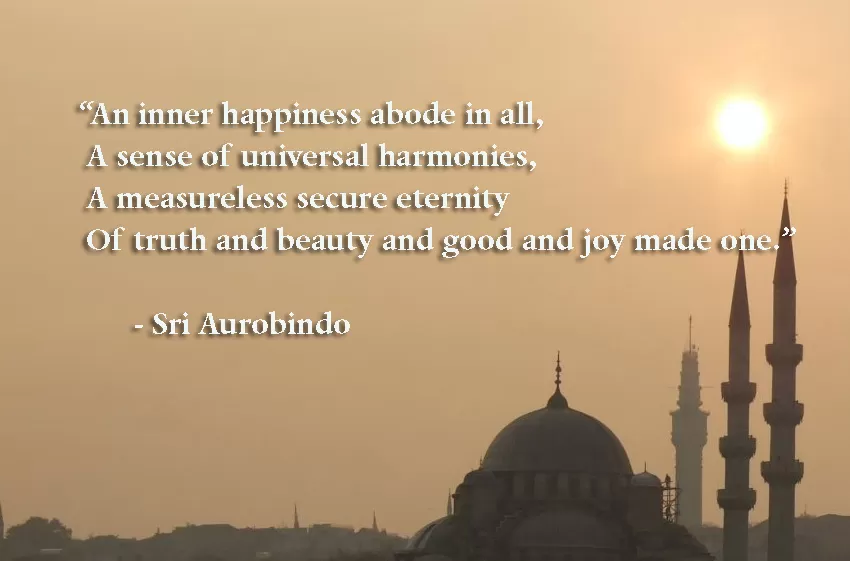
An inner happiness abode in all,
A sense of universal harmonies,
A measureless secure eternity
Of truth and beauty and good and joy made one.
(Extract from Book II, Canto XIV, The World-Soul)
These lines describe a state where inner happiness is intrinsically linked to universal peace and harmony, a secure and eternal state beyond fleeting moments. It’s a vision of happiness as an abiding presence, not a temporary visitor.
Ephemeral Moments and Overflowing Joy
Happiness can also be a sudden, exhilarating experience, a moment to be seized or savored. Short poems often capture these fleeting, intense feelings.
Hafiz, the Persian poet, offers a wonderfully concise and infectious expression of sudden joy:
I caught the happy virus last night
When I was out singing beneath the stars.
It is remarkably contagious –
So kiss me.”
This poem is a vibrant, playful take on happiness as a transmittable force. It’s immediate, sensory (singing, stars, kissing), and highlights the desire to share this overwhelming feeling. Its brevity and vivid imagery make it a memorable short poem about happiness. Sharing such moments can also be found in sweet and loving poems, where affection itself is a source of joy.
Walt Whitman, known for his expansive verse, also offers potent short insights into joy. His “Song of Joys” contains lines that, on their own, speak volumes about the feeling of happiness derived from connection and experience:
O the joy of that vast elemental sympathy
which only the human soul is capable
of generating and emitting in steady and limitless floods.
(Extract from Song of Joys)
This extract focuses on the joy found in connection and empathy, a feeling generated from within but shared outwardly, like a boundless flood. It speaks to the power of the human capacity for deep, sympathetic connection as a source of profound happiness.
The Quiet Bloom of Contentment
Happiness isn’t always loud or sudden; sometimes it’s a quiet, steady state of contentment, found in simplicity or shifting perspectives.
While Robert Frost’s “Carpe Diem” is a longer poem that explores the theme of seizing happiness versus intellectualizing it, its central message revolves around the importance of recognizing and embracing joy in the moment, even when it’s too “present to imagine”:
‘Be happy, happy, happy,
And seize the day of pleasure.’
The age-long theme is Age’s.
…
But bid life seize the present?
It lives less in the present
Than in the future always,
And less in both together
Than in the past. The present
Is too much for the senses,
Too crowding, too confusing-
Too present to imagine.
(Extracts from Carpe Diem)
These excerpts, though part of a longer work, function as a commentary on the difficulty of simply being happy in the present, even when advised to seize the day. It highlights that the idea of happiness can sometimes be easier to grasp than the lived experience, a subtle but important point in the exploration of happiness.
Emily Brontë’s “How Still, How Happy!” contrasts past perceptions of happiness (found in stormy weather and wild nature) with a present, quieter joy found in stillness and subdued light.
How still, how happy! Those are words
That once would scarce agree together;
I loved the plashing of the surge –
The changing heaven the breezy weather,
More than smooth seas and cloudless skies
And solemn, soothing, softened airs…
How still, how happy! now I feel
Where silence dwells is sweeter far
Than laughing mirth’s most joyous swell
However pure its raptures are.
 Portrait of poet and philosopher Sri Aurobindo
This poem, though longer, offers short, impactful stanzas that contrast different forms of happiness. It champions the quiet, almost passive happiness found in peace and stillness over the more boisterous joy of youth. Even amidst winter’s “withered grass” and the anticipation of storms, the speaker finds a deep contentment. This perspective might resonate with someone seeking cool romantic poems that find beauty in quiet, shared moments rather than grand gestures.
Emily Dickinson also explores the nature of joy, often in her uniquely concise and impactful style. While “Tis so much joy!” is not strictly a short poem, it contains stanzas that grapple with the overwhelming intensity of joy, bordering on fear of its loss:
Tis so much joy! ‘Tis so much joy!
If I should fail, what poverty!
And yet, as poor as I,
Have ventured all upon a throw!
Have gained! Yes! Hesitated so—
This side the Victory!
…
And if I gain! Oh Gun at Sea!
Oh Bells, that in the Steeples be!
At first, repeat it slow!
For Heaven is a different thing,
Conjectured, and waked sudden in—
And might extinguish me!
These stanzas highlight happiness as a victory, something gained at risk, and so overwhelming that its sudden arrival is almost frightening. It’s a powerful depiction of joy’s intensity and vulnerability, offering a complex view of happiness.
Conclusion
These short poems about happiness, whether concise by design or powerful extracts from longer works, offer a rich tapestry of perspectives on joy. They show us that happiness can be an inner spring, an infectious energy, a moment seized, or a quiet, evolving contentment. Exploring these verses allows us to connect with diverse experiences of joy across time and culture, reminding us of the profound and multifaceted nature of human happiness as captured through the enduring art of poetry. They stand as luminous examples of how potent emotion and deep meaning can be conveyed even in just a few lines.