
Choosing the greatest fiction books of all time is a delightful, albeit challenging, endeavor. Every reader harbors a personal list, shaped by unique experiences and preferences. Yet, certain novels transcend individual taste, earning universal acclaim for their enduring themes, groundbreaking narratives, unforgettable characters, and profound impact on literature and culture. These are the books that linger long after the final page is turned, shaping perspectives and sparking conversations across generations.
Contents
- Best Classic Novels That Define Literature
- 1. Pride and Prejudice by Jane Austen (1813)
- 2. Dracula by Bram Stoker (1897)
- 3. The Adventures of Sherlock Holmes by Arthur Conan Doyle (1892)
- 4. The Count of Monte Cristo by Alexandre Dumas (1844-1846)
- 5. Frankenstein by Mary Shelley (1818)
- Famous Books from the 19th Century
- 6. Jane Eyre by Charlotte Brontë (1847)
- 7. Moby Dick by Herman Melville (1851)
- 8. Wuthering Heights by Emily Brontë (1847)
- 9. The Picture of Dorian Gray by Oscar Wilde (1891)
- 10. The Strange Case of Dr Jekyll and Mr Hyde by Robert Louis Stevenson (1886)
- Good Fiction Books from the 20th Century
- 11. The Hobbit by J.R.R. Tolkien (1937)
- 12. Gone With the Wind by Margaret Mitchell (1936)
- 13. 1984 by George Orwell (1949)
- 14. To Kill a Mockingbird by Harper Lee (1960)
- 15. The Catcher in the Rye by J.D. Salinger (1951)
- Best New Books from the 21st Century
- 16. The Hunger Games by Suzanne Collins (2008)
- 17. The Da Vinci Code by Dan Brown (2003)
- 18. The Girl with the Dragon Tattoo by Stieg Larsson (2005)
- 19. The Night Circus by Erin Morgenstern (2011)
- 20. You Don’t Know Me by Imran Mahmood (2017)
- Best Books of All Time: Literary Masterpieces
- 21. Ender’s Game by Orson Scott Card (1985)
- 22. The Shining by Stephen King (1977)
- 23. The Kite Runner by Khaled Hosseini (2003)
- 24. Beloved by Toni Morrison (1987)
- 25. The Book Thief by Markus Zusak (2005)
At Latrespace, we celebrate the power of words, whether woven into evocative poetry or crafted into compelling prose. In the spirit of exploring literary excellence, we present a curated list of 25 fiction books that many consider essential reading. Spanning centuries and genres, these works offer a window into diverse human experiences, societal critiques, thrilling adventures, and timeless emotional truths. Prepare to expand your reading horizons and discover why these novels continue to captivate hearts and minds worldwide. Just as one might delve into summaries of Great Expectations to grasp its intricate plot, exploring a list like this provides a map to the landscape of literary greatness.
Let’s embark on this journey through some of the most impactful stories ever told, starting with foundational classics that continue to influence storytelling today.
Best Classic Novels That Define Literature
Classic novels form the bedrock of literary tradition, offering insights into the past while speaking to universal human experiences. These foundational works often explore themes of love, identity, society, and morality with unparalleled depth and artistry.
1. Pride and Prejudice by Jane Austen (1813)
Genre: Romance/Satire
A sparkling jewel of English literature, Jane Austen’s Pride and Prejudice is a masterful blend of social commentary and romantic comedy. Through the eyes of the spirited Elizabeth Bennet, Austen satirizes the intricacies of Regency-era society, particularly concerning marriage, class, and reputation. The witty banter, compelling character development (especially Elizabeth and the proud Mr. Darcy), and timeless exploration of overcoming initial judgments make this novel an enduring favorite. It practically invented the “enemies-to-lovers” trope, proving that intelligence and integrity are the true foundations of happiness. This is more than just a love story; it’s a sharp, insightful look at human foibles and societal pressures.
2. Dracula by Bram Stoker (1897)
Genre: Gothic Horror
The progenitor of the modern vampire myth, Bram Stoker’s Dracula remains a chilling and atmospheric masterpiece of Gothic horror. Told through a series of journal entries, letters, and newspaper clippings, the novel follows the terrifying journey of Count Dracula from Transylvania to England and the efforts of a small group led by Professor Abraham Van Helsing to stop him. Stoker’s vivid prose and palpable sense of dread create an immersive experience. Beyond the horror elements, the novel touches upon themes of good versus evil, the clash between tradition and modernity, and the power of faith and community. Dracula himself is an iconic figure whose shadow looms large over centuries of subsequent fiction.
3. The Adventures of Sherlock Holmes by Arthur Conan Doyle (1892)
Genre: Crime/Mystery
Step into the fog-shrouded streets of Victorian London and the iconic rooms at 221B Baker Street with Arthur Conan Doyle’s brilliant detective, Sherlock Holmes. Accompanied by his steadfast companion Dr. John Watson, Holmes uses his unparalleled powers of deduction and observation to solve intricate mysteries that baffle Scotland Yard. This collection of short stories showcases Doyle’s ingenious plotting and introduces one of literature’s most recognizable and influential characters. Each case is a complex puzzle, inviting the reader to follow Holmes’s logic (or try to get ahead of it!). For anyone seeking sharp intellect, intriguing plots, and the sheer joy of a well-crafted mystery, these adventures are, quite simply, elementary.
4. The Count of Monte Cristo by Alexandre Dumas (1844-1846)
Genre: Action/Adventure
A sweeping saga of betrayal, imprisonment, escape, and meticulous revenge, Alexandre Dumas’s The Count of Monte Cristo is the quintessential adventure novel. The story follows the young, naive Edmond Dantès who is falsely accused and imprisoned for years. His escape and subsequent transformation into the enigmatic, wealthy Count of Monte Cristo to enact vengeance upon those who wronged him make for an utterly gripping narrative. Filled with duels, hidden treasures, elaborate schemes, and dramatic reveals, Dumas delivers a thrilling page-turner that also delves into themes of justice, fate, and the corrupting nature of power. It is an epic tale of human endurance and calculated retribution.
5. Frankenstein by Mary Shelley (1818)
Genre: Science Fiction
Often cited as the first true science fiction novel, Mary Shelley’s Frankenstein is a cautionary tale of unchecked scientific ambition and its devastating consequences. Victor Frankenstein’s creation of a sentient being and his subsequent abandonment of it leads to tragedy. Shelley’s novel explores complex ethical questions about creation, responsibility, prejudice, and the nature of humanity. Set against a backdrop of stunning natural landscapes and infused with Gothic elements, it is a philosophically rich and emotionally resonant story. The Creature’s perspective, often eloquent and heartbreaking, forces readers to confront their own biases and definitions of ‘monster’. It remains a powerful exploration of the dangers of playing God and the longing for connection.
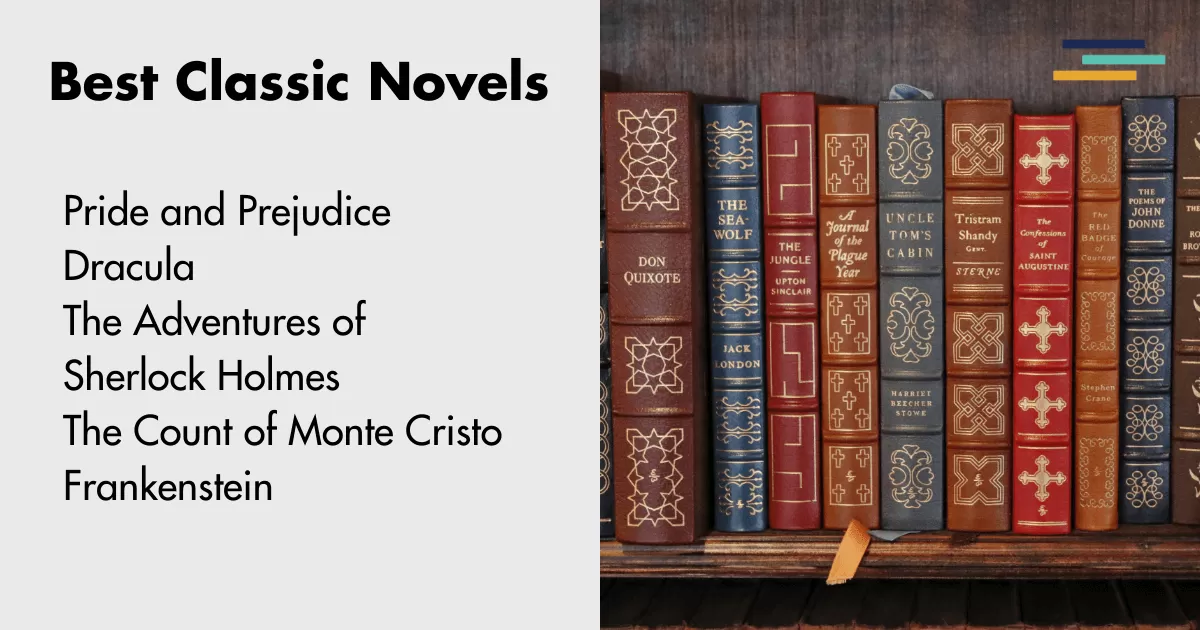 Classic novels on a shelf representing foundational literature.
Famous Books from the 19th Century
The 19th century was a prolific era for literature, producing many works that are now considered cornerstones of the novel form. These books often reflect the social, political, and cultural changes of their time, exploring human nature in intricate detail. The period also saw the rise of genres like realism, naturalism, and further development of Gothic and Romantic literature. Understanding the nuances of literature from this period might involve appreciating concepts like define pastoral in literature when examining authors who depicted rural life, or recognizing elements akin to shakespearean poem in the dramatic intensity or linguistic richness of their prose.
6. Jane Eyre by Charlotte Brontë (1847)
Genre: Romantic Suspense
Charlotte Brontë’s Jane Eyre is a pioneering novel known for its strong, independent female protagonist and its intense exploration of passion, morality, and social class. Jane’s journey from a neglected orphan to a self-possessed woman navigating complex relationships and challenging societal expectations is both compelling and emotionally resonant. The novel masterfully blends elements of romance, Gothic mystery (particularly the secrets surrounding Thornfield Hall), and social critique. Jane’s internal struggles and her unwavering commitment to her principles make her one of literature’s most beloved heroines. It’s a story that highlights the importance of self-worth and finding one’s place in the world.
7. Moby Dick by Herman Melville (1851)
Genre: Adventure
Herman Melville’s Moby Dick is far more than just a tale of a vengeful captain pursuing a giant white whale. It is an epic meditation on obsession, humanity’s relationship with nature, fate, and the limits of knowledge. The novel follows the journey of Ishmael aboard the whaling ship Pequod, captained by the monomaniacal Ahab, driven by a singular desire to hunt down the whale that took his leg. Melville weaves together adventure, detailed information about whaling, and profound philosophical and symbolic depth. The novel’s rich symbolism—from the white whale itself representing the inscrutable nature of the universe, to the Pequod as a microcosm of humanity—makes it a cornerstone of American literature. It is a challenging but incredibly rewarding read.
8. Wuthering Heights by Emily Brontë (1847)
Genre: Gothic Tragedy
A stark contrast to her sister’s work published the same year, Emily Brontë’s Wuthering Heights is a raw and turbulent portrayal of destructive love and revenge set against the wild, desolate backdrop of the Yorkshire moors. The passionate, often brutal, relationship between Catherine Earnshaw and the enigmatic Heathcliff defines this gothic tragedy. Brontë’s narrative structure, told through multiple narrators, adds layers of complexity and unreliable perspectives. The novel delves into themes of class, nature versus nurture, and the lingering effects of trauma and obsession across generations. It’s an unsettling, powerful, and utterly unique novel that defies easy categorization.
9. The Picture of Dorian Gray by Oscar Wilde (1891)
Genre: Gothic Literature
Oscar Wilde’s only novel, The Picture of Dorian Gray, is a captivating and chilling exploration of aestheticism, morality, and the corrupting influence of vanity and pleasure. A young man, Dorian Gray, wishes that a portrait of him would age and bear the marks of his sins instead of himself. His wish is granted, leading him down a path of hedonism and moral decay while his painted likeness becomes increasingly hideous. Wilde’s signature wit and epigrammatic prose are on full display, making the philosophical debates within the book both entertaining and thought-provoking. The novel feels remarkably relevant today, commenting on the pressures of appearance and the pursuit of eternal youth.
10. The Strange Case of Dr Jekyll and Mr Hyde by Robert Louis Stevenson (1886)
Genre: Gothic Horror
Robert Louis Stevenson’s chilling novella delves into the duality of human nature and the potential for darkness that lurks within even the most respectable individuals. Dr. Henry Jekyll, a kind and respected scientist, experiments with a serum that allows him to separate his good side from his evil impulses, resulting in the creation of the monstrous Edward Hyde. As Hyde’s influence grows, Jekyll struggles to control his darker half. This enduring story explores themes of repression, morality, and the conflict between societal reputation and inner desires. It’s a psychological thriller that has left a lasting mark on literature and popular culture, giving us one of fiction’s most famous examinations of the inner beast.
Good Fiction Books from the 20th Century
The 20th century witnessed unprecedented global change, and literature responded with innovative forms and challenging themes. This era produced iconic works that grappled with war, technology, social upheaval, and the complexities of the modern psyche.
11. The Hobbit by J.R.R. Tolkien (1937)
Genre: Epic Fantasy
J.R.R. Tolkien’s enchanting prelude to The Lord of the Rings, The Hobbit, is a foundational text for modern fantasy. It tells the story of Bilbo Baggins, a respectable hobbit who is swept away on an unexpected adventure with a company of dwarves and the wizard Gandalf to reclaim their treasure from the dragon Smaug. Tolkien’s unparalleled world-building, rich mythology, and memorable characters create a deeply immersive experience. It’s a classic quest narrative filled with danger, humor, and the discovery of hidden courage. The Hobbit is a perfect entry point into Middle-earth and a timeless tale of adventure, bravery, and the value of even the smallest individuals.
12. Gone With the Wind by Margaret Mitchell (1936)
Genre: Historical Romance
Set against the tumultuous backdrop of the American Civil War and Reconstruction, Margaret Mitchell’s Gone With the Wind is a sprawling epic centered on the complex and often exasperating Scarlett O’Hara. Scarlett’s determination to survive and thrive amidst the destruction of her world, her tumultuous relationships (especially with the roguish Rhett Butler), and the vivid portrayal of the era make this a compelling, albeit controversial, read. Mitchell’s characterizations are powerful, capturing the resilience and flaws of people during a period of immense upheaval. It remains a popular historical romance, though contemporary readers often critically examine its depiction of slavery and Southern society.
13. 1984 by George Orwell (1949)
Genre: Dystopian
George Orwell’s chilling dystopian novel 1984 presents a terrifying vision of a totalitarian future under the ever-watchful eye of Big Brother and the Party. Winston Smith’s quiet rebellion against the oppressive regime explores themes of surveillance, censorship, propaganda, and the manipulation of truth and history. Orwell’s concepts like “Newspeak,” “doublethink,” and the “Thought Police” have become indelible parts of our language. The novel serves as a stark warning about the dangers of authoritarianism and the importance of independent thought. Its relevance feels only to grow in the digital age, making it a powerful and necessary read.
14. To Kill a Mockingbird by Harper Lee (1960)
Genre: Legal Drama / Southern Gothic
Harper Lee’s beloved classic, To Kill a Mockingbird, is a poignant story of innocence, prejudice, and justice in the American South. Told from the perspective of young Scout Finch, the novel recounts her experiences as her father, the morally upright lawyer Atticus Finch, defends a black man falsely accused of rape. The novel masterfully explores themes of racial injustice, compassion, courage, and the loss of innocence. Atticus Finch remains one of literature’s most admired moral figures, and Scout’s journey of understanding the complexities of the world around her is deeply moving. Its powerful message and enduring characters have cemented its place as a modern classic.
15. The Catcher in the Rye by J.D. Salinger (1951)
Genre: Coming of Age
J.D. Salinger’s The Catcher in the Rye is a seminal coming-of-age novel that captures the voice and anxieties of adolescent rebellion. Narrated by the cynical yet vulnerable Holden Caulfield, the story follows his experiences in New York after being expelled from prep school. Holden’s distinctive voice, his critique of the “phony” adult world, and his struggle with alienation and identity resonate deeply with readers, particularly during adolescence. The novel explores themes of innocence, disillusionment, and the pain of growing up. Despite initial controversy, Holden’s candid narration has made the book a relatable and enduring portrayal of teenage angst and searching for authenticity.
Best New Books from the 21st Century
The 21st century continues to push the boundaries of fiction, embracing diverse voices, innovative structures, and a wide range of subjects reflecting contemporary global issues and evolving technologies. This era builds upon the foundations laid by previous centuries while forging new paths in storytelling.
16. The Hunger Games by Suzanne Collins (2008)
Genre: YA Dystopian
Suzanne Collins’s The Hunger Games became a cultural phenomenon, reigniting interest in young adult dystopian fiction. Set in the post-apocalyptic nation of Panem, where teenagers are forced to fight to the death in televised games, the story follows Katniss Everdeen’s struggle for survival and her accidental sparking of a rebellion. The novel is a thrilling adventure that also offers sharp commentary on poverty, oppression, reality television, and the desensitization to violence. Katniss is a strong, complex protagonist, and her fight for survival and justice makes for a compelling read that appeals to both young adults and adults.
17. The Da Vinci Code by Dan Brown (2003)
Genre: Action Thriller
Dan Brown’s The Da Vinci Code is a globe-trotting historical conspiracy thriller that captivated millions with its intricate plot and controversial premise. Harvard symbologist Robert Langdon is called to the Louvre Museum after a murder and becomes entangled in a web of cryptic clues, secret societies, and art historical mysteries related to the Holy Grail and the true nature of Christianity. Brown masterfully blends history, art, and code-breaking puzzles into a fast-paced narrative. While debated for its historical accuracy, the novel is undeniably a gripping page-turner that popularized symbology and brought complex historical theories into the mainstream consciousness.
18. The Girl with the Dragon Tattoo by Stieg Larsson (2005)
Genre: Scandi-Thriller
The first book in Stieg Larsson’s Millennium series, The Girl with the Dragon Tattoo, introduced the unforgettable character of Lisbeth Salander, a brilliant but troubled hacker with a photographic memory and vigilante tendencies. Journalist Mikael Blomkvist hires Salander to help him investigate the disappearance of a wealthy patriarch’s niece forty years earlier, uncovering dark family secrets and a series of brutal crimes. Larsson’s novel is a dark, complex, and utterly gripping thriller that delves into themes of corporate corruption, violence against women, and societal dysfunction in Sweden. Salander is a unique and compelling anti-heroine, making this book a standout in the crime fiction genre.
19. The Night Circus by Erin Morgenstern (2011)
Genre: Fantasy
Erin Morgenstern’s debut novel, The Night Circus, is a whimsical and atmospheric fantasy about a mysterious circus that appears without warning and is only open at night. Unbeknownst to the spectators, the circus is the stage for a magical competition between two young illusionists, Celia and Marco, trained since childhood by their respective mentors. As their powers grow and they fall in love, the stakes of the game become dangerously real. Morgenstern’s prose is lyrical and evocative, creating a truly immersive and enchanting world. The novel is a celebration of imagination, art, and the delicate balance between creation and destruction.
20. You Don’t Know Me by Imran Mahmood (2017)
Genre: Courtroom Thriller
Imran Mahmood’s You Don’t Know Me is a unique and powerful courtroom drama told directly by the defendant to the jury. The protagonist, a young man on trial for murder, dismisses his lawyer and chooses to tell his own story, revealing a complex web of events and motivations. Mahmood’s use of colloquial language and direct address pulls the reader into the defendant’s perspective, challenging assumptions about truth, identity, and justice. The novel is gritty, emotionally charged, and forces the reader to confront their own biases as they piece together the narrative. It’s a compelling exploration of societal prejudice and the search for belonging.
 A stack of diverse books representing the best books of all time.
Best Books of All Time: Literary Masterpieces
While categorizing books by era is helpful, some transcend such boundaries, standing as pinnacles of the art form. These titles frequently appear on lists of the greatest fiction books of all time, celebrated for their profound insights, narrative power, and lasting cultural resonance.
21. Ender’s Game by Orson Scott Card (1985)
Genre: Science Fiction
Orson Scott Card’s Hugo and Nebula Award-winning novel, Ender’s Game, is a thought-provoking science fiction story centered on child prodigy Ender Wiggin, trained at Battle School in preparation for an alien invasion. The novel is renowned for its complex moral dilemmas, exploration of strategy and manipulation, and deep dive into the psychology of a young genius thrust into extraordinary circumstances. Card masterfully handles themes of empathy, identity, leadership, and the harsh realities of war. It’s a gripping coming-of-age story set in a military sci-fi framework that challenges readers to think critically about conflict and consequence.
22. The Shining by Stephen King (1977)
Genre: Horror
Stephen King is a master of horror, and The Shining is arguably one of his finest works. Jack Torrance takes a job as the off-season caretaker of the isolated Overlook Hotel, bringing his wife and psychic son Danny. As winter sets in and the hotel’s supernatural forces awaken, Jack’s sanity deteriorates, turning him into a terrifying threat to his family. King expertly builds suspense and explores themes of addiction, family violence, and the insidious power of place. The Overlook Hotel itself is a character, its history and malevolence palpable. This is a psychological horror masterpiece that gets under your skin and stays there.
23. The Kite Runner by Khaled Hosseini (2003)
Genre: Historical Drama
Khaled Hosseini’s debut novel, The Kite Runner, is a powerful and heartbreaking story of friendship, betrayal, guilt, and redemption set against the turbulent backdrop of Afghanistan from the fall of the monarchy to the rise of the Taliban. The story centers on Amir, a young boy in Kabul, and his complex relationship with Hassan, the son of his father’s servant. A moment of betrayal haunts Amir for decades, leading him on a quest for atonement. Hosseini’s vivid portrayal of Afghan culture and history, combined with deeply human characters, creates an emotionally resonant narrative that has touched millions worldwide. It is a testament to the enduring power of love, loyalty, and the possibility of finding forgiveness.
24. Beloved by Toni Morrison (1987)
Genre: Historical Magical Realism
Toni Morrison’s Pulitzer Prize-winning novel Beloved is a haunting and profound exploration of the legacy of slavery. Set after the Civil War, the story follows Sethe, a former slave haunted by the traumatic past and the ghost of her baby daughter, Beloved. Morrison weaves together historical reality and magical realism to delve into the psychological and emotional scars left by slavery. The novel is challenging but incredibly rewarding, using lyrical prose to explore themes of memory, trauma, identity, and the fierce, sometimes destructive, nature of maternal love. Beloved is a essential work of American literature that confronts the nation’s brutal history with unflinching honesty and breathtaking artistry. As one might analyze William Shakespeare poems and sonnets for their complex emotional layers, Beloved demands a similar depth of engagement with its portrayal of profound human pain and resilience.
25. The Book Thief by Markus Zusak (2005)
Genre: Historical Fiction
Narrated by Death, Markus Zusak’s The Book Thief tells the story of Liesel Meminger, a young girl living in Nazi Germany who finds solace and power in stolen books. Living with foster parents, Liesel learns to read and shares the magic of words with those around her, including the Jewish man hidden in their basement. The unique narrative voice and the focus on the human capacity for both cruelty and kindness during a horrific time make this novel incredibly moving. It’s a story about the power of language, resilience, and finding beauty and humanity even in the darkest circumstances. It stands as a testament to the enduring spirit of those who resisted hate through small acts of defiance and creativity. It reminds us that words, like those found in Shakespear poems or a child’s stolen book, hold immense power.
This list represents just a fraction of the incredible fiction available, but these 25 titles offer a remarkable starting point for exploring the greatest fiction books of all time. Each one, in its unique way, showcases the transformative power of storytelling, inviting readers to step into different worlds, understand diverse perspectives, and connect with the universal threads of the human condition. Whether you seek classic romance, thrilling mystery, epic fantasy, or profound social commentary, these books promise rich experiences and lasting impressions. Happy reading!