
Traditional Haiku is a form of Japanese poetry characterized by a three-line structure, a focus on nature or a specific moment, and a sense of seasonality. Developed over centuries, it captures the beauty and fleeting nature of the world with remarkable brevity and depth. Unlike some modern interpretations, classical haiku often adheres to specific conventions that unlock layers of meaning and evoke profound emotion. This article delves into the world of traditional haiku, exploring its defining characteristics and illustrating its power through iconic examples from the great masters.
Contents
- What Defines Traditional Haiku?
- Kigo (Season Word)
- Kireji (Cutting Word)
- Focus on a Moment and Nature
- The Great Masters of Japanese Haiku
- Iconic Traditional Haiku Examples and Their Significance
- Matsuo Bashō
- Yosa Buson
- Kobayashi Issa
- Masaoka Shiki
- Other Notable Traditional-Style Examples
- The Enduring Appeal of Traditional Haiku
What Defines Traditional Haiku?
At its heart, traditional haiku is more than just a 5-7-5 syllable count. While the 5-7-5 pattern is a common guideline in English adaptation, the original Japanese structure relied on on (sound units, similar to syllables but not identical), typically totalling around 17. However, focusing solely on syllable count can sometimes force unnatural phrasing in English. The true essence lies in other elements:
Kigo (Season Word)
A central element of traditional haiku is the kigo, a word or phrase that indicates the season in which the poem is set. This could be explicit (“spring twilight,” “autumn morning”) or implied through natural imagery (“cherry blossoms,” “snowdrops,” “cicada”). The kigo grounds the poem in a specific time of year, evoking associated feelings, sensory details, and cultural references. Understanding the kigo is key to unlocking a haiku’s deeper meaning.
Kireji (Cutting Word)
Traditional Japanese haiku often employs a kireji, or “cutting word.” This word, usually placed at the end of one of the first two lines, creates a pause or break in the poem. It can separate two images, create a sense of juxtaposition, or emphasize a particular phrase, allowing the poem to “cut” through the moment and reveal an unexpected connection or insight. While direct equivalents are rare in English, punctuation (like a dash, colon, or exclamation mark) or line breaks often serve a similar function, creating a pivot or caesura.
Focus on a Moment and Nature
Traditional haiku typically captures a single, distinct moment observed in nature. It focuses on sensory details – sights, sounds, smells, textures – to convey an experience directly to the reader. This intense focus on a small, often overlooked detail in nature serves as a microcosm of larger universal truths about existence, impermanence, or the human condition.
The Great Masters of Japanese Haiku
Understanding traditional haiku means acknowledging the poets who shaped the form. Four figures are recognized as the “Great Masters”:
- Matsuo Bashō (1644–1694): Widely considered the greatest haiku poet, Bashō elevated the form to a serious literary art. His poems often convey a sense of tranquil observation, influenced by Zen Buddhism.
- Yosa Buson (1716–1784): A painter as well as a poet, Buson’s haiku is known for its vivid, often sensual imagery and descriptive quality.
- Kobayashi Issa (1763–1828): Issa’s work is characterized by its human warmth, empathy for the less fortunate and small creatures, and a touch of personal sorrow and humor.
- Masaoka Shiki (1867–1902): A pivotal figure in the modernization of haiku, Shiki championed a more realistic and objective approach to observation, while still respecting the form’s traditional roots.
These masters, along with many others, crafted poems that continue to resonate centuries later.
Iconic Traditional Haiku Examples and Their Significance
Let’s explore some classic traditional haiku examples and analyze how they embody the principles discussed above, offering insights into the natural world and the human experience.
Matsuo Bashō
Bashō’s haiku often capture quiet moments of profound realization.
-
The Old Pond
An ancient pond
A frog jumps in
The splash.This is perhaps the most famous haiku ever written. The kigo is subtle, potentially implied by the activity (frogs are associated with spring/summer). The structure creates a sharp contrast between the ancient stillness of the pond and the sudden, momentary sound of the splash. The kireji (implied pause after “in”) highlights the transition from silence to sound, the vastness of time (ancient pond) juxtaposed with the immediacy of the event. It’s a perfect example of capturing a single moment that resonates with deeper philosophical implications about change and permanence.
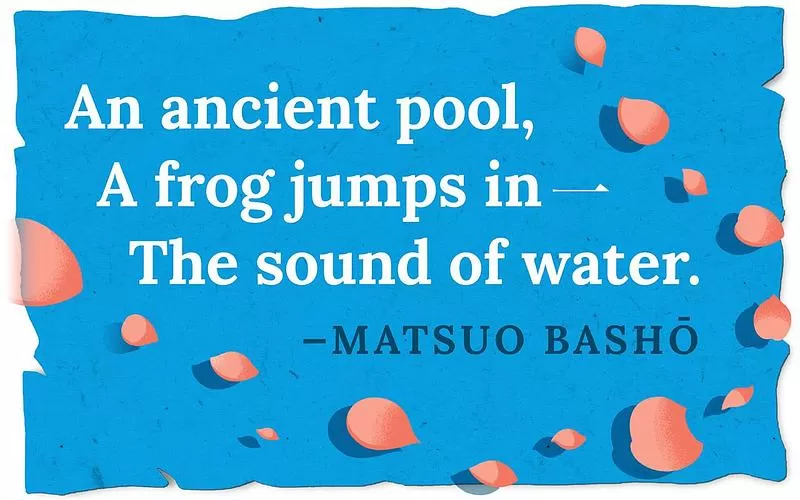 Bashō's Old Pond haiku
-
The first soft snow:
The first soft snow:
leaves of the awed jonquil
bow lowHere, the kigo is explicit: “The first soft snow.” This immediately sets the scene in late autumn or early winter. The personification of the jonquil leaves being “awed” and bowing low demonstrates Bashō’s ability to infuse nature with emotion and respect. It’s a simple, elegant observation of the natural world reacting to a seasonal change.
-
A caterpillar,
A caterpillar,
this deep in fall –
still not a butterfly.The kigo “fall” places this haiku firmly in autumn. Bashō focuses on a tiny creature, the caterpillar, observing its state at this late point in the season. The final line, “still not a butterfly,” introduces a subtle note of poignant observation – perhaps reflecting on unrealized potential or the passage of time before transformation can occur.
Yosa Buson
Buson’s haiku is often praised for its visual and sensory richness.
-
The light of a candle
The light of a candle
Is transferred to another candle —
spring twilight.“Spring twilight” acts as the kigo, providing a soft, liminal backdrop. Buson uses the simple act of lighting one candle from another to create a beautiful image. The transfer of light, undiminished, resonates metaphorically – perhaps suggesting the sharing of knowledge, inspiration, or even life itself. The gentle imagery is characteristic of Buson’s style.
-
In pale moonlight
In pale moonlight
the wisteria’s scent
comes from far away.While “pale moonlight” isn’t a strict kigo in itself, it contributes to a nocturnal, perhaps late spring or summer setting where wisteria blooms. Buson evokes the sense of smell, which is powerful in its ability to transport us. The scent coming from “far away” adds a layer of mystery and longing, allowing the reader’s imagination to fill in the unseen source.
Kobayashi Issa
Issa’s haiku often blends profound observation with personal feeling and compassion, particularly for the small and vulnerable.
-
This world of dew
This world of dew
is a world of dew,
and yet, and yet.This deeply moving haiku, written after the death of his daughter, uses “dew” as a powerful kigo symbolizing transience and fragility (associated with early morning, quickly disappearing). The repetition “This world of dew / is a world of dew” emphasizes the stark reality of impermanence. The final “and yet, and yet” (やれ打つな yare utsu na in Japanese, an exclamation of lament or resignation) adds a layer of emotional struggle and perhaps a glimmer of resilience or acceptance in the face of sorrow. It’s a powerful expression of grief within the traditional form.
An image featuring dew drops on a leaf, symbolizing transience and fragility often referenced in haiku like Issa’s.
-
O snail
O snail
Climb Mount Fuji,
But slowly, slowly!Issa often addresses creatures directly, showing his empathy. While Mount Fuji is an iconic Japanese image, “snail” isn’t a strict kigo, but the slow movement can be associated with a particular time of year or day. The humor and gentle encouragement (“But slowly, slowly!”) highlight Issa’s unique voice, appreciating perseverance even in the smallest of beings undertaking a monumental task.
-
[Even in Kyoto,]
Even in Kyoto,
Hearing the cuckoo’s cry,
I long for KyotoThe “cuckoo’s cry” is a traditional kigo for summer, often associated with nostalgia or longing for home. Even while in the culturally significant city of Kyoto, hearing the familiar sound triggers a deeper longing for an ideal or past Kyoto, perhaps a feeling of not quite belonging or the melancholic nature of memory.
-
[cherry blossoms]
cherry blossoms
fall! fall!
enough to fill my belly“Cherry blossoms” are a quintessential spring kigo, symbolizing beauty, impermanence, and celebration. Issa’s exclamation “fall! fall!” conveys eagerness and perhaps a playful, slightly exaggerated desire to immerse oneself fully in the beauty of the falling petals, almost to the point of wanting to consume them. This haiku captures the vibrant, fleeting energy of the cherry blossom season.
Masaoka Shiki
Shiki, the last of the traditional masters, brought a focus on objective observation, though his personal struggles with illness often surfaced in his work.
-
I want to sleep
I want to sleep
Swat the flies
Softly, please.While seemingly simple, this haiku reveals Shiki’s focus on the immediate reality of his sickroom. There’s no explicit kigo, but the context implies an indoor, possibly summer setting where flies are bothersome. The request “Softly, please” is poignant, reflecting weakness and a desire for gentleness even in a trivial annoyance.
-
After Killing a Spider
After killing
a spider, how lonely I feel
in the cold of night!This haiku doesn’t contain a conventional nature kigo, but “cold of night” contributes to a sense of isolation and late season. The focus is on the poet’s internal reaction to a small act. The feeling of loneliness after killing a tiny creature highlights a sensitivity and perhaps a reflection on the value of even the smallest life in alleviating solitude.
Other Notable Traditional-Style Examples
Many other poets have crafted haiku that resonate with the traditional spirit.
-
[The snow of yesterday] by Gozan
The snow of yesterday
That fell like cherry blossoms
Is water once againThis haiku beautifully combines two powerful seasonal images: “snow” (winter) and “cherry blossoms” (spring), and then focuses on their transformation into “water.” The comparison of falling snow to falling cherry blossoms links winter and spring, highlighting the cyclical nature of seasons and the theme of impermanence – something beautiful melting away.
Image depicting melting snow or ice turning into water, illustrating Gozan’s theme of impermanence.
-
[The crow has flown away:] by Natsume Soseki
The crow has flown away:
Swaying in the evening sun,
A leafless tree“Evening sun” suggests late day, while the “leafless tree” is a clear kigo for winter. The departure of the crow leaves behind a scene of quiet solitude and stark beauty. The image is simple yet evocative, capturing a moment of transition from presence to absence, and from day to twilight, set against the backdrop of the winter landscape.
-
[Plum flower temple:] by Natsume Soseki
Plum flower temple:
Voices rise
From the foothills“Plum flower” is a kigo for early spring. This haiku evokes a sense of place and mystery. The temple and the rising voices suggest human presence and perhaps spiritual activity, set against the natural backdrop of the foothills. The combination creates a tranquil yet intriguing image, blending culture and nature.
-
[The lamp once out] by Natsume Soseki
The lamp once out
Cool stars enter
The window frame.This haiku beautifully contrasts artificial light (“lamp”) with natural light (“stars”). Turning off the lamp allows the natural world to come into view. The “cool stars” suggest night, though not a specific season kigo. The image captures a moment of shifting perspective and the quiet beauty that appears when artificial distractions are removed.
-
[First autumn morning] by Murakami Kijo
First autumn morning
the mirror I stare into
shows my father’s face.“First autumn morning” is a clear kigo. This haiku grounds a moment of personal reflection in a specific season. Looking in the mirror, the poet sees not just himself, but his father’s face – a common experience as one ages. This observation, juxtaposed with the crisp reality of the autumn morning, connects personal aging and mortality to the natural cycle of the year.
-
[On the one-ton temple bell] by Taniguchi Buson
On the one-ton temple bell
A moonmoth, folded into sleep,
Sits still.This haiku creates a powerful contrast between the immense, potentially loud object (the bell) and the small, silent, sleeping creature resting upon it. This juxtaposition highlights the stillness and fragility of life in the face of imposing, inanimate force. The “moonmoth” adds a touch of ethereal beauty to the image.
The Enduring Appeal of Traditional Haiku
Traditional haiku continues to captivate readers because of its ability to find profundity in simplicity. By focusing on a single moment, often in nature, and using the subtle tools of kigo and kireji, these short poems open up vast landscapes of meaning and emotion. They train us to be more observant, to appreciate the fleeting beauty around us, and to connect the smallest natural details to universal themes of life, death, and the passage of time. Exploring traditional haiku is a practice in mindful observation and a reminder of the enduring power of carefully chosen words.
By delving into the structure, seasonal elements, and the unique perspectives of masters like Bashō, Buson, Issa, and Shiki, we gain a deeper appreciation for this elegant and insightful poetic form. The traditional haiku, far from being a rigid formula, is a delicate vessel designed to hold the weight of a moment, allowing it to bloom in the reader’s mind.