
The Lake District is inextricably linked with the legacy of William Wordsworth. It’s difficult to wander through villages like Grasmere without feeling his presence, a presence as imposing as the surrounding fells. His former residences, Dove Cottage and Rydal Mount, have long drawn literary pilgrims, and more recently, Allan Bank has joined this list of significant Wordsworth homes open to the public. These buildings offer more than just a glimpse into the past; they provide a tangible connection to the environments that shaped one of England’s most celebrated poets and the lives of the Wordsworths family.
William Wordsworth’s life in the Lake District unfolded across several different houses, each reflecting a distinct period of his journey as a poet and a man. Dove Cottage, arguably the most iconic of these homes, embodies the rustic ideal often associated with Romantic poetry. Its simple, white-walled, slate-roofed structure feels perfectly attuned to the pastoral vision Wordsworth often championed. Today, the experience begins with the Wordsworth Museum, housed in a modern building constructed from local slate. This museum provides valuable context, featuring portraits of William, Dorothy, Coleridge, and De Quincey, and highlighting the perennial financial struggles faced by writers, including the Wordsworths. Interactive exhibits allow visitors of all ages to engage playfully with the period, perhaps trying on period costumes or striking a poetic pose.
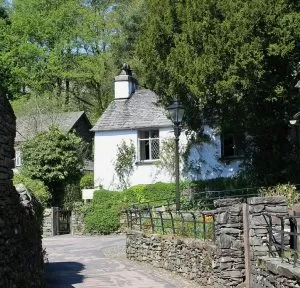 Dove Cottage in the Lake District
The guided tour of Dove Cottage, the Wordsworth family’s home from December 1799 to May 1808, takes visitors through the very rooms where some of his most famous poetry was conceived. The reception rooms, with their wooden panelling and slate floors, hint at the building’s past life as a pub, creating a dark but surprisingly cosy atmosphere. A charming detail is the picture of Peppa, the terrier gifted to the Wordsworths by Sir Walter Scott, who apparently had a habit of travelling with dogs and leaving them with his hosts.
The practicalities of 19th-century life in a small cottage are revealed through details like the stream running beneath the pantry floor, serving as a natural refrigeration system. The guide might point out Wordsworth’s coffee grinder, a small wooden box with a metal handle. Coffee was a luxury then, reserved for special occasions. While it’s tempting to picture Wordsworth as a sort of early hipster barista, the reality was likely more grounded in the simple, often challenging, daily life documented vividly in Dorothy Wordsworth’s journals.
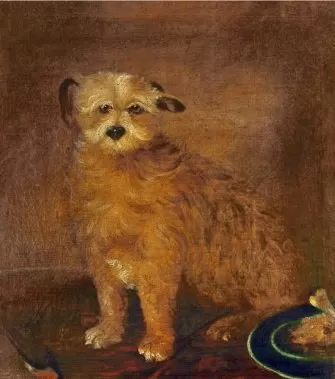 Peppa the terrier, a gift to the Wordsworths
Dorothy’s journals paint a picture of tireless devotion. She cooked, managed the household, and, crucially, transcribed William’s verses. Her keen observations of nature, such as the famous dancing daffodils, directly inspired some of his most celebrated poems. Life at Dove Cottage wasn’t without hardship; both William and Dorothy frequently suffered from illness, and Dorothy battled debilitating migraines. Yet, it was also a place of intense intellectual and creative energy. Coleridge, a frequent visitor, would sometimes express his exuberance by leaping over the garden gate. The trio embarked on long walks across the fells, engaging in deep discussions about poetry, philosophy, and the revolutionary events unfolding in France. Other literary figures like De Quincey and Southey also visited, cementing Dove Cottage’s place as a hub of Romantic thought.
Everything revolved around William’s creative process. He had sought inspiration in various places – Cambridge, London, the Alps, France – but here, in the embrace of the mountains and with the intellectual companionship of Coleridge and the unwavering support of Dorothy, he found his true poetic voice. His heartfelt address to Coleridge as “O Friend!” in The Prelude still resonates deeply. One can only imagine what the local residents, rooted in the traditions of Lakeland life, made of this intense, often abstracted young poet and his companions. The Lake District was already attracting tourists, but the Wordsworths, with their unconventional lifestyle, intellectual fervour, and complex personal histories, must have been subjects of considerable local gossip. The anecdote of locals in Somerset fearing the Wordsworths and Coleridge were French spies, based on their intense cliff-top discussions and walks, highlights how their unconventional behaviour could be misinterpreted. They were, in many ways, intellectual radicals, much like modern-day environmentalists or academics passionate about social change, though perhaps without the ultimate Frisbee.
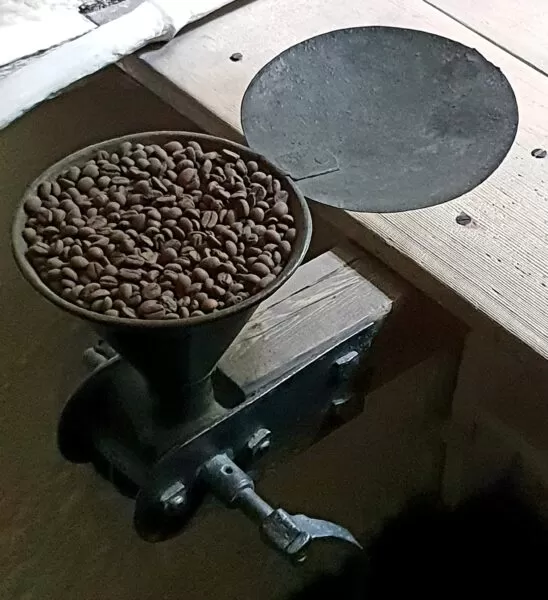 Wordsworth's wooden coffee grinder
The dynamic between William and Dorothy remains a subject of fascination and academic debate. Orphaned at a young age, separated for much of their childhood, they formed an intensely close bond upon reunion, each becoming a central figure in the other’s life. Modern scholarship has explored the depth of their relationship, with some speculating on the possibility of incest. Dorothy’s journal entry describing her distress on William’s wedding day to Mary Hutchinson, including sleeping with his wedding ring and noting that William “blessed” her twice, is often cited in these discussions. However, it’s also plausible that this was an expression of an unusually deep, complex bond between two sensitive, artistic individuals who shared trauma, a profound love of nature, and a dedication to William’s work. Regardless of the precise nature of their relationship, Dorothy’s influence on William Wordsworth’s poetry is undeniable and profound.
Even today, Dove Cottage retains an atmosphere that makes it feel as though the Wordsworths have only just stepped out. You can sense the contrast between the potential darkness of overcast Lakeland days and the warmth of the fire, feel the intensity of the conversations that took place, and imagine the increasing crampedness as William and Mary began their family there.
Upstairs, details about the Wordsworth family’s life continue to emerge. Visitors might be struck by Wordsworth’s seemingly socialist sentiment, “Men who do not wear fine clothes can feel deeply.” You can see his bed, his ice skates, and even the famous couch that features so prominently in his Daffodils poem.
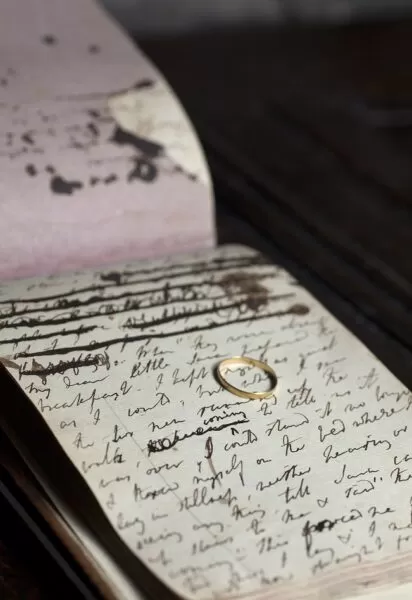 Mary Wordsworth's wedding ring on Dorothy's journal
Evidence of their growing family at Dove Cottage is subtle. The nursery, located above the buttery, was insulated with yellowing copies of the Times from 1800 – a practical measure that also hints at a certain bohemian attitude towards interior design among the Wordsworths and their literary circle. Elsewhere, a cabinet displays a laudanum pipe used by Coleridge, a stark reminder of the struggles that would later strain his relationship with the increasingly conventional Wordsworths.
The Wordsworths left Dove Cottage in 1808. The following year, Thomas De Quincey, another member of the Lake Poets circle, rented the cottage. De Quincey’s Confessions of an English Opium Eater offers a different perspective on life at Dove Cottage, painting a picture of relaxation, albeit often aided by laudanum. His subsequent alterations to the house and garden, coupled with revealing details published in his essays, Recollections of the Lake Poets, caused friction with the Wordsworths. The garden at Dove Cottage today features lines of Wordsworth’s poetry among the flowerbeds, a literal cultivation of verse. At the top of the sloping garden is a platform with a seat, built by William and his neighbour, serving as a ‘writer’s shed’ with views that, in Wordsworth’s time, were unobstructed by trees, offering a clear vista of the lake and Loughrigg Fell terraces. Sitting there, it’s easy to ponder the connections and communications of that era versus our own – perhaps less Snapchat, more laudanum-fuelled discussions, as one might wryly suggest.
 Wordsworth's ice skates display at Dove Cottage
Perhaps the most revealing of the Wordsworth homes to visit today is Allan Bank. Situated near Grasmere on the path towards Silver How, Allan Bank was rented by the National Trust and suffered a significant fire in 2011. Reopened after basic repairs in 2012, it offers a unique experience with its undecorated walls and donated furniture, creating a “fashionably distressed” aesthetic. Unlike Dove Cottage or Rydal Mount, Allan Bank lacks collections or portraits; instead, it encourages visitors to use their imagination. Visitors can make free cups of tea and relax in comfortable chairs, enjoying the spectacular views of Grasmere Island and Loughrigg. The Wordsworths lived here from 1808 to 1810. A National Trust guide might share stories of the problems Wordsworth faced with the chimney smoke constantly blowing back into the rooms – a seemingly minor inconvenience then, perhaps comparable to modern frustrations like poor Wi-Fi. Despite this, it appears a tremendous home to modern eyes.
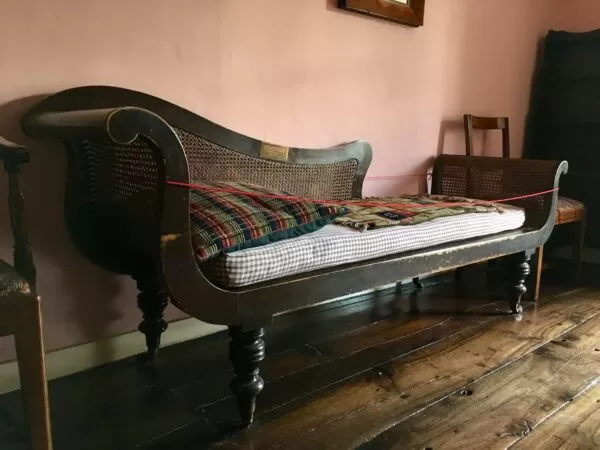 A couch mentioned in Wordsworth's Daffodils poem
Allan Bank also holds significance as the home of Canon Hardwicke Rawnsley, one of the founders of the National Trust and a great admirer of Wordsworth. Rawnsley, a fascinating character known for his energy and sometimes difficult temperament, later occupied the house. While the house was smaller in Wordsworth’s time, both men would have appreciated the superb gardens set against rocky outcrops, where moss thrives on tree roots and dry stone walls. A circular path leads visitors past Victorian follies and towards a high-level stone seat offering views across to the prominent Lion and the Lamb rock formations.
After their two years at Allan Bank, the Wordsworths spent an unhappy period at the Old Rectory in Grasmere, a building that has since been demolished. This time was marked by tragedy with the deaths of their children Catherine and Thomas, and a painful estrangement from Coleridge due to his opium addiction. Rydal Mount, their final and longest-held home, proved to be a much happier residence. Located near Ambleside, it is a more substantial property, befitting a man who had achieved significant recognition. Situated above St Mary’s church, where Wordsworth served as warden, and opposite the grounds of the 16th-century Rydal Hall, Rydal Mount lacks the rustic simplicity of Dove Cottage. It is the home of a successful poet.
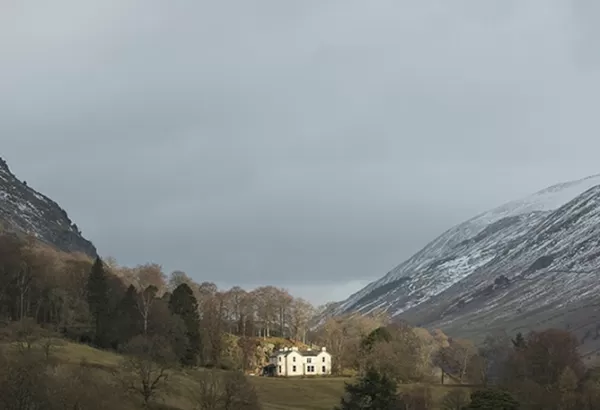 Allan Bank, one of Wordsworth's former homes
William Wordsworth lived at Rydal Mount for 37 years, from 1813 until his death in 1850. Here, he found contentment in the “happy gardens” he designed himself. The dining room features a portrait of Robert Burns, reflecting Wordsworth’s shared belief in writing about the lives of ordinary farming people – a theme explored in his own poetry. The spacious drawing-room, with its French windows opening onto the gardens, provides a connection to the nature that continued to inspire him. Above the fireplace hangs the only known portrait of a middle-aged Dorothy, a reminder of her enduring influence and devotion. The adjoining library is filled with scholarly books, though as a servant once remarked, “The library is here, the study is outside,” suggesting that Wordsworth’s deepest creative work still occurred outdoors. Some friends believed Wordsworth became too comfortable at Rydal Mount, with his daughter Dora reportedly dubbing it “Idle Mount.” If Dove Cottage represented his radical, early phase, Rydal Mount marked a more established, mainstream period in his career.
A framed copy of Wordsworth’s letter to Queen Victoria, declining the offer of Poet Laureate, hangs in William and Mary’s bedroom. Initially declining the honour due to his age and the perceived duties, Wordsworth famously accepted only after being informed he would not be required to produce official verses – making him the only Poet Laureate to essentially get away with no required workload of odes.
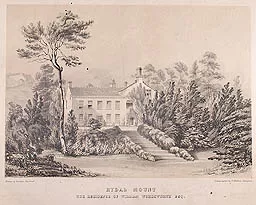 Rydal Mount house in the Lake District
Every room at Rydal Mount offers a fine view, from Windermere visible from Wordsworth’s bedroom to the imposing presence of Loughrigg Fell. Listening to the rain outside Dorothy’s window, one can sense the environment’s power in cultivating high thoughts and emotions for the Wordsworths.
Most poignant is Dora Wordsworth’s room, a small space with a creaking floor and tiny bed. William doted on Dora, who suffered from tuberculosis from the age of 18. She married at 37 but returned to Rydal Mount six years later to be cared for by her mother. She died in 1847 at the age of 38, a devastating blow to William, who was then 77. He was distraught, saying she was “ever with me and will be to the last moment of my life.” The grief-stricken elderly couple, William and Mary, along with Dorothy, who was by then suffering from what may have been dementia, found solace in planting Dora’s Field, a field of daffodils below the Rydal Mount gardens, as a memorial.
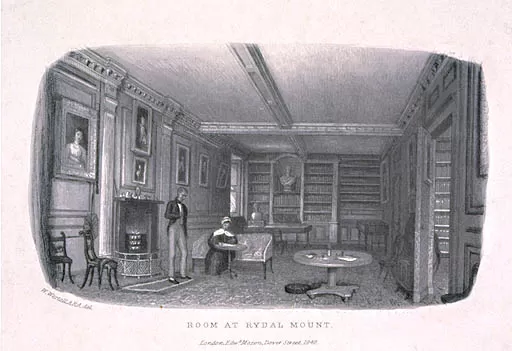 A room at Rydal Mount, a home of William Wordsworth
Today, you can still visit Dora’s Field, accessed via a gate from the church. Although now overgrown with bracken, brambles, and trees, and impacted by traffic noise, walking the circular path allows one to imagine William, Mary, and Dorothy’s sad pacing amongst the daffodils they planted to honour Dora.
My final stop on a Wordsworthian journey is the family graves at Grasmere Church. The family plot, enclosed by a low railing, is notably simple and free of grand monuments. The emotional impact of standing before William’s plain grave beside Mary and Dorothy, with Dora nearby, is powerful. For anyone who has read his major works like The Prelude or Ode: Intimations of Immortality, seeing his final resting place brings a sense of knowing the man. His lines, like “A slumber did his spirit seal,” gain added weight here. Wordsworth was remarkably prescient in his understanding of the formative power of childhood and the healing capacity of nature. His ideas resonate deeply even today.
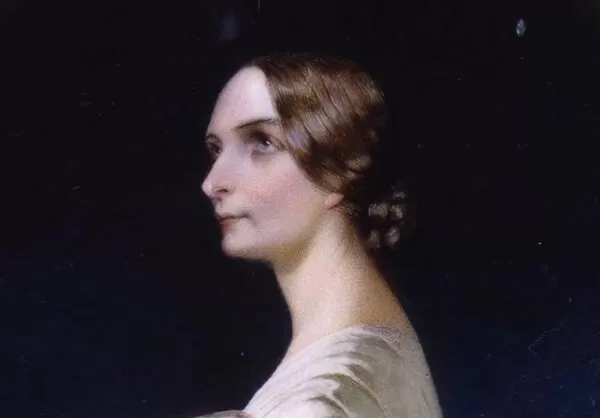 The people in Dora Wordsworth's room
One might wonder what he would make of the modern landscape surrounding his legacy – the Wordsworth Hotel and Spa, the Wordsworth Daffodil Garden. He is undoubtedly part of the Lakeland tourist industry, yet his work and spirit somehow remain untainted by the commercialisation. Wordsworth, in many ways, feels like a modern character. One could easily picture him today, perhaps travelling through Europe, engaging in radical politics, supporting friends through addiction, and perhaps even running writing workshops inspired by the landscapes around Rydal Water. Like many visitors today, he was a man who loved the crags, tarns, and the inherent beauty of the fells. Beyond his personal complexities and self-absorption, he was a literary genius who broke new ground, championed a connection to nature, and ultimately became an inseparable part of the sacred landscape he so deeply loved.