
Love, in its myriad forms, has been an eternal muse for poets. Across centuries, poets have crafted verses that capture the elation, anguish, longing, and complex beauty of this universal human experience. Classical love poems, in particular, offer a window into historical perspectives on love while often employing enduring forms and rich language that continue to resonate deeply with modern readers. Exploring these works allows us to connect with the timeless expressions of the heart, witnessing how poets wrestled with desire, devotion, and the transient or eternal nature of affection. From the Renaissance sonnets grappling with unattainable desire to the Romantic odes celebrating overwhelming passion, classical love poems provide a profound and moving exploration of the human condition. If you are interested in poems love and relationships, these classic selections offer a foundational understanding of how poets have voiced the most intimate feelings across time.
Contents
- Michael Drayton: Since There’s No Help
- Elizabeth Barrett Browning: How Do I Love Thee?
- Percy Bysshe Shelley: Love’s Philosophy
- Samuel Taylor Coleridge: Love
- Robert Burns: A Red, Red Rose
- Edgar Allan Poe: Annabel Lee
- Sir Thomas Wyatt: Whoso List to Hunt
- Andrew Marvell: To His Coy Mistress
- John Keats: Bright Star
- William Shakespeare: Sonnet 116
Let’s delve into a selection of renowned classical love poems that exemplify different facets of this powerful theme. These poems, chosen for their historical significance, artistic merit, and lasting emotional impact, offer a rich tapestry of love’s expressions.
Michael Drayton: Since There’s No Help
Michael Drayton, a contemporary of Shakespeare, captures the bitter end of an affair in this sonnet. The poem begins with a defiant declaration of indifference, a shield against the pain of parting. However, this stoic facade crumbles as the sonnet progresses, revealing the speaker’s true anguish. The final lines personify abstract concepts like Love, Passion, Faith, and Innocence as dying figures, pleading for the beloved’s kindness to revive them. It’s a poignant portrayal of the death of a relationship and the desperate, perhaps futile, hope for reconciliation, showcasing the emotional complexity often present in classical love poems.
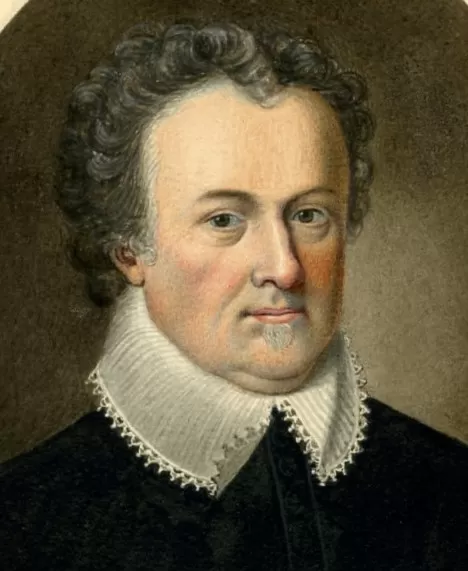 Portrait of Michael Drayton, an English Renaissance poet
Since there’s no help, come let us kiss and part;
Nay, I have done, you get no more of me,
And I am glad, yea glad with all my heart
That thus so cleanly I myself can free;
Shake hands forever, cancel all our vows,
And when we meet at any time again,
Be it not seen in either of our brows
That we one jot of former love retain.
Now at the last gasp of Love’s latest breath,
When, his pulse failing, Passion speechless lies,
When Faith is kneeling by his bed of death,
And Innocence is closing up his eyes,
Now if thou wouldst, when all have given him over,
From death to life thou mightst him yet recover.
Drayton’s sonnet, like many classical examples, uses the strict fourteen-line form to contain turbulent emotion. The turn (volta) in the sonnet, usually around the ninth line, shifts from feigned indifference to raw emotional pleading, highlighting the depth of the speaker’s loss. The personification lends a dramatic, almost allegorical weight to the abstract feelings associated with the relationship’s demise.
Elizabeth Barrett Browning: How Do I Love Thee?
Perhaps one of the most famous classical love poems, Elizabeth Barrett Browning’s Sonnet 43 from Sonnets from the Portuguese is an exuberant list enumerating the many ways the speaker loves her beloved. Written to Robert Browning, this poem is a fervent expression of total, boundless love, reaching “to the depth and breadth and height” of her soul. It is a love intertwined with daily life (“by sun and candle-light”), characterized by freedom and purity, and connected to her past joys and sorrows, ultimately aspiring to continue even beyond death.
How do I love thee? Let me count the ways.
I love thee to the depth and breadth and height
My soul can reach, when feeling out of sight
For the ends of being and ideal grace.
I love thee to the level of every day’s
Most quiet need, by sun and candle-light.
I love thee freely, as men strive for right.
I love thee purely, as they turn from praise.
I love thee with the passion put to use
In my old griefs, and with my childhood’s faith.
I love thee with a love I seemed to lose
With my lost saints. I love thee with the breath,
Smiles, tears, of all my life; and, if God choose,
I shall but love thee better after death.
This Italian (Petrarchan) sonnet structure, with its opening question answered by a detailed exploration, provides a framework for Barrett Browning’s intense emotional outpouring. The poem’s power lies in its hyperbolic yet deeply sincere declarations, employing religious metaphors (“lost saints”) and abstract concepts (“being and ideal grace”) to convey the spiritual dimension of her love. It’s a quintessential example of Romantic era passion contained within a classical form. Readers exploring poems of being in love often find this poem’s direct and passionate voice particularly resonant.
Percy Bysshe Shelley: Love’s Philosophy
Percy Bysshe Shelley’s short, lyrical poem employs observations of nature to make a compelling argument for unity and connection. The speaker points out that rivers mingle with oceans, winds mix, mountains “kiss” heaven, and flowers embrace. If all aspects of the natural world blend and connect according to a “law divine,” why, the speaker asks, should he and his beloved not do the same? It’s a playful, yet persuasive, plea for physical intimacy grounded in a perceived universal principle of mingling.
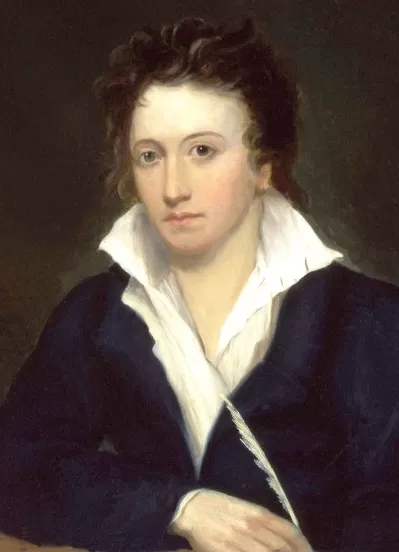 Cropped portrait of Percy Bysshe Shelley, a prominent Romantic poet
The fountains mingle with the river
And the rivers with the ocean,
The winds of heaven mix for ever
With a sweet emotion;
Nothing in the world is single;
All things by a law divine
In one spirit meet and mingle.
Why not I with thine?—

See the mountains kiss high heaven
And the waves clasp one another;
No sister-flower would be forgiven
If it disdained its brother;
And the sunlight clasps the earth
And the moonbeams kiss the sea:
What is all this sweet work worth
If thou kiss not me?
Shelley’s use of personification in describing natural phenomena (mountains kissing, waves clasping) makes the argument charming and vivid. The structure, a series of observations leading to a direct question in the final lines of each stanza, builds the persuasive case. This poem, while framed as “philosophy,” relies more on evocative imagery and rhetorical questioning than abstract reasoning, characteristic of the Romantic focus on nature and emotion in classical love poems.
Samuel Taylor Coleridge: Love
Coleridge’s “Love” is a narrative poem, a ballad that tells a story of a speaker attempting to win his beloved, Genevieve, by telling her a romantic, tragic tale of a knight and his lady. The speaker observes that all thoughts, passions, and delights serve as “ministers of Love.” His song, steeped in chivalry and sorrow, moves Genevieve to tears and ultimately leads her to confess her love. The poem is as much about the power of storytelling and shared emotion to forge connection as it is about the love between the speaker and Genevieve.
 Portrait of Samuel Taylor Coleridge, known for his Romantic poetry
All thoughts, all passions, all delights,
Whatever stirs this mortal frame,
All are but ministers of Love,
And feed his sacred flame.
... (poem continues as in original)
‘Twas partly love, and partly fear,
And partly ’twas a bashful art,
That I might rather feel, than see,
The swelling of her heart.

I calmed her fears, and she was calm,
And told her love with virgin pride;
And so I won my Genevieve,
My bright and beauteous Bride.
Coleridge employs the ballad form, often associated with narrative and folk traditions, to tell a story that unfolds in layers – the outer story of the speaker winning Genevieve, and the inner story of the knight’s fate. The use of vivid imagery and emotional language allows the reader to witness Genevieve’s reaction and understand how the speaker’s “song another’s love, Interpreted my own.” This demonstrates how classical love poems can use narrative structure to explore themes of love, empathy, and persuasion.
Robert Burns: A Red, Red Rose
Robert Burns’s famous lyric is a straightforward, heartfelt declaration of deep love and enduring fidelity. Using simple, potent metaphors comparing his love to a “red, red rose” and a “melody,” the speaker vows to love his beloved until impossible events occur (“Till a’ the seas gang dry”) and as long as life lasts. Despite an imminent parting, he promises an inevitable return, no matter the distance.
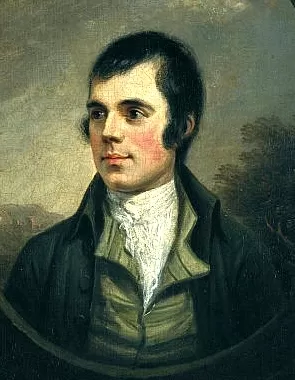 Portrait of Robert Burns, famous for his Scottish poems and songs
O my Luve is like a red, red rose
That’s newly sprung in June;
O my Luve is like the melody
That’s sweetly played in tune.

So fair art thou, my bonnie lass,
So deep in luve am I;
And I will luve thee still, my dear,
Till a’ the seas gang dry.

Till a’ the seas gang dry, my dear,
And the rocks melt wi’ the sun;
I will love thee still, my dear,
While the sands o’ life shall run.

And fare thee weel, my only luve!
And fare thee weel awhile!
And I will come again, my luve,
Though it were ten thousand mile.
Written in a simple quatrain structure with a strong ABCB rhyme scheme (or similar), Burns’s poem relies on accessible, universal imagery and hyperbolic vows to convey the depth of feeling. The use of Scottish dialect (“Luve,” “a’,” “gang,” “wi’,” “bonnie,” “weel”) adds a layer of authenticity and folk charm, connecting intense personal emotion to everyday language, a hallmark of certain types of classical love poems rooted in song.
Edgar Allan Poe: Annabel Lee
Poe’s “Annabel Lee” is a haunting, melancholic poem about eternal love tragically cut short by death. Set in a “kingdom by the sea,” the poem describes the speaker’s intense, childhood love for Annabel Lee, a love so profound that it was envied by the angels. Her death, attributed to a chilling wind sent by these envious seraphs, devastates the speaker. However, their love transcends even death, and his soul remains eternally intertwined with hers, visiting her tomb by the sea.
It was many and many a year ago,
In a kingdom by the sea,
That a maiden there lived whom you may know
By the name of Annabel Lee;
And this maiden she lived with no other thought
Than to love and be loved by me.
... (poem continues as in original)
And so, all the night-tide, I lie down by the side
Of my darling—my darling—my life and my bride,
In her sepulchre there by the sea,
In her tomb by the sounding sea.
Poe masterfully uses musicality through internal rhyme, repetition (especially of “kingdom by the sea” and “Annabel Lee”), alliteration, and assonance to create a dreamlike, incantatory effect that mirrors the speaker’s obsessive grief. The irregular stanza lengths and shifting meter contribute to the feeling of instability and emotional distress. While focused on loss, the poem defines love by its enduring power against celestial envy and mortal death, making it a powerful, albeit dark, example among classical love poems.
Sir Thomas Wyatt: Whoso List to Hunt
Sir Thomas Wyatt’s sonnet, often interpreted as being about his pursuit of Anne Boleyn, uses the metaphor of hunting a hind (female deer) to describe the speaker’s frustrating and ultimately futile quest for a beloved woman. He is exhausted by the chase but cannot give up, knowing it is like trying “in a net I seek to hold the wind.” The poem reveals that the ‘hind’ belongs to Caesar (King Henry VIII), marked as untouchable (“Noli me tangere, for Caesar’s I am”), making the pursuit both impossible and dangerous.
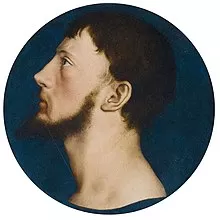 Portrait painting believed to be Sir Thomas Wyatt
Whoso list to hunt, I know where is an hind,
But as for me, alas, I may no more.
The vain travail hath wearied me so sore,
I am of them that farthest cometh behind.
Yet may I by no means my wearied mind
Draw from the deer, but as she fleeth afore
Fainting I follow. I leave off therefore,
Since in a net I seek to hold the wind.
Who list her hunt, I put him out of doubt,
As well as I may spend his time in vain.
And graven with diamonds in letters plain
There is written, her fair neck round about:
“Noli me tangere, for Caesar’s I am,
And wild for to hold, though I seem tame.”

Whoso list: whoever wants
Hind: Female deer
Noli me tangere: “Don’t touch me”
Wyatt adapts the Petrarchan sonnet form, using the octave to establish the speaker’s weariness and the futility of the hunt, and the sestet to reveal the reason for his giving up – the hind is claimed. The central metaphor of the hunt is powerful, representing the societal and political constraints placed upon love and desire in the Renaissance court. It stands out among classical love poems for its blend of personal frustration and historical context, revealing love as a complex force intertwined with power and ownership.
Andrew Marvell: To His Coy Mistress
Andrew Marvell’s celebrated poem is a persuasive, witty argument for seizing the moment and embracing physical love before time runs out. Addressing a reluctant beloved (“coy mistress”), the speaker first describes how he would love her if they had infinite time, spending centuries admiring each part of her. He then introduces the stark reality of death and decay, where virginity and desire become dust. Therefore, he argues, they should passionately embrace their love now, transforming their limited time into an intense experience that defies time itself.
 Engraving portrait of Andrew Marvell
Had we but world enough and time,
This coyness, lady, were no crime.
We would sit down, and think which way
To walk, and pass our long love’s day.
... (poem continues as in original)
Thus, though we cannot make our sun
Stand still, yet we will make him run.
Marvell employs a logical structure (If… But… Therefore…) known as a syllogism, albeit a poetic one. The first section establishes a hypothetical ideal of timeless love, filled with hyperbolic measurements of devotion. The second introduces the stark reality of mortality (“Time’s wingèd chariot”). The third presents the conclusion: carpe diem, seize the day and the love within it. The poem is famous for its vivid, sometimes startling, imagery (worms trying virginity, amorous birds of prey) and its urgent, passionate tone. While focusing on seduction, it is considered a classical love poem for its brilliant use of argument, metaphor, and its exploration of love against the backdrop of time and death.
John Keats: Bright Star
John Keats’s sonnet expresses a deep longing for steadfastness and permanence, mirroring the constancy of a star, but wishing to apply that quality not to lonely celestial observation, but to the intimate experience of being close to his beloved. He desires to be as “stedfast” as a star, not in its isolated position, but in being forever “Pillow’d upon my fair love’s ripening breast,” experiencing the gentle rhythm of her breath, wishing to live in that moment “for ever—or else swoon to death.”
Bright star, would I were stedfast as thou art—
Not in lone splendour hung aloft the night
And watching, with eternal lids apart,
Like nature’s patient, sleepless Eremite,
The moving waters at their priestlike task
Of pure ablution round earth’s human shores,
Or gazing on the new soft-fallen mask
Of snow upon the mountains and the moors—
No—yet still stedfast, still unchangeable,
Pillow’d upon my fair love’s ripening breast,
To feel for ever its soft fall and swell,
Awake for ever in a sweet unrest,
Still, still to hear her tender-taken breath,
And so live ever—or else swoon to death.
This sonnet uses the Petrarchan form to structure the speaker’s thought process: the octave setting up the comparison to the star and rejecting its lonely aspect, and the sestet focusing on the desired state of permanent intimacy. Keats, a master of sensory detail, fills the poem with tactile and auditory imagery (“ripening breast,” “soft fall and swell,” “tender-taken breath”). The final line presents a Romantic extremity – eternal life in this intimate moment or death – highlighting the overwhelming nature of his desire for lasting connection, a powerful theme in classical love poems of the Romantic era.
William Shakespeare: Sonnet 116
Considered by many to be the ultimate definition of true love among classical love poems, Shakespeare’s Sonnet 116 offers an abstract and philosophical exploration of love’s enduring nature. The poem argues that genuine love is unchanging and constant, unaffected by the passage of time or external circumstances. It is compared to an “ever-fixed mark” guiding lost ships, unwavering even in storms, and is not subject to the destructive power of Time, which may alter physical beauty (“rosy lips and cheeks”) but cannot diminish true affection.
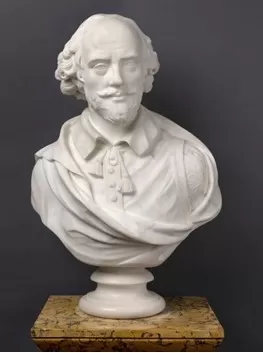 Portrait believed to be William Shakespeare
Let me not to the marriage of true minds
Admit impediments. Love is not love
Which alters when it alteration finds,
Or bends with the remover to remove.
O no! it is an ever-fixed mark
That looks on tempests and is never shaken;
It is the star to every wand’ring bark,
Whose worth’s unknown, although his height be taken.
Love’s not Time’s fool, though rosy lips and cheeks
Within his bending sickle’s compass come;
Love alters not with his brief hours and weeks,
But bears it out even to the edge of doom.
If this be error and upon me proved,
I never writ, nor no man ever loved.
Shakespeare employs the English (Shakespearean) sonnet form, concluding with a powerful couplet that acts as a challenge and reaffirmation of his definition. The poem uses powerful metaphors – the “ever-fixed mark” (a lighthouse or possibly the North Star) and Time personified with a “bending sickle” – to convey love’s stability against chaos and decay. Unlike many classical love poems that focus on personal experience or the beloved’s attributes, Sonnet 116 defines love as an ideal, a principle that transcends the physical and transient, offering a timeless vision of commitment. To explore more works by the Bard, check out shakespeares poems.
These ten poems, while diverse in their style, form, and perspective, collectively showcase the enduring power and varied expressions found within classical love poems. They remind us that the emotions of love, desire, loss, and devotion are universal, connecting us across time to poets who gave voice to the deepest stirrings of the human heart using craft and insight that continues to inspire and move readers today.