
 William Shakespeare portraitOften hailed as “The Bard,” William Shakespeare is globally recognized, primarily for his prolific work in theatre. With 37 plays attributed to him, it’s easy to overlook another significant body of his work: his poetry. While his plays dominate the literary landscape, Shakespeare’s poems, numbering over 150, offer a distinct and equally valuable insight into his genius, his craft, and the literary world of the Elizabethan era. For any serious student or lover of poetry, exploring these works is not merely supplementary but essential to understanding the foundations of English verse.
Contents
The Enduring Power of Shakespeare’s Sonnets
Among Shakespeare’s poems, the collection of 154 sonnets stands as a monumental achievement. Shakespeare masterfully employed and evolved the sonnet form, crafting fourteen lines of often iambic pentameter with a specific rhyme scheme. This structure, now widely known as the Shakespearean or English sonnet (ABAB CDCD EFEF GG), demonstrates his ability to contain complex thought and deep emotion within a rigorous formal constraint. Unlike simpler rhyming verses, Shakespeare’s poems in sonnet form achieve a profound flow and intellectual depth while adhering to their metrical and rhyming demands. Analyzing Sonnet 1, for instance, reveals his early command of this form, tackling themes of beauty and procreation with intricate wordplay and rhythm.
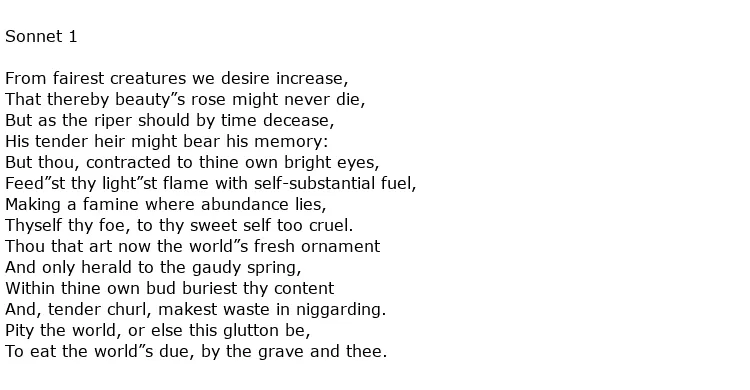 Text excerpt of a Shakespearean sonnet
This particular structure, with its three quatrains and concluding couplet, allowed Shakespeare to develop an argument or theme across the quatrains, often introducing a ‘turn’ or volta in the third quatrain or the final couplet that shifts the perspective or resolves the idea. It’s a fundamental building block in understanding poetic structure and flow, setting a precedent for countless poets who followed.
Themes Shaped by Time and Audience
While some might perceive a limited thematic scope in Shakespeare’s poems compared to later poets, this perspective overlooks the historical and economic realities of his time. In the Elizabethan era, making a living as a writer was challenging; plays were often seen as ephemeral entertainment, while poetry, particularly lengthy and formally sophisticated verse, was patronized by the nobility and upper class. Parchment itself was a valuable commodity, necessitating careful composition tailored for sale. This environment encouraged themes popular among the elite, most notably love. Shakespeare’s exploration of love in his sonnets ranges from idealized affection to intense passion, betrayal, and the complexities of human relationships, making them timeless additions to the canon of [poems for love](https://latrespace.com/poems-for-love/).
The necessity to cater to this market significantly influenced the subjects and styles Shakespeare chose for his poems. However, within these constraints, he explored universal human experiences with unparalleled psychological insight and linguistic artistry.
The Narrative Poems: Early Explorations
Less widely known than the sonnets are the two major narrative Shakespeare’s poems: Venus and Adonis (published 1593) and The Rape of Lucrece (published 1594). These longer poems, written relatively early in his career, showcase his capacity for intricate storytelling in verse. Some scholars speculate they might have served as tests of his ability to handle epic scope and narrative structure, skills that would later be honed in his plays. The fact that he wrote no further long narrative poems suggests he may have turned his focus elsewhere, likely to the more lucrative theatre.
Venus and Adonis
Dedicated to the young Earl of Southampton, Venus and Adonis is a mythological epyllion recounting the goddess Venus’s unrequited love for the beautiful youth Adonis and his tragic death. This poem highlights Shakespeare’s early fascination with classical mythology, weaving elements from Ovid’s Metamorphoses into a vibrant and sensuous narrative. The use of classical themes and figures ties Shakespeare’s poems to a long tradition of engaging with ancient sources, much like the challenges faced in [aeneid poetry in translation](https://latrespace.com/aeneid-poetry-in-translation/). Through vivid imagery and elaborate descriptions, Shakespeare explores themes of desire, beauty, nature, and mortality.
The Rape of Lucrece
A darker and more somber work, The Rape of Lucrece tells the tragic story of the virtuous Roman noblewoman Lucretia, her rape by Tarquin, and the subsequent events leading to the overthrow of the Roman monarchy. This poem delves into profound themes of honor, violation, shame, vengeance, and political tyranny. Written around the same time as some of his early plays, the poem exhibits thematic and psychological depths that foreshadow his later tragedies. The intense focus on internal turmoil and the devastating consequences of immoral acts shows a clear lineage to plays like Hamlet and Macbeth, suggesting this poem served as an important precursor to his dramatic explorations of the human psyche.
The Bard’s Poetic Legacy
For aspiring poets, studying Shakespeare’s poems offers invaluable lessons. The sonnets provide a masterclass in concise form, thematic development, and tactical wordplay. The narrative poems, though few, demonstrate skill in crafting extensive stories through poetic language.
Readers of poetry, whether seasoned or new, will find immense reward in engaging with Shakespeare’s poems. His works are not merely historical artifacts; they are vibrant explorations of the human condition that continue to influence poets today. Many modern poets acknowledge his fundamental role as a cornerstone upon which the art of poetry is built. As “The Bard,” Shakespeare’s words, both in his plays and his less-celebrated poems, remain a source of profound insight, technical brilliance, and enduring artistic value. To truly appreciate the breadth of his contribution and the richness of English poetry, one must engage with the full scope of Shakespeare’s poems.