
As European powers expanded their global reach in the 19th century, targeting new regions for influence and resources, Africa became a primary focus. Despite the devastating impact of European colonization on traditional African societies and economies, imperial leaders used various justifications, including the concept of the “white man’s burden.” Popularized by Rudyard Kipling’s 1899 poem of the same name, this idea framed imperialism as a moral obligation rather than an economic or political power grab. The philosophy underpinning how the white man’s burden was used to justify imperialism can be largely understood through the lens of the “Three C’s of Colonialism”: Civilization, Christianity, and Commerce.
Contents
The “Civilizing Mission” as Justification
The formal partitioning of Africa began with the Berlin Conference in 1884, a key event marking the acceleration of colonialism. A primary justifying principle presented was the perceived need to “civilize” the peoples of Africa, who were viewed as backward and uncivilized by European standards. This perspective was explicitly articulated in Kipling’s “The White Man’s Burden,” published shortly after the conference in 1899:
To seek another’s profit
And work another’s gain
Take up the White Man’s burden—
And reap his old reward:
The blame of those ye better
The hate of those ye guard—
The cry of hosts ye humour
(Ah slowly) to the light:
“Why brought ye us from bondage,
“Our loved Egyptian night?”
The poem suggests that the burden was to uplift (“seek another’s profit,” “work another’s gain”) ostensibly backward non-white populations. Kipling’s lines reveal a prevalent condescending attitude, implying that African people would only come “slowly to the light” and might even lament being released from their “bondage.” This encapsulates the belief that these groups were so primitive they couldn’t grasp the supposed benefits of Europeanization and needed to be reluctantly guided towards a European view of civilization, away from their “savage nature.” The idea that Europeans had a responsibility to colonize and civilize Africans became a powerful tool in the arsenal of imperial justification, helping to explain the white man’s burden ideology.
These sentiments were widespread, supported by contemporary “scientific racism” which posited the inherent cultural and intellectual inferiority of non-European races. Dr. J.C. Nott, a medical doctor speaking in the USA decades before formalized African colonialism, asserted the categorical differences and inability of African races to civilize themselves, stating, “There Africa stands with her fifty millions of blacks… without one step towards civilizations.” This deeply ingrained belief fueled the narrative that external European intervention was not only necessary but a moral duty.
While the practical implementation often devolved into violent, coercive measures like forced labor, the initial public justification centered on the idea of bringing progress. This encompassed developing infrastructure, implementing public health campaigns, establishing education systems, and introducing European political reforms. In countries like France, extensive propaganda through educational materials and media aimed to popularize these ideas of African deficiency and the necessity of a civilizing mission, illustrating a core aspect of how the white man’s burden rudyard kipling poem framed the colonial project.
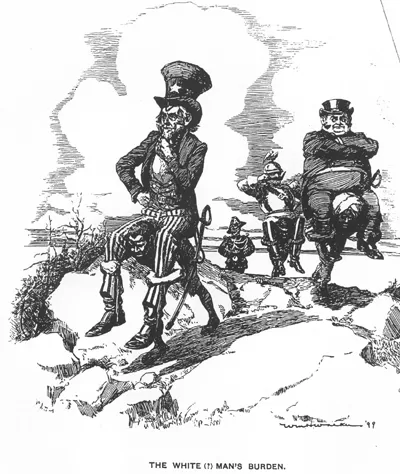 Political cartoon titled "The White Man's Burden" depicting European colonial figures struggling under the weight of carrying indigenous peoples, illustrating the perceived burden and hypocrisy of the civilizing mission justification for imperialism.
Christianity as a Moral Imperative
Another significant pillar used to justify European imperialism was the dissemination of Christianity. European nations like Britain, France, and the Netherlands viewed Christianity as intrinsically linked to Western civilization and Anglo-Saxon morality, believing their society, informed by Christian doctrine, was vastly superior to African cultures. Scholar J.D. Fage notes that “Mid-and late-nineteenth-century Europeans were generally convinced that their Christian, scientific and industrial society was intrinsically far superior to anything that Africa had produced.” This ethnocentric view led explorers and missionaries to label unfamiliar African practices as “lesser” or “savage.”
Christianity played a crucial role in the partition and colonization of Africa, serving as a “guise” or moral cover for the true motives of exploitation and conquest. As European nations competed for global power in the late 19th century, they needed justifications for their aggressive expansion. Missionaries often acted as pioneers, venturing into new territories and setting up centers that could later serve as administrative hubs.
In “The White Man’s Burden,” Kipling references this religious dimension, urging colonizers to “Take up the White Man’s burden, The savage wars of peace—Fill full the mouth of Famine and bid the sickness cease.” While originally directed at American actions in the Philippines, the underlying Anglo-centric justification applied broadly to the imperial mindset in Africa. African religious practices were dismissed as “witchcraft” or “heathenism,” necessitating conversion to what Europeans deemed a “just and compassionate doctrine.”
Kipling’s description of colonized peoples as “Your new-caught sullen peoples, Half-devil and half-child” directly reflects the European belief that Africans were “heathens” living in savagery, needing the moral guidance of Christianity. Missionaries, often genuinely believing they were saving souls, were nonetheless instruments of colonial policy. As missionary Daniel Kumler Flickinger wrote, attributing European “correct” theological views solely to the “light of Heaven” shining upon them, they provided arguments that implicitly justified the coercive tactics used to dismantle African cultures and societies under the pretense of humanitarian theology. This demonstrates how white man’s burden rudyard kipling connected the idea of civilizing with Christian evangelization.
Economic Drivers and the Promise of Commerce
While cloaked in the rhetoric of moral obligation and salvation, the true primary impetus for the colonization of Africa was economic: the potential for commerce and the wealth of natural resources. Following the decline of the slave trade, European powers saw Africa as a new, untapped region for economic expansion. The Industrial Revolution dramatically increased the demand for raw materials like rubber, minerals, and oil, which Africa possessed in abundance. This created an intense competition among European nations, leading to the rapid “Scramble for Africa” to claim territory and secure resources.
European trade companies, often backed by their governments, were the initial agents of this economic push. Driven by the potential wealth, they aggressively sought control over African territories. While initial attempts met mixed success, returning explorers and traders effectively used nationalistic arguments to lobby for increased government support. Figures like Lord Lugard, expelled from the Ugandan kingdom of Bunyoro, published works like The Rise of our East African Empire, explicitly justifying colonization as an economic necessity: “as long as our policy is one of free trade, we are compelled to seek new markets; To allow other nations to develop new fields, and to refuse to do so ourselves, is to go backward.” He argued that expansion was an obligation to ancestors and future generations to extend “the sphere of our industrial enterprise.”
Another economic factor was the need for markets to absorb the rapidly increasing volume of goods produced by industrialized European factories. As French author Jules Ferry noted, colonial expansion was driven by “the need for outlets [for exports].” European powers responded by flooding their African colonies with manufactured goods, intentionally stifling nascent local industries. This economic dimension underpinned the white man’s supposed burden, framing it as a duty to integrate Africa into the global capitalist system under European control.
The result was the complete disruption and exploitation of traditional African economies. In extreme cases, like the Belgian Congo under King Leopold II, “extractive states” were established, where populations were stripped of property and forced into labor solely to extract resources for the colonizer. This economic exploitation prevented the development of intra-African trade and left African societies economically dependent long after achieving independence. The promise of commerce, framed as bringing economic progress, was in reality a system designed for the enrichment of the colonizers.
In conclusion, the concept of how was the white man’s burden used to justify imperialism reveals a complex interplay of perceived racial superiority, religious fervor, and, most significantly, economic ambition. Popularized by Rudyard Kipling’s poem, the idea provided a moral and intellectual framework that allowed European powers to mask their exploitative endeavors in Africa under the guise of a benevolent mission. By presenting colonialism as a difficult but necessary duty to civilize, Christianize, and bring commerce to supposedly backward peoples, imperialists created a narrative that justified invasion, subjugation, and resource extraction, ultimately causing immense and lasting damage to the continent. The “burden” was not a selfless act of uplift, but a convenient justification for conquest and control.
Citations:
J.D. Fage, A History of Africa Third Edition, 1995 11 New Fetter Lane London.
Adu Boahen General History of Africa VII: Africa under Colonial Domination 1880-1935 , University of California Press 2120 Berkeley Way, Berkley California.
Rev D.K. Flickinger Ethiopia; Twenty Years of missionary Life in Western Africa.Dayton Ohio: United Brethren Publish House 1877.
Nott, J. C. (1851). An Essay on the Natural History of Mankind. Ann Arbor: ProQuest I&L Research Collections, Dade, Thompson & co. Retrieved from http://search.proquest.com/docview/88430679?accountid=10747
Kipling, Rudyard (1899, 02). The White Man’s Burden. McClure’s Magazine (1893-1926), OL. XII., 2. Retrieved from http://search.proquest.com/docview/135628529?accountid=10747
Conklin, Alice L. A Mission to Civilize : The Republican Idea of Empire in France and West Africa, 1895-1930. Stanford, Calif.: Stanford UP, 1997. Print.
D. Lugard, The Rise of Our East African Empire, (Edinburgh, 1893), I.585-587, II.69-75.
Gann, Lewis H., and Peter Duignan. “Introduction.” Colonialism in Africa, 1870-1960. London: Cambridge U.P., 1969. N. pag. Print.
Jules François Camille Ferry, “Speech Before the French Chamber of Deputies, March 28, 1884,” Discours et Opinions de Jules Ferry.
Acemoglu, Daron, Johson, Simon, and Robinson, James A., “The Colonial Origins of Comparative Development: An Empirical Investigation.” National Bureau of Economic Research. June 2000.