
On September 30, 1938, British Prime Minister Neville Chamberlain stepped off an airplane in London to a jubilant reception. Having just returned from intense negotiations in Munich with Adolf Hitler, Chamberlain carried with him a declaration signed by both leaders. He had agreed, alongside French Prime Minister Edouard Daladier, to Hitler’s demands for the cession of Czechoslovakia’s Sudetenland region to Germany. In return, Hitler offered assurances that this satisfied his territorial ambitions. Displaying the signed paper, Chamberlain spoke to the cheering crowd, stating his belief that the agreement symbolized “the desire of our two peoples never to go to war with one another again.” Later that day, addressing the public from 10 Downing Street, he delivered the now infamous declaration: “I believe it is peace in our time.”
Contents
These hopeful words quickly proved tragically misguided. Within six months, Hitler’s forces had occupied the entirety of Czechoslovakia. On September 1, 1939, less than a year after Chamberlain’s declaration, Germany invaded Poland, initiating World War II. Chamberlain’s policy leading up to Munich, and the agreement itself, became synonymous with “appeasement” – a strategy intended to reduce conflict by conceding to an adversary’s demands. While concessions were historically common in diplomacy, the failure of the Munich Agreement forever stained the term, transforming it into a byword for naive weakness in the face of aggression.
The dramatic events of September 1938 were deeply rooted in the aftermath of World War I. The Treaty of Versailles, signed in 1919, aimed to prevent future German aggression by imposing severe restrictions on its military capabilities and territorial claims. However, the rise of Adolf Hitler and the Nazi Party in 1933 fundamentally altered the European landscape. By 1936, Hitler had reintroduced military conscription and remilitarized the Rhineland, directly defying the treaty. His expansionist goals became increasingly clear with the annexation of Austria (the Anschluss) in March 1938. Each step met with concern from Britain and France, yet no decisive action was taken to halt Nazi expansion.
After Austria, Hitler turned his attention eastward to Czechoslovakia, a young democratic nation created after WWI. Czechoslovakia was home to diverse ethnic groups, including over three million Germans concentrated in the Sudetenland along the border with Germany. The Czech government, led by President Edvard Benes, had a well-equipped military and maintained good relations with Britain and France, leading them to believe they could resist Hitler’s demands.
However, Hitler was determined to bring more ethnic Germans under his control and strengthen Germany’s eastern flank. His demand for the Sudetenland triggered widespread fears across Europe of an imminent war. The devastating memory of WWI, which had decimated a generation, loomed large. British and French leaders, acutely aware of their own military unpreparedness, were hesitant to risk another major conflict. During cabinet discussions, Chamberlain’s government opted for negotiation over confrontation, arguing against plunging into “a certain catastrophe in order to avoid a future danger that might never materialize.” A particular concern was the perceived strength of the German air force (Luftwaffe), believed capable of inflicting severe damage on British cities.
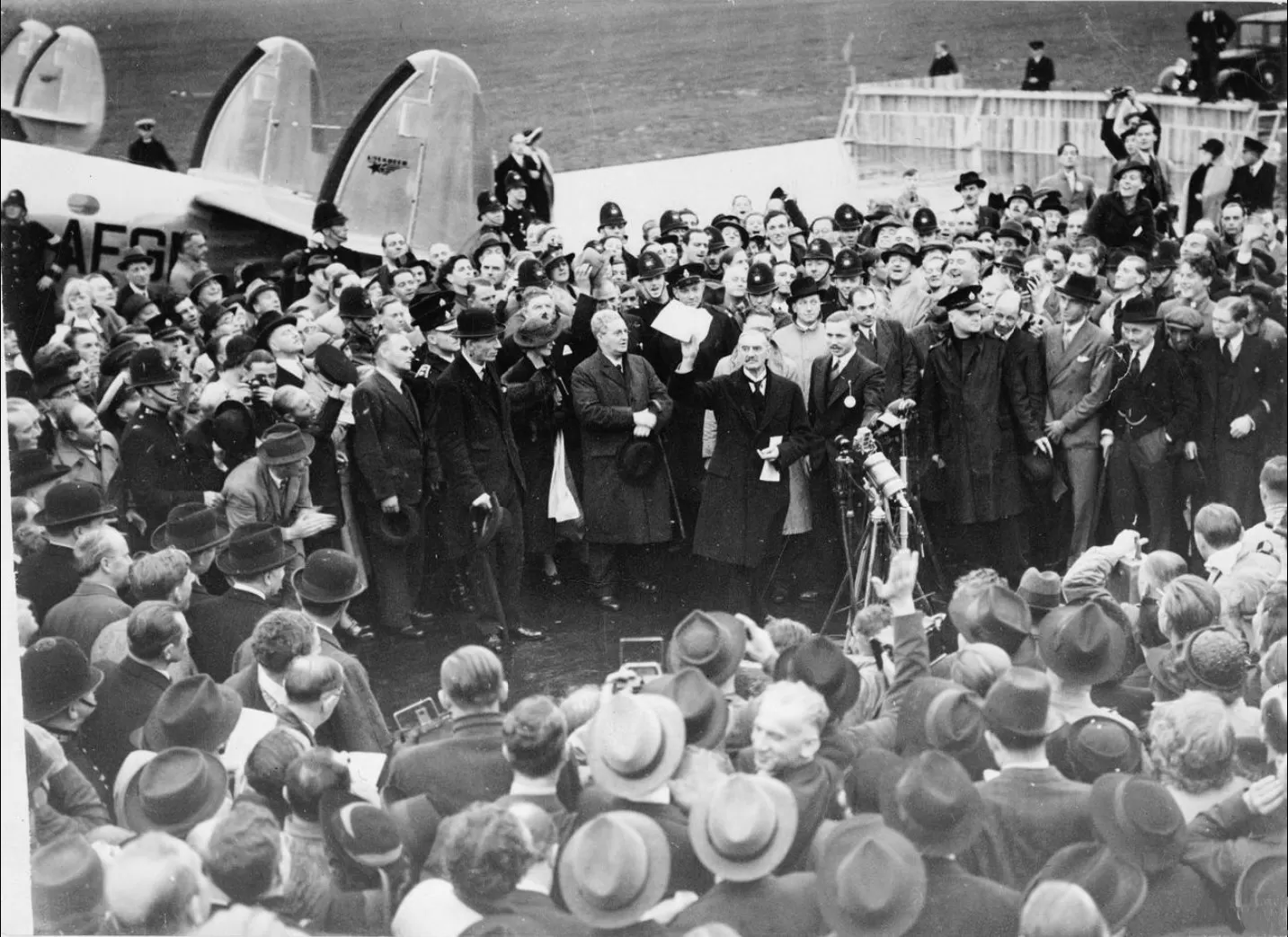 British Prime Minister Neville Chamberlain displaying the Anglo-German Declaration signed after the Munich Agreement talks with Adolf Hitler in 1938.
Driven by a profound desire to avoid war and preserve stability, Neville Chamberlain initiated intense diplomatic efforts. He met with Hitler twice before the end of September 1938, but the crisis escalated, fueled by growing unrest in the Sudetenland and German troops amassing near the Czech border. Facing a rapidly deteriorating situation, Chamberlain appealed to Italy’s fascist dictator, Benito Mussolini, to mediate. Mussolini successfully arranged a new summit in Munich, inviting Chamberlain, Mussolini, and French Prime Minister Daladier.
The Munich Agreement: Concessions for “Peace in Our Time”
The crucial talks took place in Munich on September 29, 1938. Notably absent was any representative from Czechoslovakia, whose future was being decided. By the time Chamberlain arrived in Munich, he had already conceded to Hitler’s demand for the Sudetenland. The negotiations focused not on whether the cession would happen, but how and when Germany would absorb the territory. Unwilling to confront Hitler and risk triggering a wider war, Chamberlain and Daladier signed the infamous Munich Agreement in the early hours of September 30. Believing he had secured peace, Chamberlain also obtained Hitler’s signature on a separate Anglo-German declaration, pledging continued efforts for peace and improved relations – the document he displayed upon his return to London, reinforcing his claim of peace in our time chamberlain championed. Hitler, however, privately dismissed the declaration as insignificant.
 Neville Chamberlain and Adolf Hitler pictured during the Munich Agreement discussions in September 1938.
Chamberlain’s actions were initially met with widespread relief and acclaim both in Britain and internationally. The New York Times, for instance, published an editorial defending the high price paid for peace, questioning whether critics were willing to risk the lives of loved ones in war.
However, the agreement was not universally celebrated. One of its most vocal critics was Winston Churchill, then a backbench MP, who fiercely condemned Chamberlain’s deal in the House of Commons. Less than a week after Munich, Churchill famously described the agreement as “a total and unmitigated defeat” and warned against any notion of friendship between British democracy and the “barbarous paganism” of Nazi power, predicting that such a power could never be a trusted friend. Churchill’s stark warnings, though unpopular at the time, proved tragically prescient.
‘A False Golden Age’ and the Legacy of Appeasement
Following the collapse of France in 1940, some of Chamberlain’s harshest critics published Guilty Men, a pamphlet denouncing the years of appeasement. Writing under the pseudonym Cato, the authors described the period immediately after Munich as a “false golden age,” where many British politicians falsely claimed Hitler had been “tamed” by Chamberlain. The authors were later revealed to include prominent journalists like Michael Foot, who would go on to lead the Labour Party.
Across the Atlantic, President Franklin D. Roosevelt also closely followed the Munich negotiations and initially supported the efforts to find a peaceful settlement. In a telegram to Hitler on September 26, 1938, Roosevelt earnestly appealed for negotiations to continue for a “peaceful, fair, and constructive settlement.” Yet, just over two years later, with much of Western Europe under Nazi occupation, Roosevelt’s stance on appeasement shifted dramatically. In December 1940, he warned against further attempts to appease the Nazis, famously stating, “No man can tame a tiger into a kitten by stroking it,” and urged the United States to become “the great arsenal of democracy.”
Neville Chamberlain resigned as prime minister in May 1940, shortly after the Nazi invasion of Norway, and died six months later. Despite the catastrophic failure of his appeasement policy and his declaration of “peace in our time,” even his critics acknowledged that he was driven by a sincere desire to prevent war. Historian Martin Gilbert, in 1966, characterized appeasement not as a foolish or treacherous idea, but one rooted in noble intentions like Christianity, courage, and common sense. In the decades following World War II, as more historical archives became accessible, a school of revisionist historians emerged to offer a more sympathetic view of Chamberlain and the policy of appeasement. Distinguished historian A.J.P. Taylor, for example, controversially called the Munich settlement “a triumph for British policy.”
However, the term “appeasement” has endured primarily as a pejorative. Secretary of State Henry Kissinger noted in 1976 that statesmen and nations were traumatized by the Munich experience for a generation after WWII, seeing it as proof of the folly of allowing an adversary to gain power. More recently, historians Fredrik Logevall and Kenneth Osgood highlighted that “‘Munich’ and ‘appeasement’ have been among the dirtiest words in American politics, synonymous with naïveté and weakness.” The failure of the Munich Agreement and the subsequent outbreak of World War II permanently transformed “appeasement” from a potentially positive diplomatic tactic into a symbol of disastrous misjudgment.
In retrospect, Neville Chamberlain’s optimistic declaration of “peace in our time” stands as a poignant and tragic historical moment. It represents a sincere but ultimately failed attempt to avert a devastating war, a stark reminder of the complexities and perils of diplomacy in the face of aggressive expansionism, and the enduring, negative legacy of the policy it embodied.