
 Portrait of William Shakespeare, the renowned English poet and playwright, central to understanding Shakespeare poetsWilliam Shakespeare (1564–1616) remains arguably the most celebrated figure in English literature, revered globally as “The Bard.” While his dramatic works often take center stage, his prolific output as a poet is equally significant and foundational to understanding his genius. With over 150 poems, primarily sonnets, compared to his 37 plays, Shakespeare’s contribution to poetry is vast and deeply influential for subsequent generations of classical poets. To truly appreciate Shakespeare’s literary stature, one must delve into the rich tapestry of his poetic creations. This exploration reveals not just technical mastery but a profound insight into the human condition, making his verse a cornerstone for all who appreciate or aspire to create poems from william shakespeare.
Contents
The Quintessential Sonneteer
William Shakespeare is most famously associated with his sequence of 154 sonnets. These poems adhere to a specific fourteen-line structure, now widely known as the English or Shakespearean sonnet. This form consists of three quatrains (four-line stanzas) followed by a final couplet (two-line stanza), typically following a rhyme scheme of ABAB CDCD EFEF GG. More than just following a formula, Shakespeare demonstrated an unparalleled ability to explore complex ideas and emotions within this constrained form. Unlike simpler rhyming verse, his sonnets carefully weave intricate thoughts and feelings through precise language, vivid imagery, and compelling rhythm. An examination of his very first sonnet, Sonnet 1 (“From fairest creatures we desire increase”), immediately showcases this mastery and his established position among shakespeare poets.
From fairest creatures we desire increase,
That thereby beauty’s rose might never die,
But as the riper should by time decease,
His tender heir might bear his memory:
But thou, contracted to thine own bright eyes,
Feed’st thy light’s flame with self-substantial fuel,
Making a famine where abundance lies,
Thyself thy foe, to thy sweet self too cruel.
Thou that art now the world’s fresh ornament
And only herald to the gaudy spring,
Within thine own bud buriest thy content
And, tender churl, makest waste in niggarding.
Pity the world, or else this glutton be,
To eat the world’s due, by the grave and thee.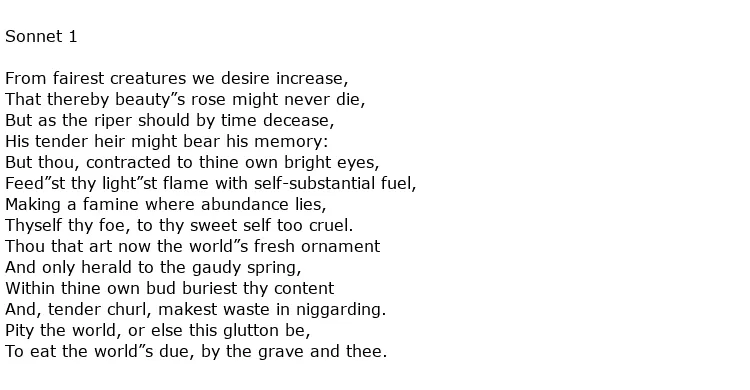 Image displaying the text of William Shakespeare's Sonnet 1, 'From fairest creatures we desire increase.', a prime example of his sonnet form and a foundational work for shakespeare poetsThe structure is evident, moving from a general proposition in the first quatrain to developing arguments and imagery in the next two, culminating in a concluding statement in the final couplet. The inherent rhythm, often iambic pentameter, creates a distinct musicality that complements the rhyme, enhancing the poem’s impact when read aloud.
Themes and Context of Shakespeare’s Verse
While Shakespeare’s sonnets explore a wide array of human experience—time, beauty, mortality, jealousy, and friendship—a significant portion are famously categorized as love poems written by william shakespeare. To understand this thematic focus, it’s crucial to consider the historical context of the Elizabethan era. Writing professionally was a challenging endeavor, and poets often relied on patronage from wealthy nobles. Parchment was scarce and valuable, making published works a significant investment. Therefore, poems, especially sonnets, were often crafted to appeal to the tastes and interests of the upper class, where themes of love and beauty were highly valued and marketable. Catering to this audience and the economic realities of the time heavily influenced the subjects Shakespeare chose to explore in his lyric poetry.
The Lesser-Known Narrative Poems
Beyond the celebrated sonnets, William Shakespeare also penned two significant narrative poems: Venus and Adonis (published 1593) and The Rape of Lucrece (published 1594). Written relatively early in his career, these longer works showcase a different facet of his poetic talent – the ability to sustain storytelling in verse. Some scholars speculate these might have served as early experiments in dramatic narrative or as commissioned works intended to secure patronage, as Venus and Adonis was dedicated to the Earl of Southampton. While less frequently studied than his sonnets or plays, they offer valuable insights into his developing style and thematic preoccupations.
-
Venus and Adonis
As the earlier of the two, this poem adapts a story from Ovid’s Metamorphoses, recounting the unrequited love of the goddess Venus for the beautiful youth Adonis. Shakespeare vividly presents a dramatic narrative exploring themes of love, lust, beauty, and death. The poem is rich in sensuous description and mythological allusion, demonstrating Shakespeare’s engagement with classical literature, a common practice among Elizabethan writers connecting them to the ancient muses. The detailed storytelling in verse foreshadows his later narrative prowess in drama. -
The Rape of Lucrece
This tragic narrative poem tells the story of the Roman matron Lucrece, her rape by Tarquin, and the subsequent political upheaval that led to the founding of the Roman Republic. Unlike the mythological fantasy of Venus and Adonis, The Rape of Lucrece is grounded in historical tragedy and moral crisis. The poem delves deeply into themes of virtue, honor, tyranny, and psychological torment. Its intense focus on inner conflict and the devastating consequences of violent action resonate with the dramatic explorations found in later tragedies like Hamlet and Macbeth. The intricate structure and psychological depth suggest this poem may have served as a significant precursor to the complex character studies and moral dilemmas central to his most famous plays.
The Enduring Legacy of Shakespearean Poetry
For aspiring poets and dedicated poetry readers alike, engaging with the works of William Shakespeare is indispensable. His sonnets provide a masterclass in concise expression, wordplay, and emotional precision within a structured form. His narrative poems offer lessons in sustained storytelling and the dramatic use of language. Many “modern” poets acknowledge his influence, building upon or reacting against the foundations he laid. As a serious student or enthusiast of verse, understanding is shakespeare poetry fundamental to grasping the evolution of the art form. William Shakespeare earned the title “The Bard” not solely for his plays, but equally for his profound impact as a poet whose words continue to resonate, instruct, and inspire centuries later.