
This collection of poems and song lyrics chronicles a four-week journey through Ireland, west central Scotland, and the Hebrides. Each piece captures the unique beauty and spirit of these Celtic lands, weaving together themes of love, loss, history, and spirituality. From ancient stone circles to the haunting melodies of a lone piper, the journey unfolds through vivid imagery and heartfelt emotion.
Contents
Lyrics: We Ne’er Again Shall Part
This poignant song tells a tale of love and loss against the backdrop of the Scottish Isles. The joy of a wedding day on Vatersay is tragically cut short, leaving behind a promise of reunion in eternity.
My feet were kissed by the morning dew
And the sun shone warm on my face.
And the flowered heather I’d gathered for you
Was adorned with silken ribbon and lace.
You had left behind fair Barra Isle,
And your home in Castlebay
To join me walking down the aisle
At the church on Vatersay.
Forever one we will always be,
One love, one life, one heart.
And for all time and eternity,
We never, ne’er again shall part.
The clouds grew dark on our wedding day,
Your hands turned cold as death.
By eventide you had passed away,
And taken your final breath
Forever one we will always be,
One love, one life, one heart.
And when we meet in eternity,
We ne’er again . . . We ne’er again . . . We ne’er again shall part.
Sonnet: Uragh Stone Circle
County Kerry, Ireland
This sonnet transports us to the ancient Uragh Stone Circle in County Kerry, Ireland. The poem reflects on the enduring presence of these stones, witnesses to centuries of human connection with the natural world.
Beneath a weathered crag and barren hill—
Where mystic mist anoints the moorland rock
And whispered winds caress a heathered rill—
Encircled stones stand vigil o’er the lough.
As old as time, ere memory began
The rooted sentinels have stood erect
To mark the sacred place where mortal man
And nature’s primal powers intersect.
A winter solstice dawn once brought forth prayer
And rhythmic chant to urge the earth toward spring.
Today, a flock of sheep has gathered there,
And bleating is the wordless hymn they sing.
Yet even here and now, as here and then,
The seen and unseen mingle in the glen.
 Ben Nevis in the Scottish Highlands (Photo by James Tweedie)
Sonnet: Glen Nevis
Lochaber, Scotland
The rugged majesty of Glen Nevis in the Scottish Highlands is captured in this sonnet. The poem evokes the raw beauty of the landscape, from cascading waterfalls to the towering peak of Ben Nevis.
Majestic, barren, rock-cropped braes ascend—
Arrayed, green-clad, in heather, gorse, and fern—
As mid-day, misty, dark’ning clouds descend
To cold-embrace each soaring tor and burn.
From heights unseen a torrent cascades free,
Unfettered into deep Ben Nevis’ glen;
Then onwards toward Loch Linnhe and the sea,
Through sodden bog and brackened, stone-strewn fen.
Though hidden from the eyes of those below,
Ben Nevis’ surly brow is sought and found
By those who brave the rain, the sleet, and snow,
To scale the cairn that marks its highest ground.
And there, amidst the cloud, God reaches down
To touch and bless fair Scotland’s Highland crown.
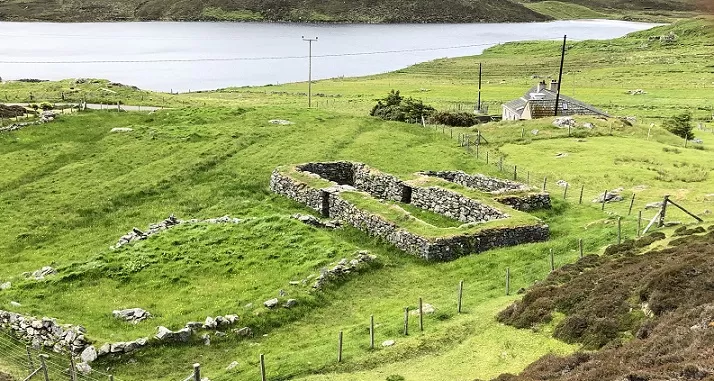 Traditional Black Houses on the Isle of Lewis (Photo by James A. Tweedie)
Sonnet: Black Houses
(Reflecting on the “Highland Clearances” circa 1750-1860)
Isle of Harris and Lewis, Outer Hebrides, Scotland
This sonnet remembers the tragic history of the Highland Clearances, focusing on the abandoned “Black Houses” left behind. The poem speaks to the displacement and resilience of the Highland crofters.
The stones cry out from scoured and windswept land
Once home to Highland crofters, braw and free,
Who eked a simple life by strength of hand
From machair and the Hebridean sea.
As clan and kin they lived and had their way,
Proud spawn of Viking, Gael, Pict, and Scot,
Till landed lairds and law swept them away—
The Highlands cleared, the crofters left to rot.
Their lives reduced to hunger and despair;
Their homes, abandoned, fell into decay;
The wretched ruins of displaced lives laid bare.
“Black Houses” are what they are called today.
In time, some did return, the wrongs made right.
The cottages that they rebuilt were white.
Sonnet: The Unknown Scribe of the 8th Century Book of Kells
Isle of Iona, Inner Hebrides, Scotland
This sonnet pays tribute to the unknown scribe who labored over the Book of Kells on the sacred Isle of Iona. The poem imagines the scribe’s devotion and dedication to his holy work.
‘Twas love of God that brought him to his knees
In humble service to his risen Lord.
Not men, but Christ alone he sought to please
In full submission to God’s Holy Word.
The Spirit led him to Iona, where
He transcribed scripture and illumed each text
With intricate designs infused with prayer;
Forsaking this world’s kingdoms for the next.
Surrounded by both peace and solitude,
He lived beneath the shadow of the cross.
And by God’s grace, in joy and gratitude,
He counted all but Christ his Lord as loss.
In death, the holy island gave him rest.
But by his life, Iona, too, was blessed.
Sonnet: The Oban Piper
Argyll & Bute, Scotland
This final sonnet captures a fleeting but memorable encounter with a piper in Oban, Scotland. The haunting melody evokes a sense of connection to the past and the enduring power of music.
The sound was faint, and yet not far away;
A piper’s chanter practicing a tune.
A youth, perhaps, rehearsing a new lay
At eventide beneath an Oban moon.
No thrum of drone, no windbag to inspire,
The piper skirled the haunting melody
With simple grace, consumed by Celtic fire.
I ken that he was piping it for me.
For somewhere deep within my soul I heard
An echo of forgotten memories—
Surprised, yet blessed, to find such passions stirred
By music carried on a Highland breeze.
The piper’s tune remains with me today;
A gift he never knew he gave away.