
William Wordsworth, born in 1770 in Cockermouth, Cumberland, stands as a giant in English literature. As one of the founders of Romanticism, his innovative approach reshaped poetry, emphasizing nature, emotion, and the experiences of common people. His long life, filled with both personal joy and sorrow, profoundly influenced his work, creating a body of poetry that resonates deeply with readers across generations. From his revolutionary youth, impacted by the ideals and later horrors of the French Revolution, to his later years as a respected poet enjoying widespread popularity, Wordsworth crafted a unique voice that continues to captivate. Understanding Wordsworth’s life, particularly his deep connection to the Lake District and his significant relationship with his sister Dorothy and fellow poet Samuel Taylor Coleridge, is indispensable for appreciating the depth and sincerity of his verse. He didn’t just describe the world; he explored the self’s interaction with it, believing that our inner landscape is shaped by our external environment. While his complete body of work is vast and rich, certain poems have achieved enduring fame and are considered among William Wordsworth’s most popular poems. These works offer a gateway into his profound insights into nature, memory, childhood, and the human condition. Let’s explore some of his most celebrated pieces.
Contents
‘I Wandered Lonely as a Cloud’ (Daffodils)
One of the most instantly recognizable poems in the English language, ‘I wandered lonely as a cloud’, often simply known as “Daffodils,” embodies Wordsworth’s connection to nature and the power of memory. Composed in 1804 and published in 1807, the poem recounts a moment of unexpected joy experienced during a walk.
I wandered lonely as a cloud
That floats on high o’er vales and hills,
When all at once I saw a crowd,
A host, of golden daffodils;
Beside the lake, beneath the trees,
Fluttering and dancing in the breeze.
Continuous as the stars that shine
And twinkle on the milky way,
They stretched in never-ending line
Along the margin of a bay:
Ten thousand saw I at a glance,
Tossing their heads in sprightly dance.
The waves beside them danced; but they
Out-did the sparkling waves in glee:
A poet could not but be gay,
In such a jocund company:
I gazed—and gazed—but little thought
What wealth the show to me had brought:
For oft, when on my couch I lie
In vacant or in pensive mood,
They flash upon that inward eye
Which is the bliss of solitude;
And then my heart with pleasure fills,
And dances with the daffodils.
While perhaps overly famous, its simple beauty and profound message continue to resonate. Wordsworth initially describes the scene with vivid imagery – the “golden daffodils” stretching in a “never-ending line,” dancing and fluttering. He compares their multitude and brilliance to “the stars that shine / And twinkle on the milky way,” elevating the humble flower to celestial grandeur.
The poem’s true power lies in its exploration of memory and the lasting impact of nature on the human spirit. The poet’s initial gazing is passive, but the experience is later recalled in moments of “vacant or in pensive mood,” transforming solitude from potential loneliness into “the bliss of solitude.” The daffodils “flash upon that inward eye,” bringing back the joy and making his “heart with pleasure fills, / And dances with the daffodils.” This concept of nature providing a spiritual and emotional resource, accessed through memory, is central to Wordsworth’s philosophy and a key reason for the enduring popularity of this poem. It captures the idea that the most profound wealth nature offers is not material but emotional and spiritual, a wellspring of happiness to be drawn upon in times of need. It perfectly illustrates how simple moments in the natural world can profoundly enrich our inner lives, offering a beautiful example of william wordsworth most popular poems.
The Lucy Poems
A collection of five short, poignant lyric poems, the “Lucy poems” are unique in Wordsworth’s work for their compression, haunting atmosphere, and mysterious subject. Composed between 1798 and 1801, they explore themes of love, loss, nature’s influence, and mortality, centered around the enigmatic figure of Lucy. The sequence includes “Strange fits of passion have I known,” “She dwelt among the untrodden ways,” “I travelled among unknown men,” “Three years she grew in sun and shower,” and “A slumber did my spirit seal.”
He dwelt among the untrodden ways
Beside the springs of Dove,
A Maid whom there were none to praise
And very few to love:
A violet by a mossy stone
Half hidden from the eye!
Fair as a star, when only one
Is shining in the sky.
She lived unknown, and few could know
When Lucy ceased to be;
But she is in her grave, and oh,
The difference to me!
(“She dwelt among the untrodden ways”)
The power of these poems lies in their subtle emotional depth and the mystery surrounding Lucy’s identity and the poet’s relationship with her. “She dwelt among the untrodden ways” presents Lucy as a hidden beauty, likened to a “violet by a mossy stone” and a single “star” in the sky. Her life was unknown, and her passing noticed by few, yet for the speaker, her death caused a profound “difference.” This poem, perhaps the most famous of the sequence, masterfully uses simple language and vivid, natural imagery to evoke a powerful sense of loss and the value of something overlooked by the world but deeply cherished by one person.
“Three years she grew” is the longest, presenting Nature itself as taking Lucy for her own, shaping her physical and spiritual being through interaction with the elements. “A slumber did my spirit seal” is perhaps the most mysterious and chilling, contemplating Lucy’s absolute stillness and integration into the indifferent natural world after death.
A slumber did my spirit seal;
I had no human fears:
She seem’d a thing that could not feel
The touch of earthly years.
No motion has she now, no force;
She neither hears nor sees;
Roll’d round in earth’s diurnal course,
With rocks, and stones, and trees.
(“A slumber did my spirit seal”)
The “Lucy poems” remain a subject of critical discussion and emotional resonance, praised for their lyrical intensity and the way they encapsulate profound themes of life, death, and memory within a concise form. Their enigmatic quality only adds to their enduring appeal, making them essential reading among william wordsworth most popular poems.
‘Expostulation and Reply’ and ‘The Tables Turned’
Explicitly paired together, these two poems published in Lyrical Ballads (1798) serve as a foundational poetic manifesto for Wordsworth and the Romantic movement. They explore the contrasting ways of acquiring knowledge and wisdom – through books and intellectual study versus through direct experience and observation of nature.
Expostulation and Reply
“Why William, on that old grey stone,
Thus for the length of half a day,
Why William, sit you thus alone,
And dream your time away?
“Where are your books? that light bequeath’d
To beings else forlorn and blind!
Up! Up! and drink the spirit breath’d
From dead men to their kind.
…
“The eye it cannot choose but see,
We cannot bid the ear be still;
Our bodies feel, where’er they be,
Against, or with our will.
“Nor less I deem that there are powers,
Which of themselves our minds impress,
That we can feed this mind of ours,
In a wise passiveness.
…
“—Then ask not wherefore, here, alone,
Conversing as I may,
I sit upon this old grey stone,
And dream my time away.”
The first poem presents a dialogue where the speaker (presumably Wordsworth) is questioned by his friend Matthew for idly sitting on a stone instead of reading. Matthew champions books as the source of knowledge, “that light bequeath’d / To beings else forlorn and blind!” Wordsworth’s reply introduces the core Romantic idea of “wise passiveness,” suggesting that the mind can be impressed by external “powers” through quiet observation rather than active intellectual pursuit. He argues that the senses (“The eye it cannot choose but see”) are constantly receptive, and this receptive state is a valid way to “feed this mind of ours.”
The Tables Turned; An Evening Scene, on the Same Subject
Up! up! my friend, and clear your looks,
Why all this toil and trouble?
Up! up! my friend, and quit your books,
Or surely you’ll grow double.
…
Books! ’tis a dull and endless strife,
Come, hear the woodland linnet,
How sweet his music; on my life
There’s more of wisdom in it.
And hark! how blithe the throstle sings!
And he is no mean preacher;
Come forth into the light of things,
Let Nature be your teacher.
…
Sweet is the lore which nature brings;
Our meddling intellect
Misshapes the beauteous forms of things;
—We murder to dissect.
Enough of science and of art;
Close up these barren leaves;
Come forth, and bring with you a heart
That watches and receives.
The second poem reverses the exhortation. Now the speaker urges his friend to abandon his books, which lead to “dull and endless strife,” and turn to nature. The songs of birds are presented as possessing “more of wisdom” than books. Nature is positioned as the ultimate “teacher,” offering “spontaneous wisdom” and “truth breathed by cheerfulness.” The famous lines “Our meddling intellect / Misshapes the beauteous forms of things; / —We murder to dissect” strongly criticize the analytical, scientific approach that fragments and destroys the holistic beauty of nature. The poem concludes with a powerful call to action: to leave behind “barren leaves” of books and “Come forth, and bring with you a heart / That watches and receives.” These poems, though brief, are pivotal in expressing Wordsworth’s philosophy and remain popular for their clear articulation of Romantic ideals and their beautiful, persuasive language, standing as strong examples of william wordsworth most popular poems.
Hart-Leap Well
Published in the 1800 edition of Lyrical Ballads, “Hart-Leap Well” is a longer narrative poem that blends legend, nature description, and moral reflection. It tells the story of Sir Walter, a knight who relentlessly hunts a stag to its death at a spring called Hart-Leap Well, and his subsequent vow to build a pleasure house and monument there. The poem is divided into two parts.
The Knight had ridden down from Wensley moor
With the slow motion of a summers cloud;
He turn’d aside towards a Vassal’s door,
And, “Bring another Horse!” he cried aloud.
…
Sir Walter, restless as a veering wind,
Calls to the few tired dogs that yet remain:
Brach, Swift and Music, noblest of their kind,
Follow, and weary up the mountain strain.
The Knight halloo’d, he chid and cheered them on
With suppliant gestures and upbraidings stern;
But breath and eye-sight fail, and, one by one,
The dogs are stretch’d among the mountain fern.
…
Sir Walter wiped his face, and cried, “Till now
Such sight was never seen by living eyes:
Three leaps have borne him from this lofty brow,
Down to the very fountain where he lies.
I’ll build a Pleasure-house upon this spot,
And a small Arbour, made for rural joy;
‘Twill be the traveller’s shed, the pilgrim’s cot,
A place of love for damsels that are coy.
The first part, narrated in a somewhat detached, ballad-like style, recounts the brutal hunt and Sir Walter’s triumphant but callous reaction to the stag’s desperate final leaps and death. His decision to commemorate the hunt by building a “Pleasure-house” highlights a human impulse to dominate and mark nature for selfish gratification.
The second part shifts perspective and tone dramatically. The speaker (Wordsworth) visits the site years later and finds the pleasure house and monument in ruins, the land around it desolate and seemingly “cursed.” He meets a shepherd who explains the legend, attributing the desolation to the tragic death of the Hart.
“There’s neither dog nor heifer, horse nor sheep,
Will wet his lips within that cup of stone;
And, oftentimes, when all are fast asleep,
This water doth send forth a dolorous groan.
…
“Grey-headed Shepherd, thou hast spoken well;
Small difference lies between thy creed and mine;
This beast not unobserv’d by Nature fell,
His death was mourn’d by sympathy divine.
The poem concludes with a direct moral lesson, a powerful statement of Wordsworth’s belief in the interconnectedness of all living things and the ethical imperative to treat even the “meanest thing that feels” with sympathy. The desolate state of the well and the ruins serves as a physical manifestation of the moral transgression against nature. “Hart-Leap Well” is notable for its narrative structure, its critique of human arrogance, and its strong environmentalist undertones, demonstrating Wordsworth’s engagement with deeper moral issues beyond lyrical descriptions of nature, and is considered one of william wordsworth most popular poems for its narrative and thematic depth.
‘The World is too much with us’
A powerful sonnet, ‘The World is too much with us’ (1807) serves as a passionate lament against the burgeoning materialism and disconnection from nature that Wordsworth observed in society. Written in the Petrarchan sonnet form, it is a concise yet forceful articulation of one of his central concerns.
The world is too much with us; late and soon,
Getting and spending, we lay waste our powers:
Little we see in Nature that is ours;
We have given our hearts away, a sordid boon!
This Sea that bares her bosom to the moon;
The winds that will be howling at all hours,
And are up-gathered now like sleeping flowers;
For this, for every thing, we are out of tune;
The octet vividly portrays humanity’s absorption in worldly pursuits (“Getting and spending”), which leads to a squandering of our vital “powers” and a profound alienation from the natural world. The speaker observes majestic natural scenes – the sea, the winds – but notes that “For this, for every thing, we are out of tune; / It moves us not.” Our focus on material gain has dulled our sensitivity to the beauty and spiritual sustenance offered by nature.
It moves us not.—Great God! I’d rather be
A Pagan suckled in a creed outworn;
So might I, standing on this pleasant lea,
Have glimpses that would make me less forlorn;
Have sight of Proteus rising from the sea;
Or hear old Triton blow his wreathèd horn.
The volta (turn) in the sestet introduces a striking and provocative wish: the speaker would rather be a “Pagan” connected to an ancient, nature-based religion than remain disconnected from the natural world in his current state. He longs for “glimpses” of mythological figures like Proteus and Triton, suggesting that even an “outworn creed” that imbued nature with divinity is preferable to a state of spiritual apathy. This sonnet is a sharp indictment of modern life’s priorities and a powerful plea for humanity to reconnect with the natural world for spiritual and emotional fulfillment. Its directness and enduring relevance to contemporary concerns about consumerism and environmental detachment make it one of william wordsworth most popular poems. It’s a strong example of how Wordsworth adapted traditional poetic forms for his revolutionary Romantic themes, a practice seen in his many other meaningful poems.
Ode: Intimations of Immortality from Recollections of Early Childhood
This expansive and philosophically complex Ode, published in 1807, is one of Wordsworth’s most ambitious and famous works. It explores the fading of a visionary gleam associated with childhood and the compensatory wisdom and insight gained with age.
The Child is father of the Man;
And I could wish my days to be
Bound each to each by natural piety.
The poem opens with an epigraph taken from Wordsworth’s earlier poem, “My Heart Leaps Up,” which sets the theme: the profound connection between childhood experience and adult identity, and the desire for a life guided by “natural piety.”
I.
There was a time when meadow, grove, and stream,
The earth, and every common sight,
To me did seem
Apparelled in celestial light,
The glory and the freshness of a dream.
It is not now as it hath been of yore;—
Turn wheresoe’er I may,
By night or day,
The things which I have seen I now can see no more.
Stanzas I-IV pose the problem: the loss of the intense, luminous perception of nature experienced in childhood. Nature, once appearing in “celestial light,” now seems stripped of that visionary “glory and freshness.” Despite the ongoing beauty of the natural world (rainbows, roses, joyous lambs), the speaker feels an undeniable sense of loss, asking, “Whither is fled the visionary gleam? / Where is it now, the glory and the dream?”
V.
Our birth is but a sleep and a forgetting:
The soul that rises with us, our life’s star,
Hath had elsewhere its setting,
And cometh from afar;
Not in entire forgetfulness,
And not in utter nakedness,
But trailing clouds of glory do we come
From God, who is our home.
Heaven lies about us in our infancy!
Stanza V introduces a philosophical framework, drawing on Platonic (or Neo-Platonic) ideas: the pre-existence of the soul, which arrives on earth from a heavenly realm (“trailing clouds of glory from God, who is our home”). Childhood is seen as a state closer to this divine origin, where “Heaven lies about us.” As the child grows, the “shades of the prison-house begin to close,” and this visionary awareness fades into “the light of common day.”
The later stanzas (VI-VIII) elaborate on how the world and “homely Nurse” (Earth) cause the child to forget its heavenly origins, training it for earthly life. Stanza VIII offers a moving address to the child, recognizing its profound spiritual depth and potential, yet lamenting its inevitable journey towards losing this “heaven-born freedom.”
IX.
O joy, that in our embers
Is something that doth live,
That nature yet remembers
What was so fugitive!
Stanza IX offers a turning point, seeking compensation for the loss. While the intense, direct vision of childhood is gone, something remains: “first affections,” “shadowy recollections,” and “high instincts.” These remnants of the soul’s original state are “yet the fountain light of all our day,” providing a deep, intuitive connection to the eternal. The mature mind can access an “immortal sea” of experience through memory and reflection.
X.
…What though the radiance which was once so bright
Be now forever taken from my sight,
Though nothing can bring back the hour
Of splendor in the grass, of glory in the flower?
We will grieve not, rather find
Strength in what remains behind;
In the primal sympathy
Which, having been, must ever be;
In the soothing thoughts that spring
Out of human suffering;
In the faith that looks through death,
In years that bring the philosophic mind.
The final stanzas find strength and consolation in the wisdom and philosophical understanding gained through life experience, as well as “the primal sympathy” and “soothing thoughts that spring / Out of human suffering.” The loss of the childhood vision is recompensed by a deeper, more reflective engagement with the world and human mortality.
XI.
And O ye fountains, meadows, hills, and groves,
Forebode not any severing of our loves!
…
Thanks to the human heart by which we live,
Thanks to its tenderness, its joys, and fears,
To me the meanest flower that blows can give
Thoughts that do often lie too deep for tears.
The poem concludes with a reaffirmation of love for nature and gratitude for the human heart’s capacity for feeling and reflection. The mature perspective allows the poet to see deep, moving significance even in the “meanest flower.” The Ode’s sweeping scope, philosophical ambition, and moving reflections on memory, loss, and the human spirit’s connection to the eternal solidify its place among william wordsworth most popular poems.
The Prelude
Often considered Wordsworth’s magnum opus, The Prelude; or, Growth of a Poet’s Mind is a long, autobiographical poem in blank verse that Wordsworth worked on throughout much of his life but was only published posthumously in 1850 by his widow. Addressing his friend Samuel Taylor Coleridge, the poem chronicles Wordsworth’s intellectual and spiritual development from childhood through early adulthood, exploring the formative influences of nature, his experiences at Cambridge, his time in revolutionary France, and his burgeoning sense of poetic identity. You can visit a resource to read The Prelude in its entirety to appreciate its full scope.
Wordsworth did not title it The Prelude; he considered it the introduction or “prelude” to a larger, never-completed philosophical work called The Recluse. However, The Prelude itself evolved through multiple versions (notably the 1805 and 1850 texts), each reflecting his changing perspectives and revisions.
Oh there is a blessing in this gentle breeze
That blows from the green fields and from the clouds
And from the sky; it beats against my cheek,
And seems half-conscious of the joy it gives.
(1805 Text, Book I)
The poem is celebrated for its detailed explorations of memory, consciousness, and the reciprocal relationship between the mind and the external world, particularly nature. Wordsworth recounts childhood experiences, such as skating, boat-stealing, and wandering through the fells, which he identifies as “spots of time” – moments of intense feeling that leave a lasting, formative impression on the mind. These episodes demonstrate how interactions with nature, sometimes sublime and sometimes terrifying, shaped his imagination and moral sensibility.
His account of his time in France during the Revolution provides insight into his initial fervent support for its ideals and his subsequent disillusionment with its violent turn. This period significantly impacted his political and philosophical views.
The Prelude is not just a chronological autobiography; it’s a deep psychological and philosophical inquiry into how a poet’s mind is shaped. It explores the role of the imagination, the complexities of urban life versus rural simplicity, and the search for a stable moral and spiritual center. Despite its length, sections of The Prelude are widely read and admired for their lyrical beauty, introspective depth, and powerful descriptions of natural landscapes and intense psychological states. Its status as Wordsworth’s life’s work and its profound exploration of themes central to Romanticism make it arguably his most significant contribution and one of william wordsworth most popular poems in terms of critical acclaim and study. It remains a key text for understanding Romantic thought and the development of the autobiographical long poem. Readers interested in exploring further can find many most famous poem books that feature selections or the entire text of The Prelude.
‘Lines Written a Few Miles Above Tintern Abbey’
Often simply called “Tintern Abbey,” this poem, published in the 1798 edition of Lyrical Ballads, is widely considered one of the greatest lyric poems in English. Composed in blank verse (unrhymed iambic pentameter), it is a meditative monologue reflecting on the speaker’s return to the Wye Valley and Tintern Abbey after five years.
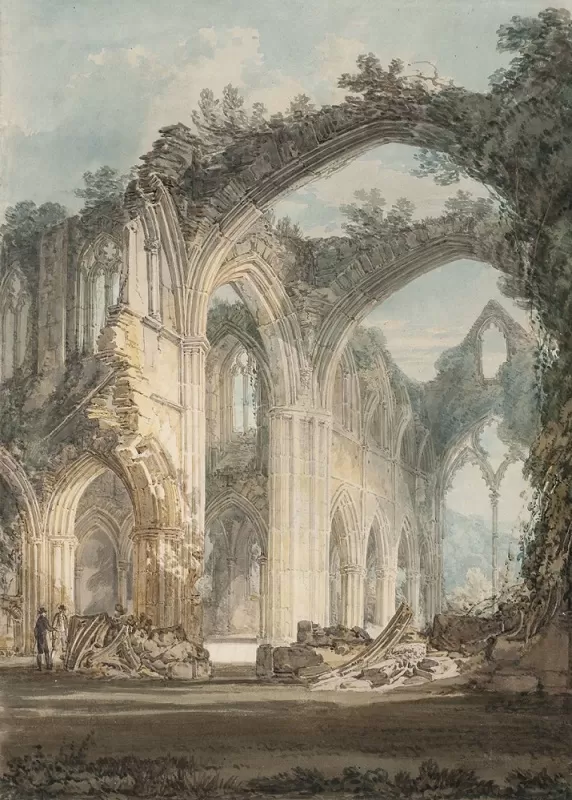 “Tintern Abbey” by J.M.W. Turner
Five years have passed; five summers, with the length
Of five long winters! and again I hear
These waters, rolling from their mountain-springs
With a sweet inland murmur. —Once again
Do I behold these steep and lofty cliffs,
Which on a wild secluded scene impress
Thoughts of more deep seclusion; and connect
The landscape with the quiet of the sky.
The poem opens with the speaker describing his return to the familiar landscape and his immediate sensory impressions – the sound of the water, the sight of the cliffs, the rural scenes. He notes how these “forms of beauty” have not been forgotten during his absence in cities; they have provided “sensations sweet” in “lonely rooms, and mid the din / Of towns and cities,” offering “tranquil restoration” and influencing his “little, nameless, unremembered acts / Of kindness and of love.”
He reflects on a deeper benefit:
…that blessed mood,
In which the burthen of the mystery,
In which the heavy and the weary weight
Of all this unintelligible world
Is lighten’d:—that serene and blessèd mood,
In which the affections gently lead us on,
Until, the breath of this corporeal frame,
And even the motion of our human blood
Almost suspended, we are laid asleep
In body, and become a living soul:
While with an eye made quiet by the power
Of harmony, and the deep power of joy,
We see into the life of things.
This passage describes a state of transcendental experience induced by contemplating nature, where the mind transcends the physical self to gain profound insight, to “see into the life of things.”
The poem then contrasts the speaker’s current experience with his youthful visits.
And so I dare to hope
Though changed, no doubt, from what I was, when first
I came among these hills; when like a roe
I bounded o’er the mountains…
For nature then…
To me was all in all.—I cannot paint
What then I was. The sounding cataract
Haunted me like a passion: the tall rock,
The mountain, and the deep and gloomy wood…
were then to me
An appetite: a feeling and a love…
In youth, his connection to nature was characterized by a more physical, unthinking passion and appetite. Now, that “aching joys are now no more, / And all its dizzy raptures” are gone. However, he finds “abundant recompence” in a more mature understanding:
For I have learned
To look on nature, not as in the hour
Of thoughtless youth; but hearing oftentimes
The still, sad music of humanity,
Not harsh nor grating, though of ample power
To chasten and subdue. And I have felt
A presence that disturbs me with the joy
Of elevated thoughts; a sense sublime
Of something far more deeply interfused,
Whose dwelling is the light of setting suns,
And the round ocean, and the living air,
And the blue sky, and in the mind of man,
A motion and a spirit, that impels
All thinking things, all objects of all thought,
And rolls through all things.
This mature perspective involves hearing “the still, sad music of humanity” and sensing a “presence… far more deeply interfused” throughout nature and the human mind – a pantheistic or spiritual force. This deeper, more reflective connection replaces the youthful intensity.
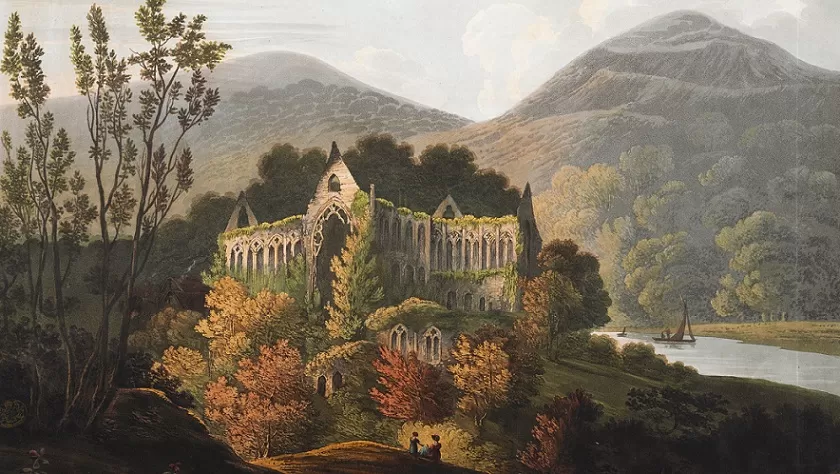 From Four Views of Tintern Abbey by Frederick Calbert
The poem concludes with a moving address to his sister, Dorothy, who is present with him. He sees in her youthful enthusiasm a reflection of his past self and prays that nature will continue to guide and sustain her, protecting her from “evil tongues,” “rash judgments,” and “the dreary intercourse of daily life.”
Tintern Abbey is celebrated for its profound meditation on memory, the stages of human development, the power of nature to heal and inspire, and the nature of perception and consciousness. Its lyrical beauty, philosophical depth, and emotional sincerity make it a cornerstone of English Romanticism and undoubtedly one of william wordsworth most popular poems. It exemplifies Wordsworth’s ability to transform a specific personal experience into universal insights about the human spirit’s relationship with the world, offering a rich example of beautiful poems of life.
Conclusion
William Wordsworth’s legacy is immense, marked by his revolutionary approach to subject matter, language, and the role of the poet. The poems discussed above represent some of his most enduring and william wordsworth most popular poems, offering a comprehensive view of his central themes: the profound influence of nature, the sanctity of childhood and memory, the complexities of human consciousness, and the critique of societal forces that alienate us from our deeper selves and the natural world.
From the simple, resonant joy of “Daffodils” and the haunting mystery of the “Lucy poems” to the intellectual challenges of “Expostulation and Reply” and “The Tables Turned,” the narrative power of “Hart-Leap Well,” the sharp social commentary of “The World is too much with us,” the philosophical grandeur of the “Intimations Ode,” and the epic introspection of The Prelude and the meditative beauty of “Tintern Abbey,” Wordsworth’s work continues to speak to readers. He taught us to see the extraordinary in the ordinary, the spiritual in the natural, and the deep significance of our own inner lives. His commitment to “natural piety” and his belief in the transformative power of nature remain as relevant today as they were two centuries ago. Exploring these popular poems is an essential journey for anyone wishing to understand the heart of Romantic poetry and the enduring power of Wordsworth’s voice, a significant figure in famous poems uk.