
Brad Leithauser’s Rhyme’s Rooms: The Architecture of Poetry offers a profound exploration into the foundational elements of verse, proposing that the very structures of poetry are deeply intertwined with human perception and limitation. This concept of poetry as a built environment, shaped by the contours of the human mind and body, provides a compelling lens through which to understand the art form. Much like physical architecture responds to the needs, capabilities, and aesthetics of its inhabitants, poetic forms – from rhyme schemes and meter to stanza shapes and typographical arrangement – create spaces for meaning and emotion to reside. Focusing on the core concept of architecture and poetry, Leithauser’s work reveals how the seemingly rigid constraints of form can become the very source of poetry’s expansive power and emotional resonance.
Contents
The book acts as a comprehensive guide, leading readers through the intricate plan of poetry. Leithauser introduces the idea of the “Funesians,” hypothetical beings with perfect recall and sensitivity to every nuance of sound and form. While initially presented as an ideal reader, the Funesians ultimately highlight a key argument: true appreciation of poetry isn’t about perfect reception, but about how form interacts with human imperfection. Our limited memory, peripheral vision, and cognitive processing speed are not obstacles poetry must overcome, but rather the very bedrock upon which its most effective structures are built. This suggests that poetry’s design, its ‘architecture,’ is fundamentally human-scaled, mirroring and ministering to our inherent nature.
Consider rhyme, a cornerstone of poetic architecture. Leithauser describes it not just as a decorative flourish, but as a dynamic mental event. It leverages the fleeting nature of auditory memory, creating a resonant echo that draws disparate words together across lines or even stanzas. This interaction with memory’s fade rate dictates rhyme’s effectiveness, subtly shaping the reader’s experience and highlighting crucial linguistic moments. The proximity required for rhyme to register meaningfully is a direct consequence of human cognitive limits, making the placement of rhyming words a critical architectural decision within the poem’s structure. This dynamic is key to understanding many classic sonnets about love examples, where intricate rhyme schemes build intensity and connect thematic elements across the fourteen lines.
Moving beyond individual devices, Leithauser examines the architecture of stanzas. He uses an architectural analogy, suggesting that just as human physiology influences the design of buildings – doorway heights, staircase pitches – our mental capacities shape poetic structures. The limited capacity of short-term memory, for instance, favoring chunks of three or four items, explains the prevalence of couplets and quatrains in English poetry. These familiar stanza forms are comfortable rooms for the mind to inhabit, manageable units of thought and sound. Exploring different examples of poetry forms reveals how variations in stanza size and structure create different reading experiences, from the tight constraint of a haiku to the sprawling expanse of a free verse poem.
Leithauser vividly illustrates how slight increases in stanza length drastically expand structural possibilities. Adding just a few lines can transform the limited choices in a couplet or triplet into a vast, almost unimaginable number of configurations in a quatrain or octave. He compares this exponential growth to chess, where a few moves quickly lead to unique positions, or to piloting a small boat on a limitless ocean. This highlights how poets, within the seemingly simple framework of lines and stanzas, are constantly navigating a complex architectural space with immense potential for novelty and expression. The chosen form becomes a foundational structure, a fixed frame within which infinite variations can occur, much like different buildings can be constructed using similar materials or blueprints. Understanding these fixed forms of poetry provides a deeper appreciation for the poet’s craft in navigating these architectural constraints.
Beyond structure and sound, the architecture and poetry connection extends to the visual and cognitive experience. Typography, line breaks (enjambment), and the layout on the page all contribute to the poem’s physical presence and the reader’s interaction with it. Enjambment, for example, plays with the reader’s expectation and peripheral vision, creating suspense, surprise, or humor by continuing a thought across a line break. The visual shape of a concrete poem, while an extreme example, directly demonstrates poetry using physical form as part of its meaning-making architecture.
Leithauser’s interdisciplinary approach further cements the link between architecture and poetry. Drawing on mathematics to explain structural permutations, physiology to ground form in human biology, and even theology to explore the idea of poetry accommodating human frailty (an ‘architecture of grace’), he demonstrates that poetry’s construction principles resonate across diverse fields. This wide-ranging perspective underscores that poetry is not an isolated art form but one deeply connected to how humans perceive, process, and build meaning in the world, whether through words, stone, or sound. The idea of beauty arising from structure, a concept often explored in philosophical works like roger scruton why beauty matters, finds a compelling parallel in Leithauser’s analysis of poetic form.
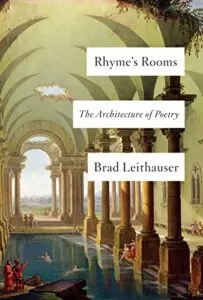 A book cover titled "Rhyme's Rooms: The Architecture of Poetry" by Brad Leithauser, featuring a muted, textured background with white text and a small illustration.
The book’s appeal extends particularly to those who may feel they’ve drifted away from poetry since their school days. Leithauser invites readers back, using familiar and less familiar examples to illuminate complex ideas without jargon. He shows that appreciating poetry isn’t about deciphering coded messages, but about engaging with a carefully constructed experience designed to work with our human minds and hearts. By understanding the ‘architecture’ – the deliberate choices of form, sound, and structure – the reader gains deeper access to the poem’s emotional and intellectual core. Much like a great piece of architecture can move us with its form and function, a well-built poem offers a similar, though intangible, dwelling place for the spirit. This connection between art forms, including the link between love music poem, highlights the shared structural and emotional principles that resonate across creative disciplines.
In conclusion, Rhyme’s Rooms powerfully articulates the concept of architecture and poetry, portraying poetic forms not as arbitrary rules but as ingenious structures crafted to house and convey human experience. Leithauser demonstrates how poetry’s architecture works by engaging with our limitations, turning potential points of failure into opportunities for beauty and profound connection. By exploring the deliberate design of verse – its rooms of rhyme, its walls of stanzas, its doorways of line breaks – readers are equipped to enter and appreciate the intricate, human-scaled palaces that poets build with words. It’s a perspective that enriches the reading experience, transforming passive consumption into an active appreciation of the poet’s architectural genius.
References
Leithauser, Brad. Rhyme’s Rooms: The Architecture of Poetry. Alfred A. Knopf, 2022.