
Haiku, a deceptively simple form originating in Japan, captures moments with striking imagery and profound emotional resonance. Traditionally structured with a 5-7-5 syllable count, these brief poems often focus on nature, seasonality, and the fleeting beauty of the world. Yet, modern haiku in English and other languages frequently adapt these conventions, exploring diverse themes and forms while retaining the core spirit of concise observation. Studying haiku samples offers a window into this rich tradition and its contemporary evolution.
Examining a variety of haiku samples allows us to appreciate the form’s versatility – how a few carefully chosen words can evoke a scene, feeling, or philosophical insight. From ancient Japanese masters to modern English-language poets, haiku continues to be a powerful medium for expressing the essence of experience. Let’s delve into 40 examples that showcase the depth and beauty packed into these tiny verses. If you enjoy these examples, you might also be interested in exploring different types, such as funniest haikus.
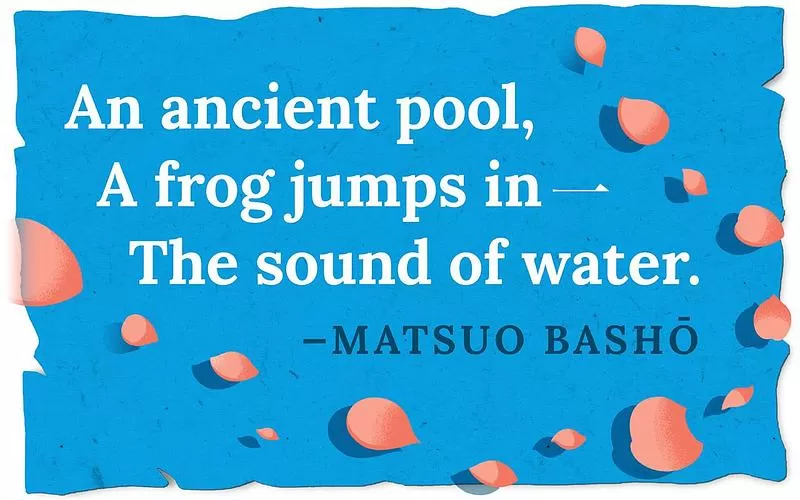
1. “The Old Pond” by Matsuo Bashō
This iconic haiku, perhaps the most famous of all, captures a moment of profound stillness shattered by a simple sound.
An old silent pond…
A frog jumps into the pond,
splash! Silence again.
Bashō, one of the greatest haiku masters, uses the contrast between the ancient stillness of the pond and the sudden, brief action of the frog to evoke a sense of timelessness punctuated by the present moment. The “splash!” serves as a kireji (cutting word), creating a break and allowing the images to resonate. It’s a poem deeply rooted in Zen philosophy, highlighting the connection between the transient and the eternal.
 A frog sits on a lily pad in a pond, illustrating Basho's 'Old Pond' haiku.
2. “The light of a candle” by Yosa Buson
The light of a candle
Is transferred to another candle —
spring twilight.
Yosa Buson, a renowned painter as well as a poet, brings a visual and slightly sensual quality to his haiku. This poem uses the simple act of lighting one candle from another to suggest continuity, shared light, or perhaps even the passing of knowledge or spirit. Set against the backdrop of “spring twilight,” the scene feels intimate and quietly hopeful, linking human action with the gentle transition of the season.
3. “Haiku Ambulance” by Richard Brautigan
A piece of green pepper
fell
off the wooden salad bowl:
so what?
Richard Brautigan’s approach to haiku is famously irreverent and unconventional. This piece defies the traditional 5-7-5 structure and subject matter. The “so what?” at the end acts as a provocative anti-kireji, dismissing the preceding image with a shrug. It’s a commentary on the mundane, the absurd, and perhaps a playful jab at the seriousness sometimes attached to poetry forms. It’s a prime example of how modern poets adapt traditional structures.
4. “A World of Dew” by Kobayashi Issa
This world of dew
is a world of dew,
and yet, and yet.
Kobayashi Issa, known for his empathy towards the suffering of ordinary people and creatures, wrote this haiku after the death of his infant daughter. The repetition “This world of dew / is a world of dew” emphasizes the ephemeral nature of life – transient and fragile like morning dew. The poignant addition “and yet, and yet” conveys a deep, unresolved sorrow, a clinging to life despite its fleetingness, or perhaps the struggle to accept inevitable loss. It’s incredibly emotionally stirring for so few words.
5. “A Poppy Blooms” by Katsushika Hokusai
I write, erase, rewrite
Erase again, and then
A poppy blooms.
Katsushika Hokusai, the celebrated ukiyo-e artist, connects the creative process with natural growth. The struggle and repetition of writing and erasing are juxtaposed with the effortless, vibrant blooming of a poppy. This haiku suggests that artistic creation, much like nature, requires patience, persistence, and refinement, culminating in something beautiful. It highlights the labor behind apparent spontaneity.
6. “In the moonlight” by Yosa Buson
In pale moonlight
the wisteria’s scent
comes from far away.
Buson again engages the senses beyond just sight. The “pale moonlight” creates a soft, perhaps melancholic visual, while the “wisteria’s scent” adds an olfactory dimension. The detail that the scent “comes from far away” adds mystery and distance, inviting the reader to imagine the unseen source and perhaps evoking a feeling of longing or nostalgia for something just out of reach.
7. “The earth shakes” by Steve Sanfield
The earth shakes
just enough
to remind us.
Steve Sanfield’s concise haiku, written in English, uses a natural event – an earthquake – as a metaphor for mortality or the precariousness of existence. The phrase “just enough” suggests a subtle but powerful jolt, not necessarily destructive, but sufficient to shift perspective and serve as a quiet, unavoidable reminder of our vulnerability and the importance of presence.
8. “In a Station of the Metro” by Ezra Pound
The apparition of these faces
in the crowd;
Petals on a wet, black bough.
Ezra Pound’s famous Imagist poem, often cited as haiku-like, captures a fleeting perception. The first line presents the ghostly faces in a busy subway station. The second line uses a semicolon (acting like a kireji) to create a sudden leap, likening the faces to “Petals on a wet, black bough.” The juxtaposition is striking – urban humanity is compared to fragile, beautiful nature, highlighting the fleetingness and unexpected beauty found in anonymity. It’s a masterful use of imagery to convey an instantaneous impression.
9. “The Taste of Rain” by Jack Kerouac
The taste
of rain
— Why kneel?
Jack Kerouac, a prominent figure of the Beat Generation, brings his characteristic questioning spirit to haiku. The first two lines create a simple sensory image – tasting rain. The third line abruptly shifts, asking “— Why kneel?”. This injects an existential or even anti-religious question into the natural observation, challenging conventional reverence and suggesting that perhaps direct sensory experience is its own form of spiritual engagement.
10. “Haiku [for you]” by Sonia Sanchez
love between us is
speech and breath. loving you is
a long river running.
Sonia Sanchez uses organic, vital imagery to describe love. Comparing love to “speech and breath” emphasizes its naturalness and necessity for life. The simile “loving you is / a long river running” suggests continuity, flow, depth, and perhaps a journey. It’s a warm and affirming expression of love’s enduring and life-giving qualities.
11. “Lines on a Skull” by Ravi Shankar
life’s little, our heads
sad. Redeemed and wasting clay
this chance. Be of use.
Ravi Shankar’s haiku takes a somber look at mortality and purpose. Using “clay” as a metaphor for the human body, it reflects on the brevity and sadness of life (“life’s little, our heads sad”). The poem urges action (“this chance. Be of use.”), contrasting the potential for meaningful existence with the inevitability of decay (“redeemed and wasting clay”). It’s a stark memento mori with a call to seize the day.
12. “O snail” by Kobayashi Issa
O snail
Climb Mount Fuji,
But slowly, slowly!
Issa often anthropomorphizes small creatures, finding connection and empathy with them. Addressing the snail directly, he gives it an immense, seemingly impossible task – climbing Mount Fuji. The gentle, repeated instruction “But slowly, slowly!” transforms the task from a challenge into a lesson in patience and perseverance. It reminds us that even the slowest progress towards a great goal is still progress, and that the journey itself has value.
13. “I want to sleep” by Masaoka Shiki
I want to sleep
Swat the flies
Softly, please.
Masaoka Shiki, the last of the Great Four haiku masters, suffered from tuberculosis for years. His haiku often reflect the confinement and discomfort of illness. This poem captures a simple, yet deeply felt, moment of frustration and weariness. The speaker’s desire for sleep is disturbed by flies, but the plea “Softly, please” reveals a fragile state, perhaps sensitive to any harshness, even towards an annoyance. It conveys a palpable sense of fatigue and vulnerability.
14. “JANUARY” by Paul Holmes
Delightful display
Snowdrops bow their pure white heads
To the sun’s glory.
Paul Holmes’ haiku for January paints a picture of the very beginning of spring’s arrival. The “delightful display” of snowdrops, early signs of life, are personified as bowing their heads in reverence to the returning strength of the sun. This simple image beautifully captures the subtle shift from winter cold to the promise of warmer days, a quiet spectacle of seasonal change.
15. “[snowmelt— ]” by Penny Harter
snowmelt—
on the banks of the torrent
small flowers
Penny Harter juxtaposes powerful forces with delicate life. The “snowmelt—” (note the em dash acting as a kireji) leads to a “torrent,” suggesting rushing, potentially destructive water. Yet, right beside this power are “small flowers,” thriving despite the turbulent environment. This haiku highlights the resilience of nature and the coexistence of strength and fragility in the landscape.
16. [meteor shower] by Michael Dylan Welch
meteor shower
a gentle wave
wets our sandals
Michael Dylan Welch’s haiku shifts focus from the cosmic to the intimately personal. It begins with a grand celestial event, a “meteor shower,” drawing the reader’s gaze upwards. But the focus quickly drops to earth, to the simple, shared experience of “a gentle wave / wets our sandals.” This juxtaposition emphasizes that even amidst universal wonders, the most memorable moments can be small, sensory, and shared with another person. It brings the vastness of the cosmos down to a human scale.
17. “[The west wind whispered]” by R.M. Hansard
The west wind whispered,
And touched the eyelids of spring:
Her eyes, Primroses.
R.M. Hansard employs personification to describe the arrival of spring. The “west wind” is given the human action of whispering and touching. Spring itself is personified as having “eyelids,” which, when opened, reveal primroses as her eyes. This evokes a gentle, almost magical transition from winter’s slumber to the awakening vibrancy of spring, seen through the delicate first flowers.
18. “After Killing a Spider” by Masaoka Shiki
After killing
a spider, how lonely I feel
in the cold of night!
Another haiku from Shiki reflecting his isolated state. The simple action of killing a spider leads to a wave of loneliness and regret. The spider, perhaps seen as a fellow inhabitant of his confined space, becomes a symbol of lost connection. The “cold of night” mirrors the speaker’s internal emotional state, amplifying the sense of isolation after performing the act. The break after “killing” emphasizes the weight of that action.
19. “[I kill an ant]” by Kato Shuson
I kill an ant
and realize my three children
have been watching.
Kato Shuson’s haiku presents a moment of sudden self-awareness. The speaker’s casual action of killing an ant is immediately framed by the realization that his children witnessed it. The poem’s tension lies in the implied reflection on the example being set, the perception of the parent’s action through innocent eyes, and the potential lesson, intended or unintended, conveyed to the next generation.
20. “Over The Wintry” by Natsume Sōseki
Over the wintry
forest, winds howl in rage
with no leaves to blow.
Natsume Sōseki presents a stark image of winter’s emptiness. The wind’s “rage” is futile because the trees are bare (“with no leaves to blow”). This can be interpreted literally, depicting the harshness of the season, or metaphorically, suggesting impotent anger, frustration directed at a void, or perhaps the quiet despair of having nothing left to give or affect.
21. “[cherry blossoms]” by Kobayashi Issa
cherry blossoms
fall! fall!
enough to fill my belly
Issa’s perspective is often grounded in the physical world and simple desires. While cherry blossoms are traditionally associated with ephemeral beauty, Issa connects them to a tangible, almost gluttonous desire – wanting so many falling petals that they could fill his belly. It’s a whimsical and earthy take on appreciating abundance, though the context of the petals falling might also hint at the desire to hold onto beauty before it vanishes. You can find many more haikus examples that play with traditional imagery in unexpected ways.
22. “[The lamp once out]” by Natsume Soseki
The lamp once out
Cool stars enter
The window frame.
This haiku by Soseki presents a simple, yet evocative, transition from artificial light to natural cosmic light. When the indoor or street lamp is extinguished, the distant stars become visible within the confines of the window. It suggests that sometimes, by turning off artificial sources of illumination or distraction, one can become aware of a grander, cooler, and more distant beauty. It can be read as a metaphor for shifting focus or gaining a wider perspective.
23. “[The snow of yesterday]” by Gozan
The snow of yesterday
That fell like cherry blossoms
Is water once again
Gozan uses a beautiful simile to link winter and spring imagery (“snow… fell like cherry blossoms”), emphasizing the visual spectacle of falling white flakes while also hinting at the ephemeral nature shared by both snow and cherry blossoms. The final line, “Is water once again,” underscores the constant flux of nature and the impermanence of forms – what seemed solid and beautiful yesterday is just ordinary water today.
24. “[First autumn morning]” by Murakami Kijo
First autumn morning
the mirror I stare into
shows my father’s face.
Murakami Kijo captures a poignant moment of confronting one’s own aging and lineage. On a crisp “First autumn morning,” a time of natural transition and decay, looking into the mirror reveals not just the speaker’s face, but the face of their father. This can evoke a sense of inherited features, the passage of time, and the inevitability of becoming like one’s parents as one grows older, perhaps carrying the weight of ancestry.
25. “[Just friends:]” by Alexis Rotella
Just friends:
he watches my gauze dress
blowing on the line.
Alexis Rotella’s contemporary haiku captures a moment of unspoken tension and desire within a platonic relationship. The opening phrase “Just friends:” sets the scene of defined boundaries. However, the image of “he watches my gauze dress / blowing on the line” introduces a layer of longing and observation that hints at something more. The delicate, revealing nature of the dress contrasts with the restraint of the relationship, highlighting the emotional space between them.
26. “[What is it but a dream?]” by Hakuen Ekaku
What is it but a dream?
The blooming as well
Lasts only seven cycles
Hakuen Ekaku reflects on the transient nature of existence, framing life itself as a dream. The “blooming,” likely referring to beautiful moments or perhaps life itself, is explicitly stated to be fleeting, lasting “only seven cycles.” This could refer to days, weeks, or perhaps years (as the commentary notes, the poet lived to 66, roughly 7 cycles of 9-10 years). The poem underscores the Buddhist concept of impermanence (anicca) and the dream-like quality of perceived reality.
27. “[Even in Kyoto,]” by Kobayashi Issa
Even in Kyoto,
Hearing the cuckoo’s cry,
I long for Kyoto
This paradoxical haiku by Issa expresses a complex feeling of longing for a place while being there. Being “Even in Kyoto,” a city of cultural significance and beauty, the sound of the cuckoo (a traditional symbol associated with home or the past) triggers a feeling of homesickness or nostalgia for a past experience of Kyoto, perhaps from his youth. It highlights how memory and emotion can color our perception of the present, making us long for what is simultaneously here and gone.
28. “[The crow has flown away:]” by Natsume Soseki
The crow has flown away:
Swaying in the evening sun,
A leafless tree
Soseki paints a scene of quiet emptiness as day transitions to night and autumn to winter. The departure of the crow leaves a sense of stillness and perhaps loneliness. The focus then shifts to the “leafless tree,” stark against the setting “evening sun.” The swaying suggests vulnerability in the wind. It’s an image of transition, loss, and the stark beauty found in the bareness of the season.
29. “[The neighing horses]” by Richard Wright
The neighing horses
are causing echoing neighs
in neighboring barns
Richard Wright, known for his novels, also wrote haiku. This example uses a technique sometimes called a “haiku sequence” or “round,” where the end seems to cycle back to the beginning. A sound (“neighing horses”) travels and causes a reaction (“echoing neighs”) which is similar to the original sound, creating a sense of cyclical action and resonance across space. It’s a simple observation of sound propagation made poetic.
30. “[Lily:]” by Nick Virgilio
Lily:
out of the water
out of itself
Nick Virgilio’s acclaimed English-language haiku uses a colon (acting as a strong kireji) after “Lily” to create a sharp pause. The lines that follow describe the lily rising “out of the water” (its physical environment) and “out of itself” (transcending its mere physical form or potential). This can be interpreted as blooming, reaching towards light, or even a spiritual emergence or transformation, achieving its full potential from humble beginnings. It is often included when showcasing powerful [haiku samples].
31. “Childless woman” by Hattori Ransetsu
The childless woman,
how tenderly she caresses
homeless dolls …
Hattori Ransetsu, a student of Bashō, evokes deep pathos in this haiku. The image of a childless woman tenderly caring for “homeless dolls” is incredibly poignant. The dolls become surrogates for the children she doesn’t have, and her gentle caresses reveal her unfulfilled maternal love and longing. It’s a simple, yet heartbreaking, portrait of quiet sorrow and the human need to nurture.
32. “[A raindrop from]” by Jack Kerouac
A raindrop from
the roof
Fell in my beer
Kerouac again contrasts natural elements with human habits, often with a touch of dry humor or detachment. The raindrop falling from the roof is a common, natural occurrence. However, its landing “Fell in my beer” brings it into a human context, slightly disrupting a moment of leisure. Unlike traditional haiku which often harmonizes with nature, Kerouac’s raindrop is an intrusion, a reminder of the external world impinging on private space.
33. “[I was in that fire]” by Andrew Mancinelli
I was in that fire,
The room was dark and somber.
I sleep peacefully.
Andrew Mancinelli’s haiku speaks of overcoming a difficult experience. The “fire” could be literal or metaphorical – a trauma, conflict, or intense struggle. The aftermath described as a “dark and somber” room reflects the lingering effects or memories. However, the final line, “I sleep peacefully,” suggests healing, resolution, or finding peace after enduring the hardship. It moves from past suffering to present tranquility.
34. “[Plum flower temple:]” by Natsume Soseki
Plum flower temple:
Voices rise
From the foothills
Soseki creates an evocative, slightly mysterious scene linking a specific location (“Plum flower temple”) with distant sounds (“Voices rise / From the foothills”). The temple, often associated with peace and beauty (plum flowers bloom early, symbolizing perseverance), is set against the natural landscape of the foothills. The unseen “voices” add a human element, perhaps suggesting worship, community, or simply the sounds of life echoing upwards, adding to the serene or slightly mysterious atmosphere of the temple setting.
35. “[The first soft snow:]” by Matsuo Bashō
The first soft snow:
leaves of the awed jonquil
bow low
Bashō again focuses on the subtle interactions between nature’s elements. The arrival of “The first soft snow” is depicted as a gentle, beautiful event. The jonquil leaves, symbols of delicate life and cheer, are personified as “awed,” bowing low under the snow’s weight or in reverence to its quiet beauty and power. It captures a moment of quiet respect between the living plant and the descending winter. You can explore more about the poets who mastered this form in articles about haiku masters.
36. “[A caterpillar,]” by Matsuo Bashō
A caterpillar,
this deep in fall –
still not a butterfly.
Bashō observes a caterpillar late in the season. The phrase “this deep in fall” sets a context of nearing winter and the end of growth for many creatures. The observation that it’s “still not a butterfly” introduces a sense of unfulfilled potential or delayed transformation. It can be read literally, as a simple nature observation, or metaphorically, reflecting on aspirations that haven’t yet been realized as time passes.
37. “[On the one-ton temple bell]” by Taniguchi Buson
On the one-ton temple bell
A moonmoth, folded into sleep,
Sits still.
Taniguchi Buson creates a powerful contrast between immense potential sound and complete stillness. The “one-ton temple bell” has the capacity for a massive, resonant sound. Juxtaposed against this is a delicate “moonmoth, folded into sleep,” resting silently upon it. The image highlights the quiet fragility of life existing peacefully alongside monumental, dormant power, unaware of the potential disturbance.
38. “[losing its name]” by John Sandbach
losing its name
a river
enters the sea
John Sandbach’s haiku uses the metaphor of a river merging into the sea to explore themes of identity, selflessness, and becoming part of something larger. The river “losing its name” signifies the dissolution of its individual identity as it joins the vast, undifferentiated sea. This can represent giving up one’s ego or individuality to merge with a greater whole, whether nature, humanity, or the cosmos.
39. “[Grasses wilt:]” by Yamaguchi Seishi
Grasses wilt:
the braking locomotive
grinds to a halt.
Yamaguchi Seishi creates a striking image of both natural decline and mechanical power coming to a stop. The wilting grasses beside the tracks are a quiet sign of nature’s cycle or the impact of human infrastructure. The “braking locomotive” represents human technology and force, which ultimately also comes to a halt. The “grinds” adds a harsh sound image. The poem juxtaposes organic life yielding and mechanical power ceasing, perhaps hinting that even powerful human endeavors are temporary or subject to natural forces over time.
40. “[Everything I touch]” by Kobayashi Issa
Everything I touch
with tenderness, alas,
pricks like a bramble
Issa concludes our collection with a poignant expression of pain derived from connection. Despite approaching things or people “with tenderness,” the result is pain, like being pricked by a bramble. The interjection “alas,” adds a sense of sorrow or regret. This haiku speaks to the difficulty of forming gentle connections in a world that seems to respond with pain or defense, reflecting Issa’s often pessimistic view tempered by vulnerability.
These haiku samples demonstrate the enduring power of the form to capture fleeting moments, evoke deep emotions, and offer unique perspectives on the world, from the grandeur of nature to the quiet struggles of the human heart.