
William Shakespeare’s Sonnet 116, often beginning “Let me not to the marriage of true minds,” is one of the most celebrated poems in the English language. It is widely quoted as a quintessential definition of steadfast love. Its enduring popularity lies in its eloquent expression of love’s constancy, unaffected by time or circumstance. However, a deeper understanding of this iconic poem, including Shakespeare’s brilliant use of meter, reveals a more complex and dynamic voice than a surface reading might suggest.
Most contemporary readers approach poetry, including classical works like Sonnet 116, with an ear tuned to free verse. This often means reading primarily for semantic meaning, imposing stresses based on modern conversational patterns. While this can capture the poem’s literal sense, it risks losing the subtle layer of meaning and tone that Shakespeare, a master playwright and poet, wove into the very fabric of his verse through iambic pentameter.
Meter in poetry, particularly in Shakespeare’s era, wasn’t just a rigid rule; it was a tool. It could create rhythm, emphasize certain words, and even tell a story parallel to the narrative in the words themselves. Ignoring the meter in a poem designed around it is like listening to a piece of music but ignoring the rhythm or melody – you get some information, but you miss much of its intended effect and emotional power.
Let’s consider Sonnet 116 in its entirety, a timeless declaration found in countless collections of poem love and widely studied among love poems written by william shakespeare.
Let me not to the marriage of true minds
Admit impediments. Love is not love
Which alters when it alteration finds,
Or bends with the remover to remove:
O no; it is an ever-fixéd mark,
That looks on tempests, and is never shaken;
It is the star to every wand’ring bark,
Whose worth’s unknown, although his height be taken.
Love’s not Time’s fool, though rosy lips and cheeks
Within his bending sickle’s compass come;
Love alters not with his brief hours and weeks,
But bears it out even to the edge of doom.
If this be error and upon me proved,
I never writ, nor no man ever loved.
A standard modern reading, emphasizing words based on typical sentence stresses, might scan differently from how Shakespeare’s contemporaries, attuned to the iambic rhythm, might have read it.
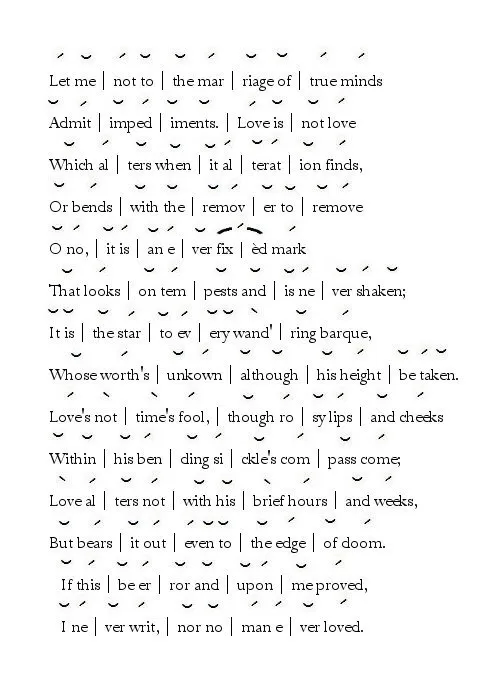 Modern reading of Sonnet 116 line 1
This reading sounds natural to a modern ear, but it overlooks the underlying iambic pattern (unstressed-stressed) that was the bedrock of Shakespeare’s verse. The original author of the source analysis argues that such a reading, while acceptable for free verse, would have been metrically jarring to a 16th-century audience and might obscure Shakespeare’s intended emphasis.
A historically informed reading, guided by the pulse of iambic pentameter (five iambic feet per line), suggests different stresses and, consequently, a different tone.
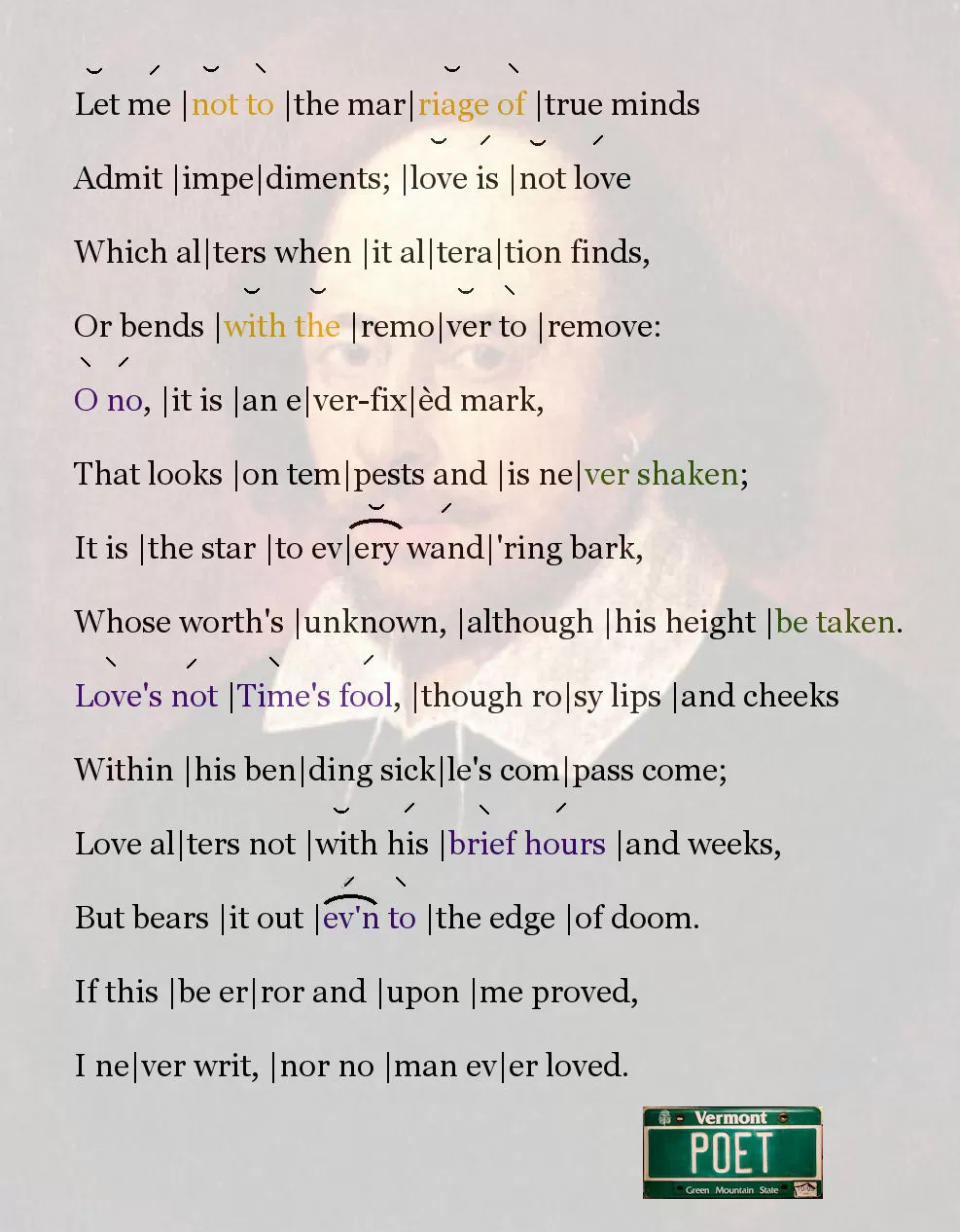 Historically informed scansion of Shakespeare's Sonnet 116
Let’s examine specific instances where attending to the meter shifts our understanding.
Lines 1-2: “Let me not to the marriage of true minds / Admit impediments. Love is not love”
A modern reading might stress “Let” and “not,” giving the first line a declarative or even slightly hesitant feel. However, an iambic reading often stresses “me” and “not,” as seen in some historical analyses.
Let me | not to | the mar– | riage of | true minds |
This emphasis on “me” can make the opening sound almost defensive, as if the speaker is responding to an accusation or challenge: “Don’t accuse me of admitting impediments!” It immediately sets a tone of engagement, suggesting this isn’t just a detached definition but part of a conversation or argument, a common feature in Shakespeare’s dramatic sonnets, many of which are poem of love story or dialogue.
Consider the second line’s conclusion: “Love is not love”.
Modern: Love is not love
Iambic: Love is | not love
Comparison of modern and iambic stress on “Love is not love”, revealing emphasis on the verb ‘is’ in the iambic reading
By stressing the verb “is“, the metrical reading adds significant emphasis to the assertion. It’s not just stating a fact; it’s insisting upon it, perhaps pushing back against a counter-argument that would define love differently.
Line 3: “Which alters when it alteration finds,”
Again, the metrical reading can guide our emphasis.
Modern: Which al– | ters when | it al- | ter- a– | tion finds |
Iambic: Which al- | ters when | it al- | ter- a– | tion finds |
Comparison of stress patterns for “Which alters when”, showing how meter can emphasize ‘when’
Stressing “when” imbues the line with a potential tone of sarcasm or scorn, as noted in the source analysis. It highlights the conditional nature of false love (“Love is not love which alters when…”), contrasting it sharply with the unwavering constancy of true love.
Lines 5-8: The “Ever-Fixed Mark”
“O no; it is an ever-fixéd mark,”
Here, meter helps with pronunciation, a key element for reading older poetry. The accent over the “é” in “fixéd” indicates it should be pronounced as two syllables (“fix-ed”), fitting the iambic pattern, even if modern editions omit the accent.
O no; | it is | an e– | ver- fix– | ed mark |
Iambic scansion of Sonnet 116 line 5, showing the two-syllable pronunciation of ‘fixéd’
Furthermore, line 7, “It is the star to every wand’ring bark,” often sees emphasis on the verb “is” again in an iambic reading (It is | the star…), reinforcing the declaration. This repetition of stressing “is” strengthens the sense of the speaker firmly asserting love’s true nature, potentially in defiance of someone who doubts or misdefines it.
Lines 9-12: Love and Time’s Challenge
“Love’s not Time’s fool, though rosy lips and cheeks
Within his bending sickle’s compass come;
Love alters not with his brief hours and weeks,
But bears it out even to the edge of doom.”
The analysis points to the emphasis on “his” in line 11 (Love al– | ters not | with his | brief hours | and weeks |).
Iambic scansion of Sonnet 116 line 11, illustrating how meter can emphasize ‘his’
This stress accentuates the personification of Time. It’s his fleeting moments, his destructive power, that love defies. It makes the assertion more defiant and dynamic. Line 12 also contains a common elision (“even” often read as “e’en”) to maintain the iambic rhythm, a convention of the period that reinforces the meter’s importance.
Lines 13-14: The Final Couplet
“If this be error and upon me proved,
I never writ, nor no man ever loved.”
The sonnet concludes with a powerful couplet, often seen as summarizing the argument. The source analysis highlights the metrical emphasis in the final line:
I ne– | ver writ, | nor no | man e– | ver loved.
Iambic scansion of the final line of Sonnet 116, showing metrical emphasis on ‘no’
Stressing “no” adds a powerful, almost angry or contemptuous force to the line. It transforms the conclusion from a simple assertion of the truth of his definition into a daring challenge. “If you can prove me wrong,” Shakespeare seems to say, “then it must be true that no man has ever loved,” an impossibility that underlines the absolute certainty of his statement. It’s a rhetorical flourish made more potent by the metrical emphasis. This kind of insightful analysis is key to appreciating the genius behind some of the most famous love poem examples.
Understanding these metrical nuances turns Sonnet 116 from a static definition of love into a vibrant, almost argumentative monologue. It’s the voice of someone not just stating a truth, but defending it, perhaps against common misconceptions or personal doubts raised by another. This “Historically Informed Reading,” attentive to the conventions of Shakespeare’s time, reveals a more passionate, dynamic, and ultimately richer sweet poems experience. By listening to the poem’s meter as well as its words, we gain access to a deeper layer of Shakespeare’s artistry and the enduring power of Sonnet 116.