
When the name William Shakespeare is mentioned, minds often leap to his iconic plays – the tragedies of Hamlet and Macbeth, the comedies of A Midsummer Night’s Dream, or the histories of Henry V. Yet, to focus solely on his dramatic works is to overlook a vast and influential body of work: his poems. Comprising over 150 sonnets and two significant narrative poems, the shakespeare poem is a cornerstone of English literature, offering profound insights, exquisite craftsmanship, and a unique window into the poetic landscape of the Elizabethan era. Exploring these non-dramatic works reveals why Shakespeare earned his title as “The Bard” not just for the stage, but for the page as well.
Contents
 Historical portrait of William Shakespeare, author of renowned poems and sonnets
The Enduring Power of the Shakespearean Sonnet
Shakespeare is perhaps most famous in the realm of poetry for his 154 sonnets. The sonnet form, consisting of fourteen lines with a specific rhyme scheme and meter, was popularized by him in English. The structure that bears his name, the Shakespearean or English sonnet, typically follows an ABAB CDCD EFEF GG rhyme scheme, ending with a rhyming couplet. This form provided Shakespeare with a compact yet flexible canvas to explore complex ideas and emotions.
Consider the opening lines of his first sonnet, which immediately demonstrates his mastery of the form and his thematic concerns:
From fairest creatures we desire increase,
That thereby beauty’s rose might never die,
But as the riper should by time decrease,
His tender heir might bear his memory:
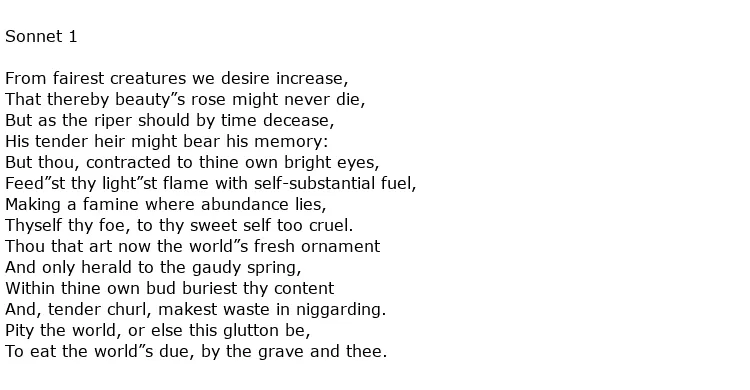 Text of William Shakespeare's Sonnet 1, 'From fairest creatures we desire increase'
Beyond the technical rhyme and structure, the Shakespearean sonnet is known for its development of thought across the quatrains (four-line stanzas) and the concluding couplet. The first three quatrains often present variations on a theme or arguments, while the final couplet provides a resolution, summary, or often a surprising twist. This intricate interplay of form and content is a hallmark of a shakespearean poem in the sonnet form and has influenced countless poets who followed.
Love and Context in Shakespeare’s Poems
While Shakespeare’s sonnets cover a range of themes including time, beauty, mortality, and jealousy, a significant portion, particularly those addressed to the “Fair Youth” and the “Dark Lady,” delve into the complexities of love and desire. It’s important to view these poems within their historical context. During the Elizabethan era, poetry, especially elaborate sonnet sequences, was often written for aristocratic patrons and the courtly audience. Playwriting was still finding its footing as a respectable profession, and poems were often seen as a more elevated or marketable art form among the elite.
Writing on themes like love was commercially viable and culturally appreciated. Thus, many a william shakespeare love poems explores various facets of romantic and platonic affection, sometimes idealized, sometimes starkly realistic. The intricate language and sophisticated emotional exploration made them appealing to the noble society who could afford printed works. You can find many insights into shakespeare about love poems in his extensive sonnet collection.
Beyond the Sonnets: Narrative Poems
Less known than his sonnets are Shakespeare’s two major narrative poems: Venus and Adonis (1593) and The Rape of Lucrece (1594). These longer works, published early in his career when London theatres were closed due to plague, allowed Shakespeare to explore storytelling in a different poetic mode. They are substantial pieces that showcase his ability to sustain complex narratives, develop characters, and employ vivid imagery and rhetorical flourish over extended passages.
Venus and Adonis, dedicated to Henry Wriothesley, Earl of Southampton, is an Ovidian-style mythological poem recounting Venus’s unrequited passion for the beautiful youth Adonis and his tragic death. It’s rich with sensual description and showcases Shakespeare’s early engagement with classical mythology, a common source of inspiration for Elizabethan poets. The poem’s blend of desire and sorrow, life and death, touches upon themes Shakespeare would revisit throughout his career.
The Rape of Lucrece is a darker, more psychologically intense poem based on Roman history. It tells the story of the virtuous Lucretia, her violation by Tarquin, and her subsequent suicide, which traditionally sparked the rebellion that founded the Roman Republic. This poem delves into themes of honor, shame, tyranny, and violence. The intense focus on internal emotional turmoil and moral debate foreshadows the deep psychological exploration found in his later tragedies. Reading shakespeare poems about death and its surrounding circumstances, like this one, provides a fascinating link between his poetic and dramatic sensibilities. The intense focus on suffering and its political consequences connects thematically to plays like Hamlet or Macbeth, demonstrating the range of a shakespeare death poems.
The Enduring Legacy
The shakespeare poem, in all its forms – sonnet or narrative – remains crucial for understanding the full scope of Shakespeare’s genius and the development of English poetry. His sonnets codified a form that remains vital today, and his narrative poems demonstrated the power of poetry for complex storytelling. For aspiring poets, studying his work offers invaluable lessons in form, meter, rhyme, imagery, and emotional expression. For readers, his poems offer not just historical artifacts, but living works of art that continue to resonate with the universal human experience. They are essential reading for anyone seeking to appreciate the foundations upon which much of subsequent English poetry has been built.