
William Shakespeare stands as a towering figure in English literature, universally celebrated for his groundbreaking plays. Yet, to fully appreciate the breadth of his genius, one must delve into his extensive body of poetry – a collection often overshadowed by his dramatic works. With over 150 poems, including his renowned sonnets and two significant narrative poems, Shakespeare’s verse offers a profound exploration of the human condition, demonstrating his mastery of language, form, and emotional depth. Understanding the poem on William Shakespeare requires looking beyond the stage and into the intricate world of his lyrical and narrative verse.
Contents
 Portrait of William Shakespeare, English playwright and poet
The Significance of Shakespeare’s Sonnets
Shakespeare’s collection of 154 sonnets is perhaps his most famous contribution to poetry. These fourteen-line poems follow a specific structure known as the Shakespearean or English sonnet form, characterized by a distinct rhyme scheme: ABAB CDCD EFEF GG. This structure comprises three quatrains (four-line stanzas) followed by a concluding couplet (two lines). The thematic development often progresses through the quatrains, with a “turn” or shift in thought typically occurring before the final couplet, which provides a resolution, summary, or surprising twist.
Beyond the end rhymes, Shakespeare’s sonnets possess a natural verbal rhythm, often achieved through his skillful use of iambic pentameter – a line of ten syllables alternating unstressed and stressed beats. This creates a musicality that enhances the emotional impact of the verse. The subjects explored within these sonnets are vast, encompassing timeless themes such as love, beauty, time, mortality, jealousy, and the power of verse itself to immortalize its subject. Studying these sonnets provides deep insight into Shakespeare’s poetic techniques and his philosophical reflections on life and art. Readers interested in exploring themes like love can find extensive collections online, including various poem on love examples that demonstrate Shakespeare’s lasting influence on this genre.
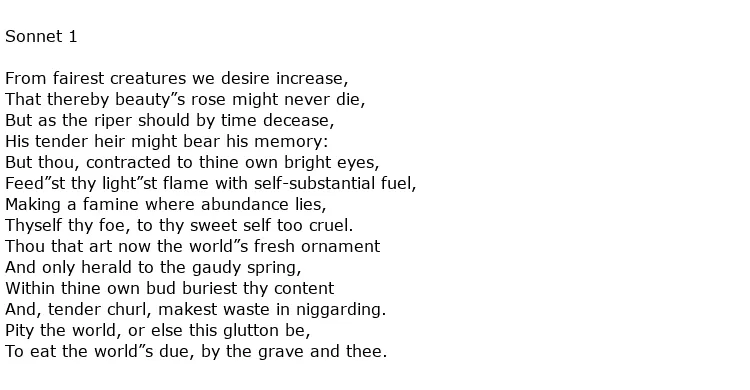 Text of a quatrain from William Shakespeare's Sonnet 1
Context and Themes in Shakespeare’s Verse
To understand the thematic landscape of Shakespeare’s poetry, particularly his sonnets, it is crucial to consider the historical and economic context of the Elizabethan era. Unlike playwriting, which was often seen as less prestigious, poetry, especially commissioned or dedicatory verse, was a valued art form patronized by the nobility and upper class. Parchment was a scarce and expensive material, making each line precious. Poets were often keen to write on subjects that would appeal to potential patrons and the reading public.
During this time, themes of love, beauty, and desire were highly popular and commercially viable. While it might appear at first glance that Shakespeare’s poems, particularly his sonnets, focus predominantly on love compared to the wider thematic range of later poets, this focus was partly a reflection of the market and cultural tastes of the period. However, even within this popular theme, Shakespeare demonstrates remarkable complexity, exploring different facets of romantic love, platonic affection, and the challenging realities of desire and betrayal, contributing significantly to the tradition of romantic poems.
Shakespeare’s Narrative Poems: The Lesser Known Works
Beyond the celebrated sonnets, Shakespeare also penned two significant narrative poems: Venus and Adonis (1593) and The Rape of Lucrece (1594). These longer works are often less discussed than his plays or sonnets but represent an important facet of his early poetic career, showcasing his ability to sustain complex stories in verse.
Venus and Adonis
Venus and Adonis is the earlier of the two, a Ovidian epic poem based on classical mythology. Dedicated to the young Earl of Southampton, a prominent patron, the poem tells the story of the goddess Venus’s unrequited passion for the beautiful youth Adonis, who is more interested in hunting than love. Shakespeare employs lush descriptive language and vivid imagery to explore themes of desire, resistance, and the destructive nature of passion. This poem highlights Shakespeare’s engagement with classical sources and mythology, a feature that recurs throughout his plays and sonnets.
The Rape of Lucrece
The Rape of Lucrece is a darker, more psychologically intense narrative poem focusing on the Roman legend of the virtuous Lucretia, her violation by Tarquin, and her subsequent suicide, which ultimately leads to the overthrow of the Roman monarchy. Composed around the same time as some of his early historical plays, this poem delves into themes of honor, shame, tyranny, and the consequences of violence. Readers familiar with his tragedies like Hamlet or Macbeth can see thematic and psychological complexities in Lucrece that foreshadow his later dramatic masterpieces, suggesting a potential influence of his narrative poetic explorations on his theatrical career.
The Bard’s Enduring Legacy in Poetry
William Shakespeare earned the title “The Bard” not solely for his plays, but for his profound impact across the entire spectrum of English letters, including poetry. His sonnets codified a form that continues to be studied and utilized by poets today, and his narrative poems demonstrated the power of verse to tell compelling stories. For anyone seeking to understand the foundations of English poetry, exploring Shakespeare’s verse is essential.
Many modern poets have drawn inspiration from or directly engaged with Shakespeare’s works, adapting his forms, themes, and language. His ability to blend intricate form with deep emotional and intellectual content remains a benchmark for poets. Studying his sonnets provides a masterclass in poetic structure and concise expression, while his narrative poems offer lessons in descriptive verse and character psychology. To truly appreciate the art of poetry and its historical trajectory, one must certainly lend an earnest ear to the enduring poem on William Shakespeare.