
Theodor Seuss Geisel, universally known as Dr. Seuss, left an indelible mark on literature, primarily through his beloved children’s books. While celebrated for his imaginative stories and distinctive illustrations, his genius is deeply rooted in his mastery of poetry by Dr. Seuss. He wasn’t just a storyteller; he was a linguistic innovator who used rhyme, rhythm, and wordplay to create worlds that captivated readers of all ages. His poetic style is instantly recognizable – a vibrant mix of playful absurdity, catchy meter, and often, surprisingly profound underlying themes.
Contents
Dr. Seuss’s approach to poetry breaks from traditional forms while adhering strictly to its musicality. His use of anapestic meter (two unstressed syllables followed by a stressed one, e.g., “I was walk-ing | in the night“) creates a galloping, energetic pace that is inherently engaging, especially for young listeners. This rhythmic consistency, coupled with his ingenious and often unexpected rhymes, makes his verses incredibly memorable and fun to read aloud. But beyond the technical skill, Seuss’s poetry excels in its ability to explore human emotions and experiences through fantastical lenses.
One prime example of the unique charm and subtle depth found in poetry by Dr. Seuss is the poem “The Pale Green Pants.” It’s a lesser-known piece compared to hits like “The Cat in the Hat” or “Green Eggs and Ham,” yet it perfectly encapsulates his ability to turn a simple, absurd premise into a compelling narrative with emotional resonance.
Let’s delve into “The Pale Green Pants” to see these elements in action:
THE PALE GREEN PANTS
I was walking in the night
And I saw nothing scary.
For I have never been afraid
Of anything. Not very.
 A cartoon image of a character walking at night, suggesting a brave or fearless demeanor.
Then I was deep within the woods
When, suddenly, I spied them.
I saw a pair of pale green pants
With nobody inside them!
 Cartoon illustration showing a pair of pale green pants standing upright in the woods at night.
I wasn’t scared. But, yet, I stopped
What could those pants be there for?
What could a pair of pants at night
Be standing in the air for?
And then they moved? Those empty pants!
They kind of started jumping.
And then my heart, I must admit,
It kind of started thumping.
So I got out. I got out fast
As fast as I could go, sir.
I wasn’t scared. But pants like that
I did not care for. No, sir.
 A cartoon image depicting a pair of walking pale green pants.
After that a week went by.
Then one dark night in Grin-itch
(I had to do an errand there
And fetch some Grin-itch spinach)
Well, I had fetched the spinach.
I was starting back through town
When those pants raced around a corner
And they almost knocked me down!
I lost my Grin-itch spinach
But I didn’t even care.
I ran for home! Believe me,
I had really had a scare!
Now, bicycles were never made
For pale green pants to ride ‘em,
Especially spooky pale green pants
With nobody inside ‘em!
And the NEXT night, I was fishing
For Doubt-trout on Roover River
When those pants came rowing toward me!
Well, I started in to shiver.
 Cartoon image of pale green pants rowing a boat on a river.
And by now I was SO frightened
That, I’ll tell you, but I hate to
I screamed and rowed away and lost
my hook and line and bait, too!
I ran and found a Brickle bush
I hid myself away.
I got brickles in my britches
But I stayed there anyway.
I stayed all night. The next night, too
I’d be there still, no doubt,
But I had to do an errand
So, the next night, I went out.
I had to do an errand,
Had to pick a peck of Snide
In a dark and gloomy Snide-field
That was almost nine miles wide.
I said, “I do not fear those pants
With nobody inside them.”
I said, and said, and said those words.
I said them. But I lied them.
Then I reached inside a Snide bush
And the next thing that I knew,
I felt my hand touch someone!
And I’ll bet that you know who.
Cartoon illustration showing a pair of pale green pants standing upright in the woods at night.
And there I was! Caught in the Snide!
And in that dreadful place
Those spooky, empty pants and I
were standing face to face!
I yelled for help. I screamed. I shrieked.
I howled. I yowled. I cried,
“OH, SAVE ME FROM THESE PALE
GREEN PANTS WITH NOBODY INSIDE!”
But then a strange thing happened.
Why, those pants began to cry!
Those pants began to tremble.
They were just as scared as I!
 Illustration showing the pale green pants appearing scared, with trembling lines.
I never heard such whimpering
And I began to see
That I was just as strange to them
As they were strange to me!
So….
I put my arm around their waist
And sat right down beside them.
I calmed them down.
Poor empty pants
With nobody inside them.
And now, we meet quite often,
Those empty pants and I,
And we never shake or tremble,
We both smile and we say…”Hi!”
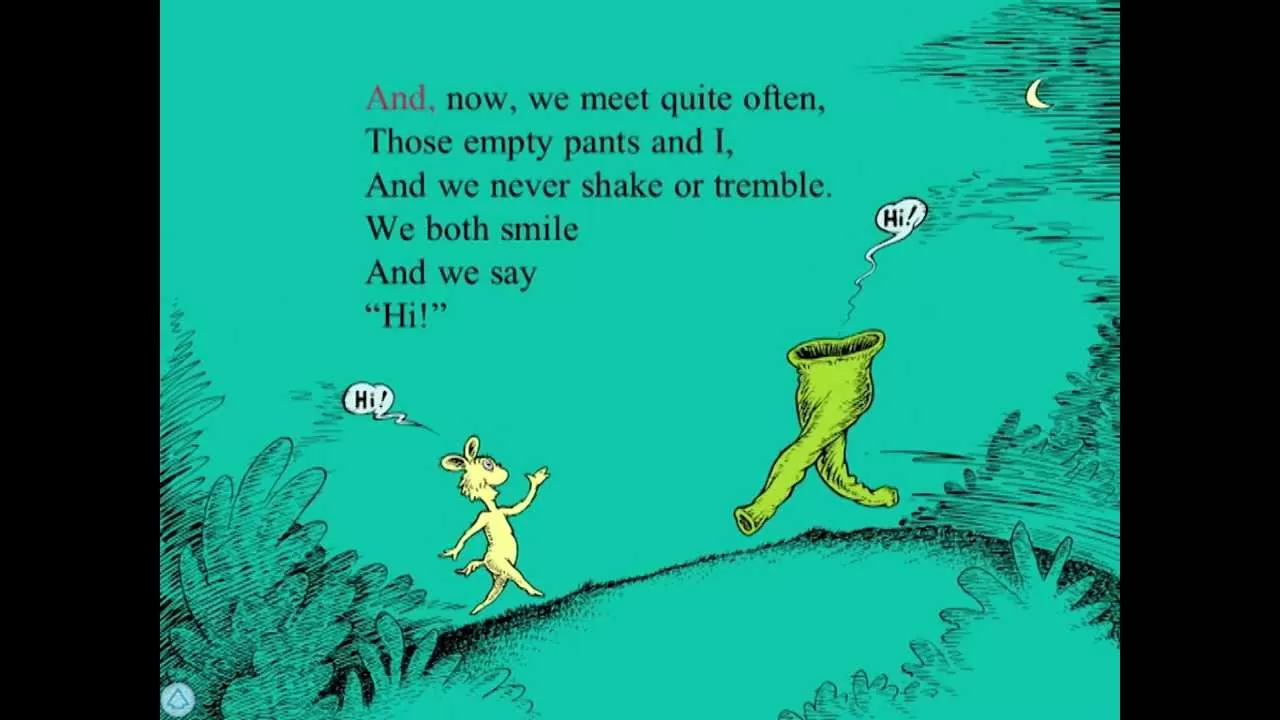 A colorful cartoon image showing a character and the pale green pants smiling and waving, suggesting friendship.
Analyzing “The Pale Green Pants”: Narrative, Fear, and Friendship
At first glance, “The Pale Green Pants” presents a straightforward, albeit peculiar, narrative: a narrator encounters a pair of empty, walking pants and is terrified, only to discover the pants are equally afraid. This culminates in an unexpected friendship. This simple structure allows Seuss to explore several facets of the human (or perhaps, Seuss-ian creature’s) experience.
The poem uses repetition and escalating encounters to build suspense and emphasize the narrator’s growing fear, despite initial claims of bravery. The sequence of events – seeing the pants, encountering them racing through town, finding them rowing on a river, and finally being trapped with them – mirrors the way irrational fears can sometimes feel like they are following you. The whimsical details, like “Grin-itch spinach” and “Doubt-trout on Roover River,” ground the absurdity in a specific, albeit fictional, world that is distinctly Seuss.
The Power of Perspective in Seuss’s Verse
The turning point of the poem lies in the revelation that the pants are also scared. This moment transforms the narrative from a tale of a narrator being haunted by a strange entity to a story about mutual fear and misunderstanding. It teaches a valuable lesson, characteristic of much of poetry by Dr. Seuss: things that seem frightening from a distance or without understanding can become less so, or even friendly, upon closer inspection and empathy. The narrator’s realization, “That I was just as strange to them / As they were strange to me!”, is the core message – fear often stems from perceiving the “other” as alien or threatening, a theme explored in many of Seuss’s works dealing with tolerance and acceptance.
The resolution is typically Seuss: simple, heartwarming, and slightly absurd. The narrator doesn’t defeat the fear or the pants; they embrace them. The final image of the narrator and the pants meeting often and greeting each other with a smile is a powerful, child-friendly metaphor for overcoming prejudice and finding connection in unexpected places.
Delving into themes like overcoming fear is common in Seuss’s work, often hidden beneath layers of fun and fantasy. Exploring poems about such deep emotions can lead us to strong love deep love poems for him, revealing how poetry can articulate the spectrum of human feeling, from the whimsical fear of pale green pants to the profound depths of romantic connection.
Seuss’s Poetic Technique in “The Pale Green Pants”
Beyond the narrative and themes, “The Pale Green Pants” showcases Seuss’s technical brilliance. The consistent rhythm pulls the reader along, mimicking the feeling of being pursued or rushing away. The rhymes are inventive and playful (“scary”/”very”, “spied them”/”inside them”, “jumping”/”thumping”). He isn’t afraid to use internal rhymes or near rhymes, adding to the unpredictable fun of the language. The personification of the pants is key, making them characters with emotions (fear, trembling, crying) despite having no body inside them. This simple yet effective literary device allows the central theme of mutual fear to land with emotional impact.
Compared to poems often considered poems most famous, Seuss’s work might seem less complex on the surface. However, his genius lies in this apparent simplicity, making profound ideas accessible through engaging language and unforgettable imagery. His contribution redefined what children’s literature, and indeed poetry, could be, proving that verse can be both educational and purely joyful.
The Lasting Appeal of Dr. Seuss’s Poetry
“The Pale Green Pants,” like much of poetry by Dr. Seuss, resonates because it taps into universal feelings – the initial fear of the unknown, the irrationality of phobias, and the surprising comfort found in understanding and connection. While ostensibly for children, the lessons embedded in his simple rhymes hold truth for adults too. His poems encourage imagination, critical thinking, and empathy, all wrapped in packages of pure, unadulterated fun.
From contemplating spooky pants to celebrating holidays with christmas poems or national pride with poems about 4th of july, poetry offers countless ways to explore our world and feelings. Dr. Seuss carved out a unique space within this art form, proving that serious themes can be approached with lightness and humor, and that even the most peculiar subjects, like empty pale green pants, can inspire stories that teach us about ourselves and the world around us. His legacy endures because his poetry speaks directly to the heart, encouraging readers to look beyond the surface and find the unexpected connections that make life both strange and wonderful. Even complex structures like the example sonnet poem serve different purposes than Seuss’s rhythmic narratives, highlighting the vast diversity and potential within the world of poetry.
In conclusion, poetry by Dr. Seuss is far more than just simple rhymes for kids. It is a masterclass in using language playfully to explore complex emotions, build engaging narratives, and impart timeless lessons about fear, perspective, and friendship. “The Pale Green Pants” stands as a charming testament to his unique poetic voice and his unparalleled ability to find wonder and wisdom in the wonderfully weird.