
The Romantic era (roughly 1785-1832) stands as a transformative period in English literature, celebrated for its emphasis on emotion, individualism, the power of nature, and the sublime. When discussing poetry from the Romantic era, figures like William Wordsworth, Samuel Taylor Coleridge, William Blake, Lord Byron, John Keats, and Percy Bysshe Shelley often dominate the conversation. These “Big Six” indeed produced foundational works that shaped the movement’s legacy. However, focusing solely on this male-centric canon risks overlooking the diverse contributions of other poets, including significant female writers who explored similar themes through unique lenses shaped by their distinct experiences. Recognizing these broader voices provides a richer, more complete understanding of Romanticism’s true scope and impact.
Contents
The traditional view of Romanticism sometimes portrays it as a primarily male literary movement, partly because many of the grand, adventurous experiences depicted in the poetry – like solitary encounters with vast, untamed landscapes – were more readily accessible to wealthy men of the time. Women, often constrained by societal expectations and domestic responsibilities, experienced the world differently. Yet, they were far from silent. They adapted Romantic themes and aesthetics to reflect their realities, demonstrating that the emotional intensity and imaginative depth characteristic of the era were not confined to mountain peaks or grand tours. Exploring their work alongside the canonical poets reveals fascinating insights into how shared literary movements are filtered through individual, gendered, and social experiences. Delving into this period offers a chance to appreciate the full spectrum of Romantic expression. For those interested in the emotional power of verse, exploring [romantic poems for bf] or other forms of heartfelt expression can offer a personal connection to poetry’s enduring ability to capture feeling, a quality central to the Romantic spirit.
Unpacking Key Themes in Romantic Poetry
Romantic poetry from the Romantic era is characterized by several recurring themes and concerns. While explored differently by various poets, these elements form the backbone of the movement’s artistic and philosophical outlook. Four particularly prominent themes include: The Sublime, Nature, Melancholy, and the Figure of the Poet.
The Sublime: Awe, Terror, and Power
Perhaps the most discussed concept linked to Romanticism is the Sublime. Edmund Burke, in his A Philosophical Enquiry into the Origin of Our Ideas of the Sublime and Beautiful (1757), defined the sublime in terms of experiences that evoke a sense of awe, terror, or danger, yet without actual immediate threat. It is “productive of the strongest emotion which the mind is capable of feeling.” For Romantic poets, the natural world was a primary source of the sublime. Witnessing towering mountains, vast oceans, or violent storms could inspire this feeling of overwhelming power, dwarfing the individual observer and hinting at forces beyond human control or comprehension.
This experience was often gendered by contemporary thought. Burke himself associated the sublime with masculine traits (strength, magnitude, terror) and beauty with feminine ones (smallness, smoothness, delicacy). This categorization, coupled with women’s limited access to the wild, untamed landscapes that provided the most common examples of the natural sublime in poetry, seemed to exclude women from experiencing, and thus writing about, the sublime in the same way as their male counterparts. However, women poets found alternative avenues to explore this powerful concept.
The Domestic Sublime: Finding Awe in the Everyday
Denied easy access to Alpine peaks, women poets turned their insightful gaze inward, exploring the domestic sphere and everyday life as sources of profound emotion and even sublime feeling. This approach has been termed the “domestic Romanticism” or the “domestic sublime.” It takes the mundane and reveals its potential for terror, awe, or intense emotional resonance.
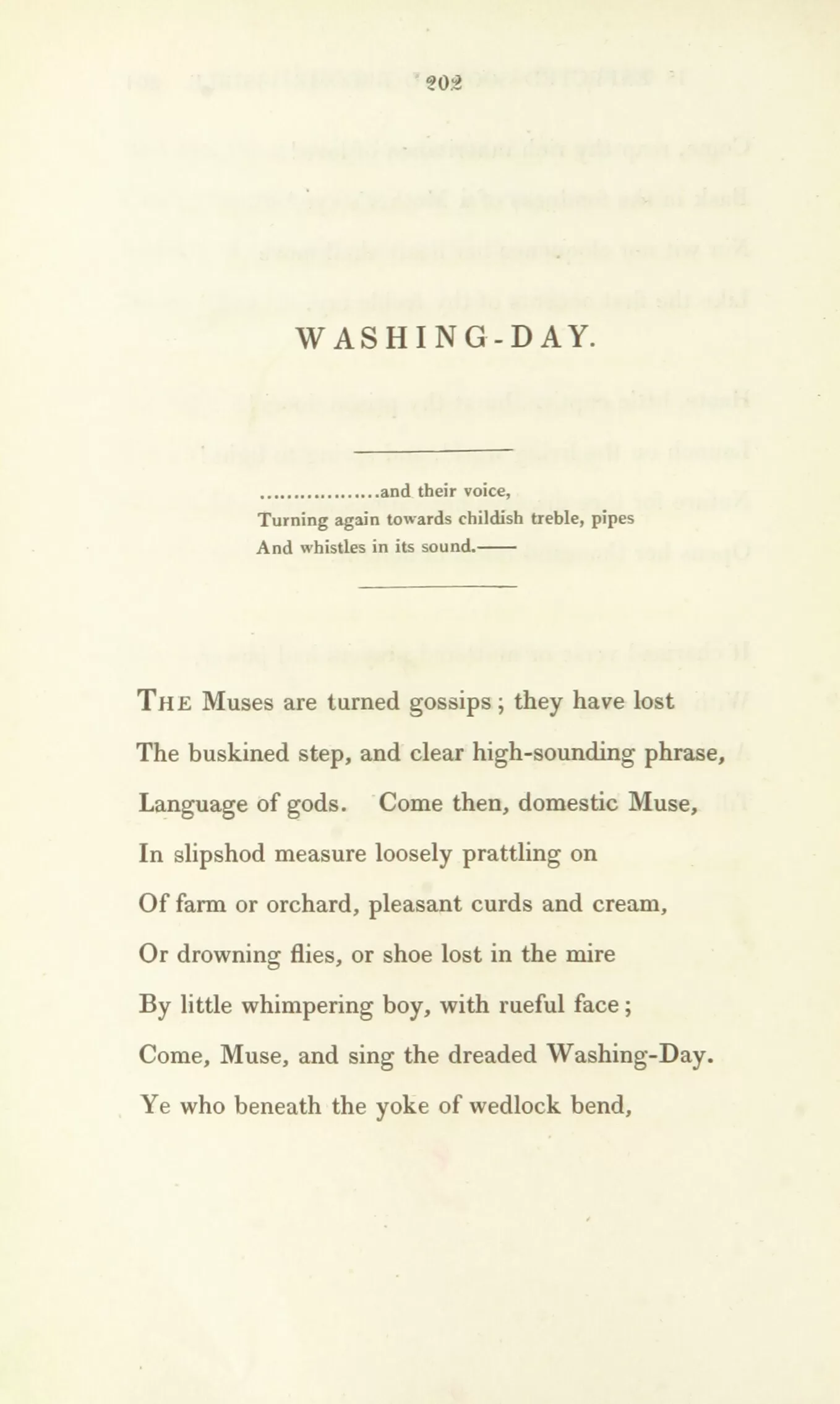 Historical illustration depicting women doing laundry, reflecting the domestic themes explored in women's Romantic poetry.
Anna Laetitia Barbauld’s poem “Washing-Day” is a masterful example. By invoking the Muses at the poem’s opening – “Come, Muse; and sing the dreaded Washing-Day” – Barbauld elevates a routine household chore to epic or even tragic significance. The poem captures the sense of dread and anxiety associated with this laborious task, while also recalling the awe it inspired in childhood.
Come, Muse; and sing the dreaded Washing-Day;
The poem’s opening lines immediately signal an elevation of the domestic to a subject worthy of elevated verse.
The passage of time is marked by the relentless cycle of washing-days – “Which week, smooth sliding after week, brings on/Too soon” – instilling a sense of anxiety about life slipping away. Yet, interwoven with this dread is a surprising thrill, a childhood memory of the day striking “awe into her.” This mix of terror, excitement, wonder, and discomfort aligns remarkably with Burke’s description of the sublime, experienced not on a mountaintop, but within the confines of the home. Barbauld reveals a sublime accessible through the rituals and realities of women’s lives.
Joanna Baillie also explored the sublime, often in more traditionally natural settings, but with a distinct intensity. Her poem “Thunder” captures the terrifying power of a storm, aligning closely with the Burkean ideal of the sublime in nature.
Th’ advancing clouds sublimely roll’d on high,
Deep in their pitchy volumes clothe the sky;
Like hosts of gath’ring foes array’d in death,
Dread hangs their gloom upon the earth beneath,
It is thy hour: the awful deep is still,
And laid to rest the wind of ev’ry hill.
This passage vividly portrays the menacing grandeur of storm clouds, evoking terror through martial imagery (“hosts of gath’ring foes”) and emphasizing nature’s stillness before unleashing its power. Baillie demonstrates that while women might access the sublime differently, they were equally capable of capturing its essence in verse.
Nature as a Source of Inspiration and Connection
Nature was a central muse for many Romantic poets, offering solace, inspiration, and a space for philosophical reflection. This focus wasn’t merely descriptive; it often involved a deep, reciprocal relationship between the human observer and the natural world. Charlotte Smith, known for her elegiac sonnets, frequently explored this bond. Her poem “The Glow Worm” presents an unusual subject, a small creature discovered by a child, symbolizing the potential for wonder found in the natural world and the developing connection between humanity and its environment.
He sees before his inexperienced eyes
The brilliant Glow-worm, like a meteor, shine
On the turf-bank;—amazed, and pleased, he cries,
“Star of the dewy grass!—I make thee mine!”—
While the poem touches on the child’s limited understanding and the transience of the glow-worm’s magic, it nonetheless captures the Romantic delight in discovery and the inherent beauty found in nature, however small. This contrasts with the overwhelming power of nature in sublime depictions, highlighting the varied ways the natural world featured in Romantic poetry. For those who appreciate poetry’s ability to connect with deep emotion, whether personal or universal, exploring themes like solace in nature or the complexities of relationships, as found in [romantic love poems], showcases the vast emotional landscape poetry can navigate.
Mary Robinson’s “Ode to Spring” embodies a more traditional Romantic engagement with nature, using personification and classical allusions (Hellenism was another Romantic interest) to celebrate the season’s vitality. Her repetition and joyous tone mirror the enthusiasm found in Wordsworth’s or Keats’s nature poetry.
Melancholy and the Poetic Psyche
Melancholy, a state of deep sadness or pensive reflection, was another fertile ground for Romantic exploration. This often tied into themes of isolation, loss, or a yearning for the unattainable. Poets used it to delve into the depths of human emotion and the complexities of the inner self.
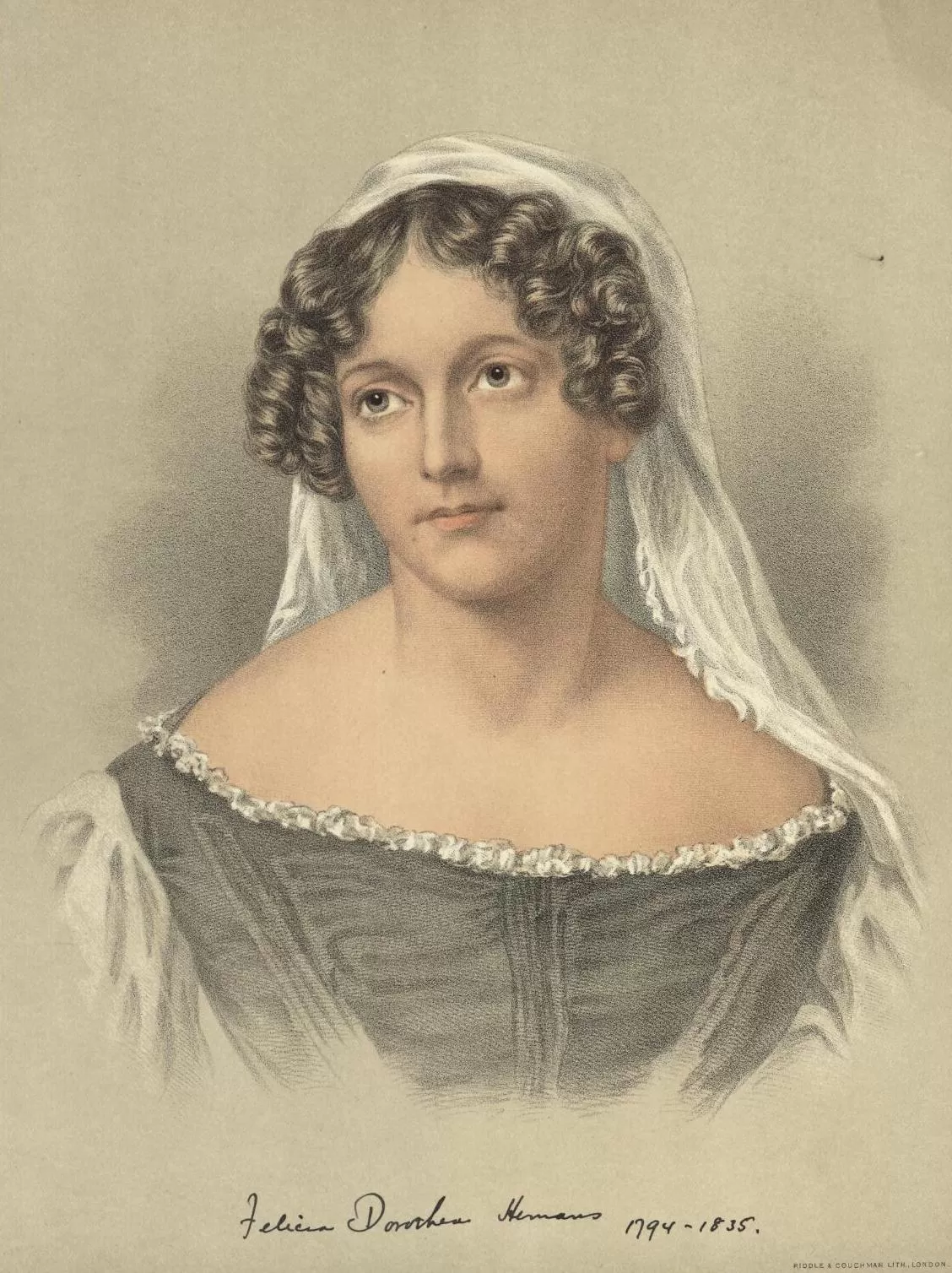 Portrait of Romantic poet Felicia Hemans, known for works exploring themes of melancholy and confinement.
Felicia Hemans’s “The Last Song of Sappho” is a poignant example. Depicting the legendary Greek poet Sappho isolated on a rock, contemplating her fate, the poem captures a profound sense of desolation and longing for home. Despite her despair, Sappho maintains a sense of selfhood, acknowledging her poetic legacy. The poem culminates in her fatal leap, seeking freedom from isolation in death. Hemans frequently returned to themes of female suicide, reflecting her own feelings of confinement and the tension between domestic life and artistic ambition. The palpable sorrow in “The Last Song of Sappho” exemplifies the Romantic engagement with deep, often painful, emotion.
The nightingale became a potent symbol of melancholy in Romantic poetry. Its solitary, mournful song sung in the darkness resonated with feelings of loneliness and sorrow. Keats’s “Ode to a Nightingale” is perhaps the most famous instance, but Charlotte Smith also used the motif effectively. In her sonnet “To a Nightingale,” she initially addresses the bird as “poor, melancholy bird” but shifts to expressing her own longing for the nightingale’s freedom, feeling caged by societal constraints unlike the bird, despite its sadness. Smith’s repeated use of the nightingale across multiple sonnets underscores its significance as a symbol for the Romantic exploration of sorrow and confinement.
The Figure of the Poet: Archetype and Critique
The Romantic era also saw the development of a distinct archetype for the Poet: a sensitive, often solitary and melancholic figure, deeply attuned to nature and emotion, possessing unique imaginative power. Wordsworth famously described the poet in his Preface to Lyrical Ballads as a “man speaking to men,” emphasizing his vision of poetry rooted in the “real language of men,” which inadvertently reinforced the idea of Romanticism as a male domain.
Mary Robinson engaged directly with this archetype in poems like “The Poet’s Garret.” While seemingly describing the traditional “poor poet” figure residing in a humble attic, Robinson’s tone carries a subtle, perhaps satirical, edge.
Come, sportive fancy! come with me, and trace
The poet’s attic home! the lofty seat
Of the heav’n-tutor’d nine! the airy throne
Of bold imagination, rapture fraught
Above the herds of mortals…
These opening lines, while seemingly elevating the poet’s space, can also be read with a hint of irony, questioning the often-performative nature of this Romantic persona. Robinson, a successful poet herself, writes about a figure that doesn’t fully represent her experience, implicitly critiquing the narrowness of the dominant archetype. She touches upon the stereotype of the poet’s “madness” and their reliance on “potent spirits,” painting a vivid, perhaps mocking, portrait of the tortured male artist.
Mary Alcock also offered a critique of the male Romantic poet’s perceived arrogance in her poem “To a Certain Author, on His Writing a Prologue, wherein he Describes a Traveller. Frozen in a Snow Storm.” Her opening lines, “No more let poets vainly boast/Their fine descriptive art,” directly challenge the Romantic poet’s self-proclaimed mastery, suggesting their technical skill often fails to “warm the heart” in the way a true “Bard” can. Both Robinson and Alcock, by examining and critiquing the prevalent image of the male poet, carved out space for their own voices and perspectives within the movement, pushing back against the notion that this sensitive, imaginative figure could only be male.
Broadening Our View of Romantic Poetry
Exploring these themes through the work of both canonical male poets and often-overlooked female poets reveals the true richness and complexity of poetry from the Romantic era. While Wordsworth, Keats, and Shelley gave us breathtaking visions of the sublime in nature and profound explorations of emotion, poets like Barbauld, Baillie, Smith, Hemans, Robinson, and Alcock expanded the boundaries of Romanticism. They demonstrated that the movement’s core concerns – imagination, emotion, nature, society, the individual’s place in the world – could be explored from diverse vantage points, finding the sublime in a washing-day or critiquing the very archetypes being created. The enduring power of poetry lies in its ability to connect with universal feelings and experiences, whether through grand landscapes or intimate domestic scenes, offering a window into the many ways the human heart responds to the world. Just as [poem to a man you love] speaks to a specific, deep connection, Romantic poetry, in its entirety, speaks to the vast range of human emotional and intellectual life.
To truly appreciate Romantic poetry, we must move beyond the traditional “Big Six” and engage with the wider chorus of voices that contributed to this dynamic literary period. By doing so, we gain a deeper understanding of the era itself and recognize the enduring power and versatility of poetry to capture the full spectrum of human experience, from the awe-inspiring sublime to the profound depths of melancholy and the quiet dignity of everyday life.