
William Shakespeare, the Bard of Avon, remains unparalleled in his ability to dissect the human condition. While renowned for his tragedies, comedies, and historical dramas, his exploration of love in its myriad forms is perhaps one of his most enduring legacies. Through the voices of his characters, Shakespeare gives us profound insights into the passion, pain, joy, and despair that love can bring. Some of the most powerful expressions of these emotions are found in his monologues – moments when a character bares their soul, offering us an intimate glimpse into the tumultuous landscape of the heart. These shakespeare monologues about love are not just poetic exercises; they are windows into the very essence of loving and being loved.
Contents
- Passion and Declaration: Romeo and Juliet
- Romeo’s Balcony Invocation (Act 2, Scene 2)
- Juliet’s Heartfelt Plea (Act 2, Scene 2)
- A Tragic Farewell (Romeo, Act 5, Scene 3)
- Love’s Complexities and Consequences
- Unrequited Longing: Helena in A Midsummer Night’s Dream (Act 1, Scene 1)
- Suffering in Silence: Viola in Twelfth Night (Act 2, Scene 4)
- A Hero’s Courtship: Othello in Othello (Act 1, Scene 3)
- Love’s Tragic End: Othello in Othello (Act 5, Scene 2)
- Immortal Longings: Cleopatra in Antony and Cleopatra (Act 5, Scene 2)
- Conclusion
In this article, we delve into some of Shakespeare’s most iconic monologues centered around the theme of love. We will explore the context, analyze the language, and uncover the emotional depth that makes these speeches resonate across centuries. From the dizzying heights of new romance to the devastating lows of loss and betrayal, Shakespeare’s monologues capture the timeless power and complexity of love.
Passion and Declaration: Romeo and Juliet
Perhaps no play is more synonymous with passionate, youthful love than Romeo and Juliet. The monologues within this tragedy offer some of the most famous and fervent declarations in literary history, capturing the immediate, overwhelming nature of first love.
Romeo’s Balcony Invocation (Act 2, Scene 2)
When Romeo first sees Juliet on her balcony, unaware of his presence, he delivers a monologue that is a pure outpouring of infatuation and adoration.
But, soft! what light through yonder window breaks?
It is the east, and Juliet is the sun.
Arise, fair sun, and kill the envious moon,
Who is already sick and pale with grief,
That thou her maid art far more fair than she:
Be not her maid, since she is envious;
Her vestal livery is but sick and green
And none but fools do wear it; cast it off.
She speaks, yet she says nothing: what of that?
Her eye discourses; I will answer it.
I am too bold, 'tis not to me she speaks:
Two of the fairest stars in all the heaven,
Having some business, do entreat her eyes
To twinkle in their spheres till they return.
What if her eyes were there, they in her head?
The brightness of her cheek would shame those stars,
As daylight doth a lamp; her eyes in heaven
Would through the airy region stream so bright
That birds would sing and think it were not night.
See, how she leans her cheek upon her hand!
O! that I were a glove upon that hand,
That I might touch that cheek.
This monologue uses celestial imagery extensively, immediately elevating Juliet to a divine status. She is the “sun,” far surpassing the moon (Rosaline, perhaps, or even Diana, goddess of the moon and chastity, which Romeo rejects). His language is hyperbolic, reflecting the all-consuming nature of his sudden love. The desire to be a “glove upon that hand” shows a yearning for physical closeness that is both tender and intense. It’s a powerful depiction of love at first sight, expressed with a breathless wonder. Readers interested in this kind of powerful romantic language might also enjoy other [poem on love].
Juliet’s Heartfelt Plea (Act 2, Scene 2)
Unaware that Romeo is listening, Juliet’s famous balcony monologue reveals her own feelings, wrestling with the constraints of their families’ feud.
O Romeo, Romeo! wherefore art thou Romeo?
Deny thy father and refuse thy name;
Or, if thou wilt not, be but sworn my love,
And I'll no longer be a Capulet.
Though brief here, the full monologue extends to question the importance of names and identity in the face of true affection. Her willingness to give up her name, her family, her very identity, for Romeo highlights the depth of her love and her belief that their love transcends the arbitrary labels that divide them. It is a bold statement for the time, challenging societal structures in the name of personal connection. This speech perfectly captures the internal conflict caused by forbidden love.
 A silhouette illustration of Romeo and Juliet on a balcony under a moonlit sky
A Tragic Farewell (Romeo, Act 5, Scene 3)
Before taking his own life in Juliet’s tomb, Romeo delivers a final monologue that speaks to his enduring love, even in the face of death.
In faith, I will.—Let me peruse this face.
Mercutio's kinsman, noble County Paris!
What said my man, when my betossed soul
Did not attend him as we rode? I think
He told me Paris should have married Juliet.
Said he not so? or did I dream it so?
Or am I mad, to think it so? O, give me thy hand,
One writ with me in sour misfortune's book!
I'll bury thee in a triumphant grave.
A grave? O no! a lantern, slaughter'd youth,
For here lies Juliet, and her beauty makes
This vault a feasting presence full of light.
Death, lie thou there, by a dead man interr'd.
[Laying Paris in the tomb]
How oft when men are at the point of death
Have they been merry! which their keepers call
A lightning before death: O, how may I
Call this a lightning? O my love! my wife!
Death, that hath suck'd the honey of thy breath,
Hath had no power yet upon thy beauty:
Thou art not conquer'd; beauty's ensign yet
Is crimson in thy lips and in thy cheeks,
And death's pale flag is not advanced there.—
Tybalt, liest thou there in thy bloody sheet?
O, what more favour can I do to thee,
Than with that hand that cut thy youth in twain
To sunder his that was thine enemy?
Forgive me, cousin! Ah, dear Juliet,
Why art thou yet so fair? Shall I believe
That unsubstantial Death is amorous,
And that the lean, abhorred monster keeps
Thee here in dark to be his paramour?
For fear of that, I still will stay with thee;
And never from this palace of dim night
Depart again: here, here will I remain
With worms that are thy chamber-maids; O, here
Will I set up my everlasting rest,
And shake the yoke of inauspicious stars
From this world-wearied flesh.—Eyes, look your last!
Arms, take your last embrace! and, lips, O you
The doors of breath, seal with a righteous kiss
A dateless bargain to eternity!
Come, bitter conduct, come, unsavoury guide!
Thou desperate pilot, now at once run on
The dashing rocks thy sea-sick weary bark!
Here's to my love! [Drinks] O true apothecary!
Thy drugs are quick.—Thus with a kiss I die.
This monologue is a culmination of grief and unwavering devotion. Romeo’s contemplation of Juliet’s unchanging beauty in death leads him to fear that Death itself is in love with her. His decision to stay with her forever, even in death, underscores the depth of his bond. The language moves from despair to a kind of grim resolve, framing his suicide as a final act of loyalty and love. It’s a heart-wrenching moment that cements their tragic love story. These speeches are among the most famous [shakespear poems] in dramatic form.
Love’s Complexities and Consequences
Beyond the intense, pure expressions of love in Romeo and Juliet, Shakespeare explores love in more varied and complicated contexts.
Unrequited Longing: Helena in A Midsummer Night’s Dream (Act 1, Scene 1)
In the whimsical world of A Midsummer Night’s Dream, Helena’s monologue about her unrequited love for Demetrius captures the pain and self-pity that can accompany love that is not returned.
How happy some o'er other some can be!
Through Athens I am thought as fair as she.
But what of that? Demetrius thinks not so;
He will not know what all but he do know.
And as he errs, doting on Hermia's eyes,
So I, admiring of his qualities.
Things base and vile, holding no quantity,
Love can transpose to form and dignity:
Love looks not with the eyes, but with the mind;
And therefore is winged Cupid painted blind:
Nor hath love's mind of any judgment taste;
Wings, and no eyes, figure unheedy haste:
And therefore is love said to be a child,
Because in choice he is so oft beguil'd.
As waggish boys in game themselves forswear,
So the boy Love is perjured every where:
For ere Demetrius look'd on Hermia's eyne,
He hail'd down oaths that he was only mine;
And when this hail some heat from Hermia felt,
So he dissolved, and showers of oaths did melt.
I will go tell him of fair Hermia's flight:
Then to the wood will he to-morrow night
Pursue her; and for this intelligence
If I have thanks, it is a dear expense:
But herein mean I to enrich my pain,
To have his sight thither and back again:
Helena articulates the well-known truth that “Love looks not with the eyes, but with the mind,” acknowledging how love can make the beholder blind to flaws or see virtues where none exist. Her despair is palpable as she laments Demetrius’s blindness to her own worth, consumed instead by infatuation with Hermia. The monologue ends with her desperate, ill-fated plan to win his favour by betraying her friend, highlighting the irrational actions love can inspire, particularly unrequited love.
 A Renaissance-style painting depicting a pensive woman, likely Helena from A Midsummer Night's Dream.
Suffering in Silence: Viola in Twelfth Night (Act 2, Scene 4)
In Twelfth Night, the disguised Viola, serving Duke Orsino whom she has fallen in love with, speaks of a fictional sister who loved a man with a similar silent devotion. This monologue, while ostensibly about another, is a thinly veiled reflection of her own painful, hidden love.
She never told her love,
But let concealment, like a worm i' the bud,
Feed on her damask cheek: she pined in thought;
And with a green and yellow melancholy
She sat like patience on a monument,
Smiling at grief. Was not this love indeed?
We men may say more, swear more: but indeed
Our shows are more than will; for we still prove
Much in our vows, but little in our love.
Though short, this speech is incredibly moving. It paints a vivid picture of love that is hidden and consuming, causing physical and emotional decay (“like a worm i’ the bud”). Viola, speaking as Cesario, uses this tale to contrast what she portrays as men’s fleeting declarations of love with the deep, enduring, and often silent suffering of women’s affections. It’s a poignant moment capturing the quiet pain of loving someone who cannot see your true self. It resonates with anyone who has had to conceal their true feelings for fear of rejection or complication. This theme relates to expressing deep affection, much like crafting [i love you poems girlfriend].
A Hero’s Courtship: Othello in Othello (Act 1, Scene 3)
Othello, the Moorish general, is not a character often associated with romantic monologues in the vein of Romeo. However, his account to the Duke and senators of how he wooed Desdemona is a powerful depiction of winning love through shared experiences, admiration, and storytelling.
Her father loved me, oft invited me;
Still question'd me the story of my life,
From year to year, the battles, sieges, fortunes,
That I have pass'd.
I ran it through, even from my boyish days,
To the very moment that he bade me tell it:
Wherein I spoke of most disastrous chances,
Of moving accidents by flood and field
Of hair-breadth scapes i' the imminent deadly breach,
Of being taken by the insolent foe
And sold to slavery, of my redemption thence
And portance in my travels' history:
Wherein of antres vast and deserts idle,
Rough quarries, rocks and hills whose heads touch heaven,
It was my hint to speak,—such was my process;—
And of the Cannibals that each other eat,
The Anthropophagi and men whose heads
Do grow beneath their shoulders. This to hear
Would Desdemona seriously incline:
But still the house affairs would draw her thence;
Which ever as she made great haste return'd
And with a greedy ear devour'd my discourse:
Which I observing, oft took occasion
To find her in her chamber, and I did consent
In faith, 'twas strange, 'twas passing strange,
'Twas pitiful, 'twas wondrous pitiful:
She wish'd she had not heard it, yet she wish'd
That heaven had made her such a man: she thank'd me,
And bade me, if I had a friend that loved her,
I should but teach him how to tell my story,
And that would woo her. Upon this hint I spake:
She loved me for the dangers I had pass'd,
And I loved her that she did pity them.
This only is the witchcraft I have used:
Here comes the lady; let her witness it.
This is not a monologue about the feeling of love itself, but rather a narrative of how love was forged. Othello presents his life story as the instrument of his courtship, highlighting how shared wonder and empathy (“She loved me for the dangers I had pass’d, / And I loved her that she did pity them”) formed the foundation of their bond. He counters accusations of witchcraft by presenting the honest truth of their mutual admiration, framing their love as a natural response to shared humanity and compelling narrative. It offers a fascinating perspective on how love can bloom from respect and shared vulnerability, demonstrating a different dimension of [poem about love].
Love’s Tragic End: Othello in Othello (Act 5, Scene 2)
Othello’s final monologue before taking his own life is a complex mix of love, regret, and the acknowledgment of his tragic mistake fueled by jealousy.
Soft you; a word or two before you go.
I have done the state some service, and they know't;—
No more of that.—I pray you, in your letters,
When you shall these unlucky deeds relate,
Speak of me as I am; nothing extenuate,
Nor set down aught in malice: then must you speak
Of one that loved not wisely but too well;
Of one not easily jealous, but, being wrought,
Perplexed in the extreme; of one whose hand,
Like the base Indian, threw a pearl away
Richer than all his tribe; of one whose subdu'd eyes,
Albeit unused to the melting mood,
Drop tears as fast as the Arabian trees
Their med'cinable gum. Set you down this;
And say besides, that in Aleppo once,
Where a malignant and a turban'd Turk
Beat a Venetian and traduc'd the state,
I took by the throat the circumcised dog,
And smote him, thus.
This speech is a chilling and poignant conclusion to Othello’s journey. He reflects on his actions, famously describing himself as one “that loved not wisely but too well.” The monologue grapples with the devastating consequences of his love being twisted into destructive jealousy. The image of throwing away a “pearl / Richer than all his tribe” vividly captures the immense value he placed on Desdemona and the magnitude of his loss. It is a powerful depiction of the dark side of love – how easily it can be corrupted and lead to ruin if not tempered with wisdom and trust.
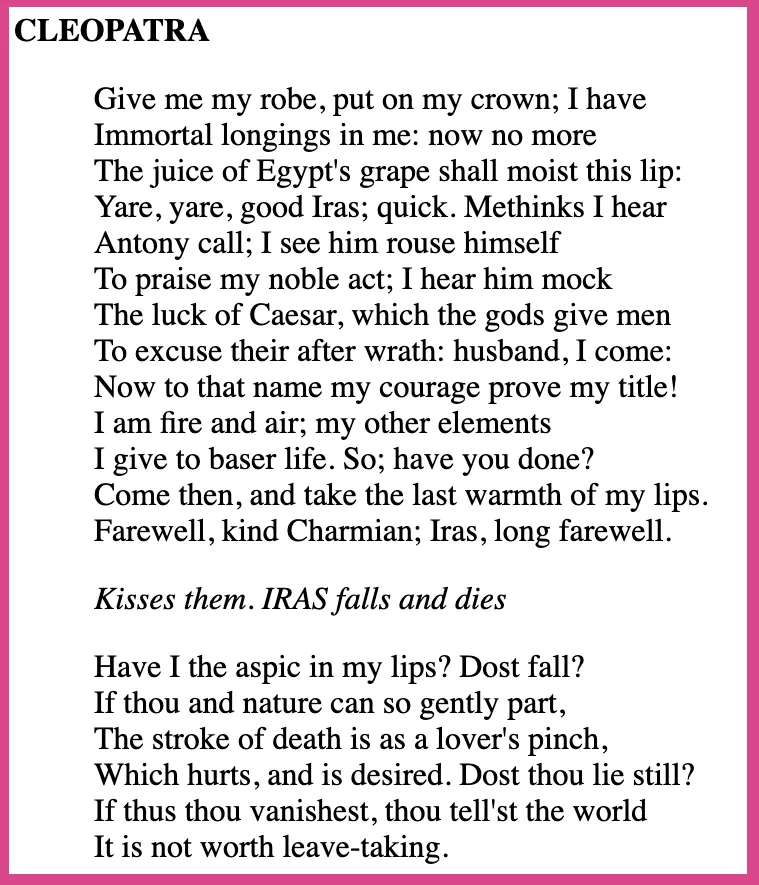
Immortal Longings: Cleopatra in Antony and Cleopatra (Act 5, Scene 2)
Cleopatra, facing capture by Octavian after Antony’s death, prepares for her own end. Her final monologue is a defiant, majestic speech that speaks to her enduring love for Antony and her desire to reunite with him in the afterlife, preserving her dignity against Roman conquest.
Give me my robe, put on my crown; I have
Immortal longings in me: now no more
The juice of Egypt's grape shall moist this lip:—
Yare, yare, good Iras; quick.—Melt Egypt into Nile!
And the high Roman fashion: with dispatch.
Though brief, this is arguably one of the most iconic lines about love and death in Shakespeare. Cleopatra’s decision to kill herself is intertwined with her love for Antony and her identity as a powerful queen. Her “Immortal longings” are for reunion with her beloved Antony in a realm beyond earthly defeat. She dresses in her regal attire, facing death not as a prisoner, but as a sovereign rejoining her partner. It’s a powerful statement of love that defies political reality and embraces an eternal connection.
 A classic painting depicting Cleopatra in regal attire, holding an asp.
Conclusion
Shakespeare’s monologues on love traverse the entire spectrum of human emotion. From the idealistic passion of Romeo and Juliet to the silent suffering of Viola, the tragic ruin of Othello, and the defiant devotion of Cleopatra, these speeches offer unparalleled insights into the nature of love. They demonstrate Shakespeare’s mastery of language, his ability to capture the nuances of the heart, and his enduring relevance. Studying these monologues provides not only a deeper appreciation for his work but also a timeless understanding of the complex, powerful, and often contradictory force that is love. Whether you are an actor seeking [easy shakespeare monologues] to perform or a reader exploring the depths of human emotion, these speeches offer a rich and rewarding journey into the heart of Shakespeare’s genius.