
While William Shakespeare (1564-1616) is universally celebrated for his towering achievements in drama, his contribution to poetry is equally significant and warrants deep exploration. Known affectionately as “The Bard,” Shakespeare penned over 150 poems in addition to his 37 plays, a substantial body of work that reveals his mastery of language, form, and human emotion. To truly appreciate the breadth of Shakespeare’s literary genius, delving into his diverse collection of shakespeare poems is essential for any student, scholar, or lover of verse.
Contents
 Portrait of William Shakespeare, author of renowned shakespeare poems and plays
Shakespeare’s Sonnets: Masters of Form and Feeling
Shakespeare is perhaps most famous in the poetic realm for his collection of 154 sonnets. These fourteen-line poems, often written in iambic pentameter, demonstrate a sophisticated command of meter and rhyme. The structure now known as the English or Shakespearean sonnet typically follows an ABAB CDCD EFEF GG rhyme scheme, comprising three quatrains and a concluding couplet, which often provides a summary, a turn, or a surprising twist.
In his very first sonnet, Shakespeare immediately showcases his capacity to blend rigorous form with profound thought. Analyzing its structure and flow reveals the musicality and careful construction that defines his poetic style. Beyond the end rhymes, a distinct verbal rhythm pulses through the lines when read aloud, highlighting Shakespeare’s innate understanding of language’s sonic qualities. This careful attention to both structure and sound allows Shakespeare to convey complex ideas and emotions within the confines of the sonnet form, setting a high standard that continues to influence poets today.
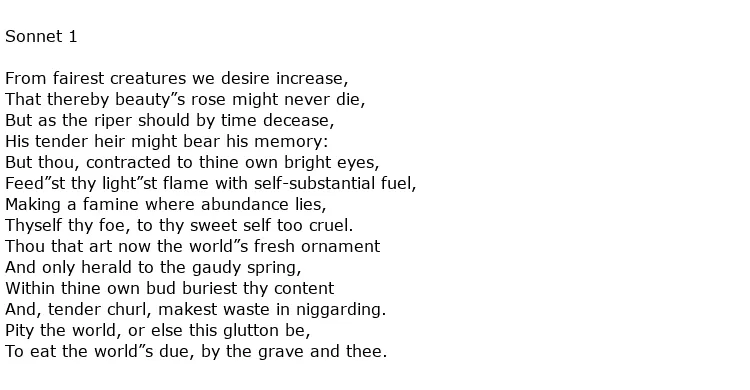 Snippet of text from Sonnet 1, illustrating the form of Shakespeare's sonnets
Many of Shakespeare’s sonnets engage with themes of love, beauty, time, mortality, and jealousy. While later poets would diversify poetic subjects more broadly, the prevalence of love themes in Shakespeare’s era was partly influenced by the economic realities faced by writers. Parchment was costly, and earning a living from writing was challenging. Poems, particularly sonnets, were often commissioned by or dedicated to wealthy patrons and members of the aristocracy, making themes appealing to this audience, such as love, particularly marketable during the Elizabethan Era. Thus, exploring Shakespeare’s love sonnets offers not only a glimpse into matters of the heart but also into the socio-economic context of his time.
Beyond the Sonnets: Shakespeare’s Narrative Poems
Lesser known than his sonnets but equally important are Shakespeare’s two major narrative poems, Venus and Adonis (published 1593) and The Rape of Lucrece (published 1594). These longer poems represent significant early works in his career and demonstrate his versatility in handling extended poetic forms to tell complete stories. While the exact reasons for writing only two such narratives remain debated, their existence highlights Shakespeare’s willingness to experiment with different poetic structures before focusing primarily on plays and sonnets.
Venus and Adonis: Myth, Passion, and Patronage
Venus and Adonis, based on Ovid’s Metamorphoses, is a vivid and sensuous depiction of the goddess Venus’s unrequited love for the beautiful youth Adonis. This poem was dedicated to Henry Wriothesley, the young Earl of Southampton, a significant patron in Shakespeare’s life. In this work, Shakespeare not only weaves a compelling story of love, desire, and tragic loss but also liberally incorporates mythological figures and references, a practice seen throughout his plays and other poems. The narrative unfolds with rich descriptive language and dramatic intensity, foreshadowing his later theatrical works.
The Rape of Lucrece: Tragedy and Thematic Links
Published shortly after Venus and Adonis, The Rape of Lucrece tells the tragic story of the virtuous Roman noblewoman Lucretia and the devastating consequences of her rape by Tarquin. This poem delves into dark themes of violation, honor, shame, and political tyranny. Readers familiar with Shakespeare’s tragedies will recognize thematic echoes and explorations of psychological torment that connect this early poem to later masterpieces like Hamlet (c. 1599-1601) and Macbeth (c. 1606). Many scholars view The Rape of Lucrece as an early exploration of tragic themes and character psychology that would become central to his most famous plays.
The Lasting Legacy of The Bard’s Poetry
For aspiring poets and avid readers alike, studying shakespeare poems offers invaluable lessons in craft, language, and the enduring power of verse. His sonnets provide a masterclass in concise expression and formal ingenuity, while his narrative poems showcase skill in storytelling through poetic means. The influence of Shakespeare’s poetic works on subsequent generations of poets is immeasurable, with many “modern” poets having studied and drawn inspiration from his lines and structures.
Understanding Shakespeare’s poetry is crucial because it forms part of the foundational bedrock of English verse. His exploration of universal themes, his innovative use of language, and his command of poetic forms have shaped the landscape of poetry. To fully grasp the evolution of the art form, one must engage with the works of “The Bard.”
In conclusion, exploring Shakespeare’s poems, from his renowned sonnets to his powerful narrative works, provides essential insight into his genius beyond the stage. These poems are not merely historical artifacts but vibrant works of art that continue to resonate, offering emotional depth and technical brilliance that enriches our understanding and appreciation of poetry.