
In the rich tapestry of Greek mythology, few figures hold as much symbolic power and inherent mystery as the Fates. Known collectively as the Moirai, these three enigmatic goddesses—Clotho, Lachesis, and Atropos—were believed to govern the inescapable destiny of every mortal, and even the gods themselves. They personified the beginning, duration, and end of life, embodying a universal truth about the limits of human agency against the loom of cosmic fate.
Contents
- Clotho: The Spinner of Life’s Thread
- Lachesis: The Allotter of Life’s Span
- Atropos: The Cutter of the Final Strand
- The Fates’ Mystifying Lineage
- Portion, Share, and Destiny’s Allotment
- Tales Woven by the Fates: Myths of Destiny
- Achilles: Glory vs. Life
- Meleager: A Thread and a Log
- Alcestis: A Bargain with Fate
- Orpheus and Eurydice: A Glance Against Destiny
- Pelops: Life Restored
- The Enduring Symbolism of the Fates
These divine weavers were central to the ancient Greek understanding of moira, a concept translating to “allotted portion” or “share.” It suggested that each individual was assigned a fixed destiny, a path woven into the very fabric of existence. While humans possessed free will to navigate this path, the Fates knew the ultimate outcome, measuring the thread of life and holding the final shears. Their influence extended from the moment of birth to the soul’s journey beyond death, making them figures of both awe and apprehension in the classical world.
 the three fates greek mythology painting
The artistry with which the Fates’ roles are described in classical texts and depictions often relies on textile metaphors, presenting life itself as a thread spun, measured, and cut. This potent imagery resonates deeply within the realm of poetry, where symbols of weaving, spinning, and threads frequently appear to convey themes of creation, connection, and the delicate nature of human existence. Understanding the individual roles of the three sisters of fate helps illuminate this powerful symbolism.
Clotho: The Spinner of Life’s Thread
Clotho, whose name derives from the Greek word for spinning, was the first of the Moirai. Her essential duty was to spin the thread of life from her distaff, signifying the moment of birth and the beginning of an individual’s existence. This thread was not merely a symbol of physical life but was believed to contain the future choices, actions, and experiences that would shape a person’s destiny. She was often invoked during pregnancy and childbirth, associated with the fragile commencement of a new soul’s journey.
Ancient Greek literature frequently employs the metaphor of the spinning Fates to underscore the predetermined nature of events. Homer, in the Odyssey, speaks of the unavoidable path twisted into a man’s thread of destiny from the moment of his arrival in the world, a testament to Clotho’s foundational role.
“He must look to meet whatever events his own fate and the stern Klothes (Clotho) twisted into his thread of destiny when he entered the world and his mother bore him.” (Homer, Odyssey 7.193)
The idea that choices were accounted for within the initial spin introduced a fascinating complexity to the concept of fate. It wasn’t necessarily a rigid, predetermined line but perhaps a thread with multiple potential knots and loops, all encompassed by the initial fiber spun by Clotho. This highlights the intricate relationship between fate and the semblance of free will.
 giani three the fates
Lachesis: The Allotter of Life’s Span
The second sister, Lachesis, bore the name meaning “the Allotter.” Her task was to measure the length of the thread spun by Clotho, determining the duration of a person’s life. She used a measuring rod or a scale, signifying the portion or share (meros) of time granted to each mortal. This wasn’t just about the number of years; Lachesis also decided the significant events and trials that a soul would encounter throughout its allotted span.
Plato, in his Republic, places Lachesis in a pivotal cosmic scene where souls choose their next life. She is described as the maiden daughter of Ananke (Necessity), emphasizing the unavoidable nature of the life span she allots.
“This is the word of Lachesis, the maiden daughter of Ananke (Necessity), souls that live for a day, now is the beginning of another cycle of mortal generation where birth is the beacon of death.” (Plato, Republic 617c)
Her role underscores the ancient Greek preoccupation with the concept of moira not just as destiny, but as one’s rightful share or portion, whether of life, glory, or even hardship. Lachesis determined the boundaries of this share, setting the stage for the challenges and opportunities within a life’s finite limits.
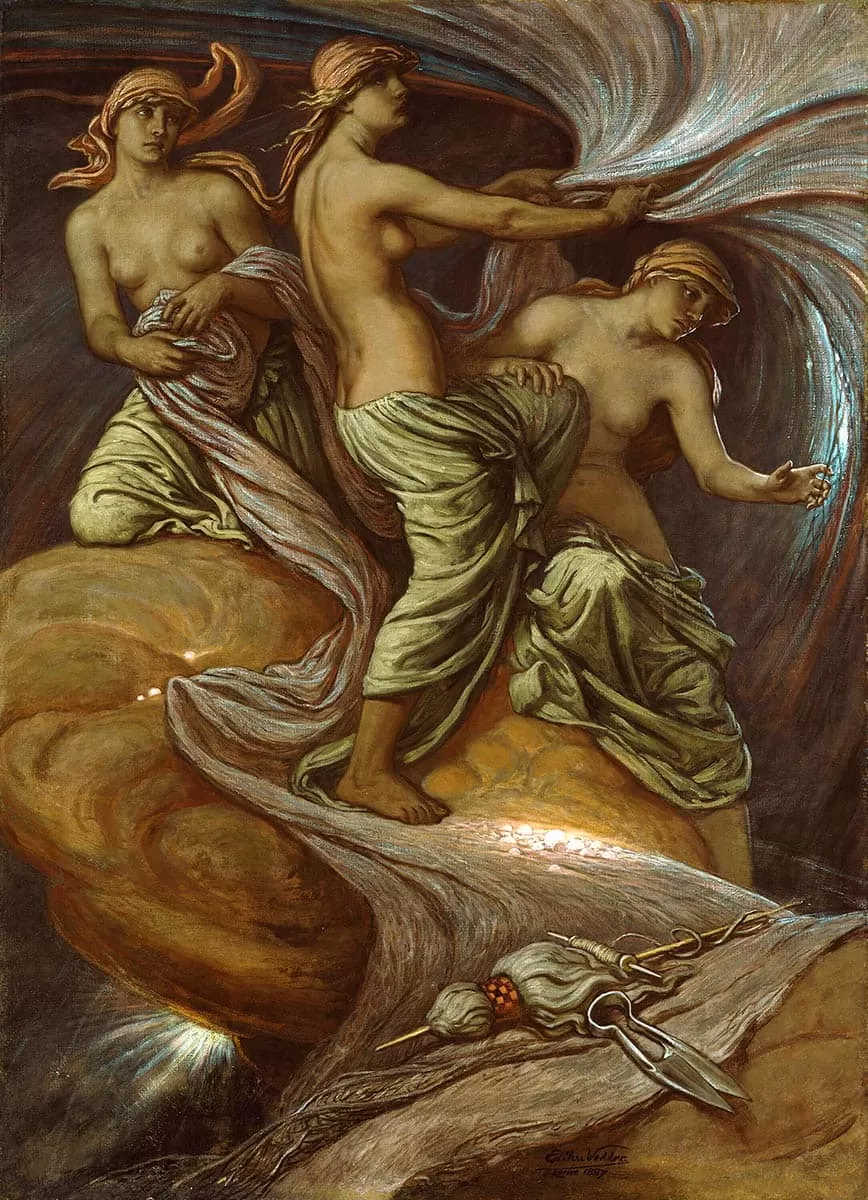 vedder the fates gathering stars
Atropos: The Cutter of the Final Strand
Atropos, the third and often most feared of the three sisters of fate, held the shears. Her name, meaning “the un-turnable” or “she who cannot be turned,” speaks to the absolute finality of her role: to cut the thread of life spun by Clotho and measured by Lachesis. At the point where Atropos made her cut, mortal existence ceased, and the soul transitioned to the afterlife.
Atropos was not merely the agent of death; she determined the manner of death, choosing the circumstances under which life’s thread would be severed. This made her a particularly potent and somber figure, often depicted as older and more stern than her sisters, reflecting the gravity of her ultimate power.
The finality of Atropos’s cut has been a powerful image throughout literature. John Milton famously invoked her in his elegy Lycidas:
“Comes the blind Fury with th’abhorred shears, / And slits the thin spun life.” (John Milton, Lycidas, 1. 75)
This image of the “thin spun life” emphasizes the fragility of human existence, held precariously by a thread that Atropos alone could sever at will. Her role cemented the Moirai’s power over the ultimate boundary of mortal life, a reminder that all destinies converge towards this inescapable end.
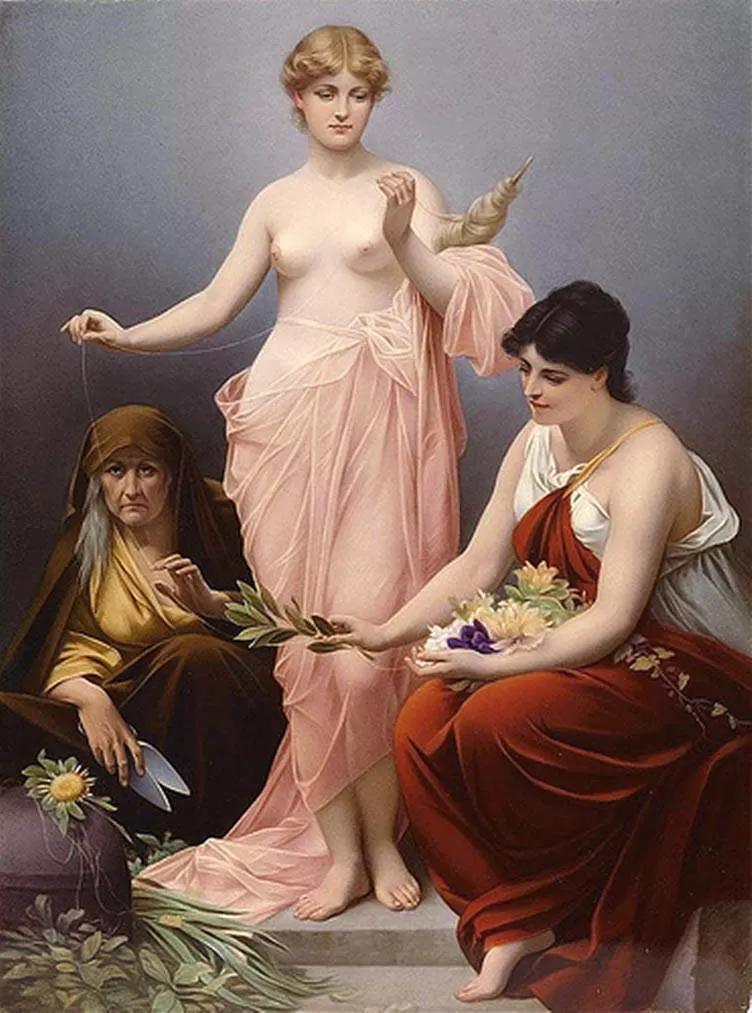 thumann the fates
The Fates’ Mystifying Lineage
The origin of the Moirai is presented with some variation in classical sources, adding layers to their symbolic meaning. One prominent tradition, found in Plato’s Republic, identifies them as the daughters of Ananke, the primordial goddess of Necessity and Inevitability. As children of Ananke, the Fates represent the unavoidable order of the cosmos, the fundamental laws governing existence. This lineage paints them as objective forces, neither inherently good nor evil, simply enacting the necessary course of events.
Alternatively, Hesiod, in his Theogony, lists the Moirai among the fearsome children of Nyx (Night), born without a father. This parentage links the Fates to the primal darkness and mystery of existence, suggesting a more somber, perhaps even punitive, aspect to their power. Hesiod’s description emphasizes their role in pursuing transgressions and punishing sinners, adding a dimension of divine retribution to their weaving of fate.
A third suggestion proposes Themis, the goddess of divine law and justice, as their mother. This lineage casts the Fates as enforcers of cosmic order and moral consequence, ensuring balance and justice within the predetermined framework of destiny.
Each proposed lineage adds a unique interpretative lens to the nature of the three sisters of fate, exploring whether destiny is a matter of inescapable necessity, dark consequence, or divine justice.
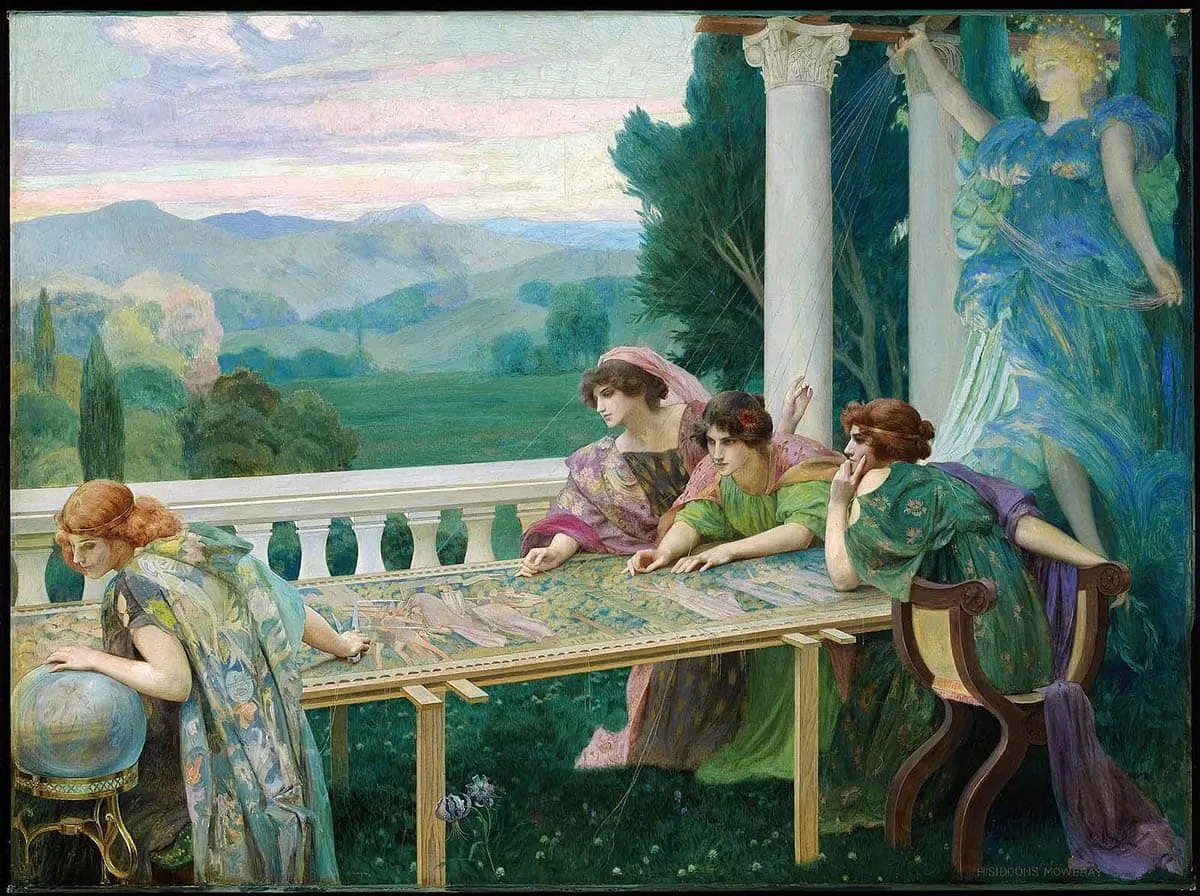 mowbray the fates destiny
Portion, Share, and Destiny’s Allotment
The Greek concept of moira is deeply intertwined with the idea of receiving an “allotted portion” or “share” (meros). This term was used in mundane contexts, like dividing food, but also carried profound implications for one’s cosmic lot or destiny (moros). The Moirai, as the “allotters,” were the agents who ensured that each person received their designated share of life’s experiences, whether good or ill, glory or suffering, wealth or hardship.
Taking someone’s meros was seen as a grave violation, disrupting the natural order and defying the Fates’ apportionment. This concept highlights the ancient Greek worldview where life was seen as a finite quantity, divided and distributed by higher powers, and any attempt to unjustly seize another’s share was a transgression against destiny itself.
Tales Woven by the Fates: Myths of Destiny
The power of the three sisters of fate is illustrated in numerous Greek myths, where heroes and gods alike grapple with the threads of destiny. These stories offer glimpses into the Greek understanding of fate’s influence and the possibilities (or limitations) of human and divine intervention.
Achilles: Glory vs. Life
The myth of Achilles in the Trojan War provides a poignant example of a hero confronting a destiny with two distinct pathways woven by the Fates. Achilles was given a choice: live a long, quiet life at home and be forgotten, or fight at Troy, die young, but gain eternal fame. His decision to pursue glory, even at the cost of his life, was his exercise of free will within a fated structure. The Fates had prepared both threads, and Achilles chose which one to follow, demonstrating that while the options might be fixed, the hero’s choice could determine which preordained path was taken.
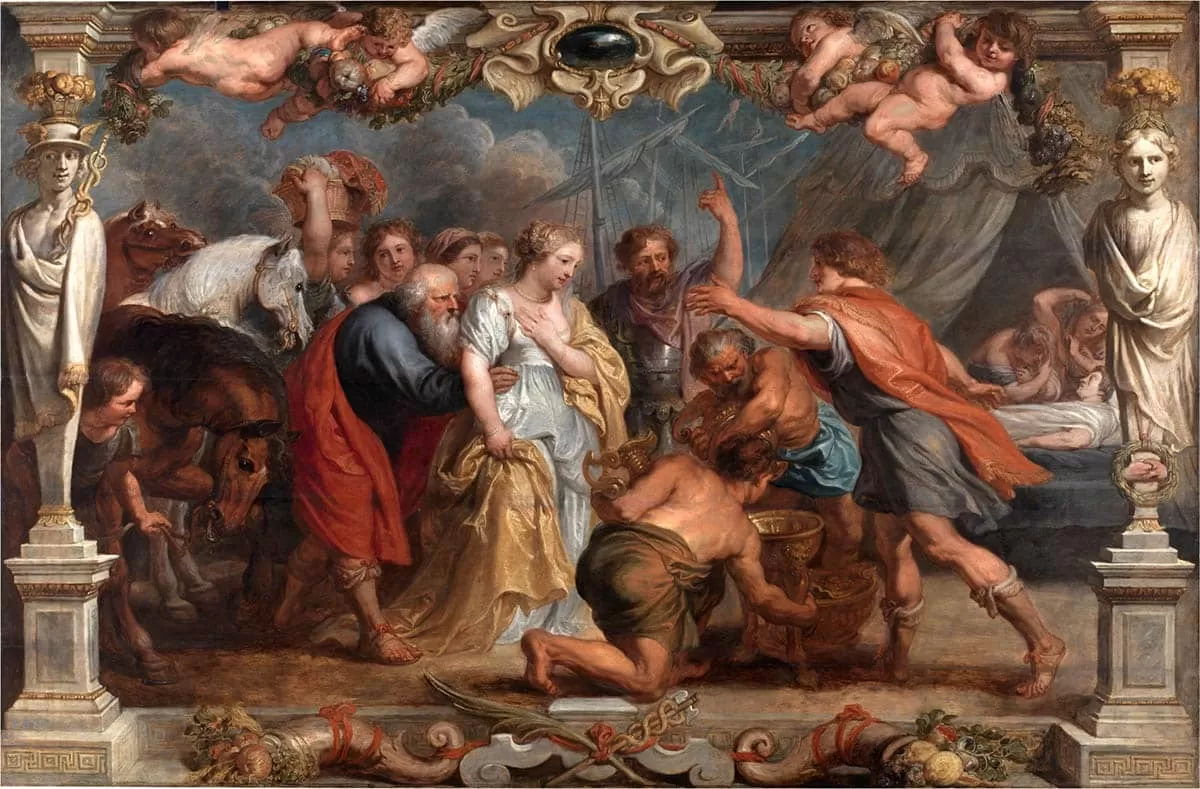 rubens briseis returned achilles
His conflict with Agamemnon over Briseis further illustrates the concept of meros. When Agamemnon took Briseis, he wasn’t just taking a prize; he was taking Achilles’ fated portion, a deep insult that challenged the very idea of his allotted share and triggered the chain of events leading to his choice of glorious, short life.
Meleager: A Thread and a Log
The story of Prince Meleager involves a more tangible representation of his fated life thread. When he was born, the Fates appeared and declared his life would last only as long as a specific log burning in the hearth remained unburned. His mother, Althaea, seized the log, extinguished it, and hid it, effectively taking control of her son’s allotted life span from Lachesis and Atropos.
This myth explores the potential for human action to interfere with fate, but also its tragic consequences. When Althaea, enraged by Meleager’s killing of her brothers, threw the log back into the fire, she was fulfilling the Fates’ original prophecy through her own vengeful choice. The myth suggests that while the means might involve human action, the fated end could still be unavoidable.
 bone althaea burns log the fates
Alcestis: A Bargain with Fate
The myth of Alcestis, wife of King Admetus, directly confronts the rigidity of Atropos’s cut. Admetus was fated to die, but Apollo, favored by Admetus, tricked the Fates into agreeing that someone else could die in his place. While many refused, Alcestis selflessly offered her life. Her willingness to sacrifice herself opened a loophole in the Fates’ decree, showcasing that destiny, while powerful, could be contingent on extraordinary circumstances and actions.
Ultimately, Heracles intervened, wrestling Death (Thanatos) himself and bringing Alcestis back from the Underworld. This myth, though ending happily, emphasizes how exceptionally difficult and rare it was to alter a destiny woven by the three sisters of fate. It required divine intervention (Apollo) and heroic strength (Heracles) coupled with immense human sacrifice (Alcestis).
 desplaces hercules bringing alcestis
Orpheus and Eurydice: A Glance Against Destiny
In contrast to Alcestis, the tragic myth of Orpheus and Eurydice underscores the implacable nature of fate. Orpheus, the legendary poet and musician, charmed Hades and Persephone with his music, persuading them to allow his wife Eurydice to return from the Underworld on one condition: he must not look back at her until they reached the surface.
Orpheus’s inability to resist glancing back, out of love or doubt, sealed Eurydice’s fate. She was pulled back into the realm of the dead, her thread of life irrevocably severed by Atropos, despite the temporary reprieve granted by the Underworld rulers. Statius describes the Fates (the Sisters) resuming their grim task:
“It shames me [says the god Hades]! How Tartarus opened a way to [Orpheus]; with my own eyes I saw the Eumenides [Erinyes, Furies] shed base tears at those persuasive strains, and the Sisters [Fates] repeat their allotted task [bringing Eurydice back to the underworld].” (Statius, Thebaid 8. 58)
This tale serves as a stark reminder that defying or circumventing the Fates, even with divine favor, is perilous and often doomed to fail.
 cosway the fates cupid
Pelops: Life Restored
While the Fates are primarily associated with ending life, there are rare instances where they are depicted as having the power to restore it. The myth of Pelops is one such case. After being murdered and served to the gods by his father Tantalus, the gods, recognizing the horrific act, punished Tantalus severely. The Fates, in an act suggesting their ultimate authority over life and death, restored Pelops to life (though missing a shoulder, replaced by ivory).
This unusual event highlights the Fates’ supreme power – they are not merely cutters of threads but masters of the loom of existence itself, capable of reweaving when the cosmic order demands it. As Nonnus writes, emphasizing their control over destiny:
“May you escape all the bitter things which the wreathed spindle of apportioned Moira has spun for your fate — if the threads of the Moirai ever obey!” (Nonnus, Dionysiaca 2.675)
 doyle the fates drawing
The Enduring Symbolism of the Fates
The three sisters of fate, Clotho, Lachesis, and Atropos, remain powerful archetypes, symbolizing destiny, necessity, and the ultimate limits of human control. Their depiction as weavers using threads, looms, and shears provides a vivid, tangible metaphor for the intangible forces believed to shape our lives. This imagery has resonated through centuries, appearing not only in classical Greek literature but also influencing later art, philosophy, and poetry.
Whether seen as daughters of Necessity, Night, or Justice, the Moirai embody a fundamental human contemplation: the relationship between fate and free will. Their myths serve as cautionary tales and reflections on the unpredictable yet seemingly predetermined nature of existence. The enduring power of the three sisters of fate lies in their ability to personify the universal mystery of where our individual stories begin, how they unfold, and when they will inevitably end. They remind us that every life, no matter how grand or humble, is a thread within a larger, cosmic design, held and ultimately severed by powers beyond our full comprehension.