
Shen Yun Performing Arts has become a ubiquitous presence in the cultural landscape, known for its vibrant advertisements promising a journey through 5,000 years of Chinese civilization. Yet, beyond the striking visuals and claims of reviving traditional culture, lies a complex history deeply intertwined with the spiritual discipline Falun Gong. Understanding the origins and evolution of Shen Yun requires delving into the narrative of its parent organization, the context of religious freedom in China, and the unique way the performance art company was established and has grown on a global scale. This article aims to provide a detailed historical overview, tracing the development of Shen Yun from its founding to its current status as a worldwide touring phenomenon.
The genesis of Shen Yun Performing Arts is directly linked to the Falun Dafa (also known as Falun Gong) spiritual movement. Founded in 1992 by Li Hongzhi, Falun Gong is a practice that combines meditation and qigong exercises with a moral philosophy centered on the principles of truthfulness, compassion, and forbearance. Initially recognized and even supported by the Chinese government, the movement experienced rapid growth, reportedly attracting tens of millions of adherents by the mid-1990s. This widespread popularity, however, soon led to concern from the ruling Chinese Communist Party, which became wary of any large organization outside of its direct control. The government estimated the group had seventy million adherents by 1999, potentially surpassing the membership of the Communist Party itself. This perceived challenge to state authority marked a turning point in the history of Falun Gong and, subsequently, shaped the purpose and mission of Shen Yun.
In 1999, following a large, silent protest by over ten thousand Falun Gong practitioners outside the central government compound in Beijing, the Chinese government launched a severe crackdown on the movement. Li Hongzhi had already moved to the United States. The Chinese legislature subsequently passed and began violently enforcing an anti-cult law specifically targeting groups like Falun Gong. Practitioners in China faced arrest, imprisonment, torture, and even forced organ harvesting, according to numerous reports. This intense persecution outside of China fueled a desire among overseas practitioners to raise awareness about the situation and to preserve and promote traditional Chinese culture, which they felt was being suppressed by the Communist regime.
It was in this context of persecution and exile that Shen Yun Performing Arts was founded in 2006 in New York’s Hudson Valley. The company put on its first touring show in 2007. The explicit mission of Shen Yun, as stated by the organization itself, is to revive 5,000 years of traditional Chinese culture and arts, which they claim have been destroyed under Communist rule. However, the performances also openly depict the persecution of Falun Gong in China, incorporating dance dramas that portray the struggles and resilience of practitioners. This dual focus—showcasing classical Chinese art forms while simultaneously addressing contemporary human rights issues—is a defining characteristic of Shen Yun. Those interested in the broader narrative behind the company can learn more about the story of shen yun.
The organization’s structure reflects its close ties to the Falun Gong community. The dancers are trained at the Fei Tian Academy of the Arts, situated on a large campus in upstate New York established for Falun Dafa practitioners. This campus also houses Fei Tian College, which shares faculty and facilities with the academy. The performers are predominantly practitioners of Falun Gong, and the training regimen at the academy includes adherence to the spiritual discipline’s teachings. Each touring company consists of around forty dancers and is accompanied by an orchestra that uniquely blends Western classical instruments with traditional Chinese ones. By 2009, Shen Yun had expanded to three touring companies, and today, it operates six equally sized companies, each comprising approximately eighty people, including dancers, musicians, vocalists, and production staff.
From its relatively modest beginnings, Shen Yun has grown into a massive, globally touring production. It performs in dozens of cities across North America, Europe, Asia, and Oceania each year. The scale of its operation is significant; for example, in a single year, it might perform in ninety-six American cities alone, in addition to numerous international venues. This rapid expansion and extensive reach are supported by a sophisticated and pervasive advertising strategy. Shen Yun ads are known for their distinctive visual style—often featuring brightly colored images of leaping dancers—and their omnipresence in major cities, appearing on billboards, public transport, television, radio, and online.
The funding behind this extensive touring and advertising operation comes primarily from local Falun Dafa associations around the world. Shen Yun operates as a non-profit organization. In 2016, for example, it reported substantial assets and revenue, illustrating the financial scale necessary to maintain multiple touring companies simultaneously. The coördinated nature of the advertising blitzes has become a recognized phenomenon in many areas, often appearing seasonally as tours are announced. The marketing often emphasizes the artistic and cultural aspects, promising beauty and a connection to ancient traditions, while the show itself incorporates the narrative of persecution and Falun Gong’s spiritual message.
The content of the Shen Yun performance is a key part of its history and impact. The shows typically consist of a series of short dance pieces, interspersed with vocal and instrumental solos. The dance pieces draw inspiration from classical Chinese dance, ethnic and folk dances, and story-based dances depicting historical events, mythological tales, and contemporary stories, particularly those portraying the persecution of Falun Gong practitioners in modern China. Digital backdrops project animated scenery that interacts with the dancers on stage, a visual technique that is a hallmark of the production.
The historical narrative presented in the show emphasizes a glorious, spiritually rich past of China, distinct from the period of Communist rule. The name “Shen Yun” itself, meaning “the beauty of divine beings dancing” or “the rhythm of a divine spirit,” hints at the spiritual underpinnings of the performance. The vocal soloists often sing songs with lyrics translated on the backdrop that convey messages aligned with Falun Gong teachings, including themes of divine salvation, the dangers of atheism and modern ideologies, and the importance of traditional values. These elements make the show more than just an artistic performance; it is a vehicle for conveying the history, beliefs, and experiences of Falun Gong practitioners.
The explicit portrayal of the persecution of Falun Gong and the integration of the organization’s spiritual tenets into the performance have led to controversy and criticism, particularly from the Chinese government, which actively tries to discourage people from attending the shows. The Chinese Embassy has issued warnings in various countries, labeling Shen Yun as a propaganda tool of the “Falun Gong cult” and urging the public to stay away.
The use of the term “cult” in relation to Falun Gong is debated. While the organization does not have a history of violence and its stated values are truthfulness, compassion, and forbearance, certain teachings of Li Hongzhi, such as views on evolution, race, and homosexuality, and accounts from former adherents about discouraging modern medicine, have drawn scrutiny. The organization’s defensive reactions to criticism and journalistic inquiry have also been noted. However, the core historical fact remains that Falun Gong is banned and severely persecuted in mainland China, and Shen Yun was founded as a direct response to this situation, using artistic performance to inform the world.
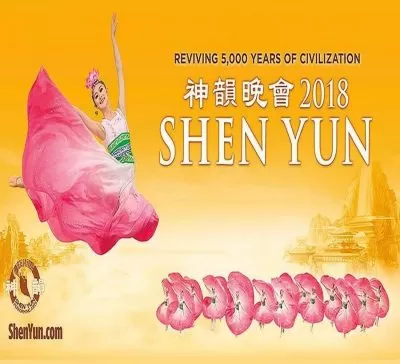 Example of a Shen Yun advertisement from 2018 promoting the revival of 5000 years of culture.
The history of Shen Yun is thus inseparable from the history of Falun Gong after the 1999 crackdown. It represents a large-scale, artistic effort by adherents of a persecuted spiritual group to share their culture, beliefs, and plight with a global audience. The extensive marketing campaign, while sometimes perceived as enigmatic due to its focus on broad cultural revival without explicit mention of the contemporary political context, serves the purpose of drawing in as wide an audience as possible to witness the performance and, by extension, learn about the story of shen yun.
Over the years, the marketing messages have slightly varied, from “Reviving 5,000 Years of Civilization” to “Experience a Divine Culture” and claims of being the “No. 1 show in the world.” This evolution in messaging, alongside the consistent visual style, forms its own sub-history within the broader narrative of the company’s rise to prominence. The sheer volume and persistence of Shen Yun’s advertising have made it a cultural meme in many regions, a phenomenon that highlights its unique approach to reaching potential audience members. This historical pattern of pervasive advertising underscores the organization’s commitment to its mission and its capacity to mobilize resources through its network of supporters. Artistic expression takes many forms, from grand theatrical performances to more personal expressions like a heartfelt i love you poem to girlfriend. Each form has its own history and purpose, reflecting the diverse ways humans seek to communicate meaning and emotion.
The financial aspect is also a part of Shen Yun’s history. Operating multiple large touring companies and funding extensive advertising requires significant resources. The non-profit status and funding via local Falun Dafa associations indicate a model reliant on the support of the Falun Gong community and its sympathizers. This funding structure allows Shen Yun to maintain independence from commercial pressures and governmental influence (other than the Chinese government’s opposition), enabling it to consistently present its core message. Different artistic endeavors have vastly different histories and funding models, from large-scale productions to the more intimate world of literature and poetry, such as the history embedded in short robert frost poems.
In conclusion, the history of Shen Yun Performing Arts is a fascinating narrative of cultural preservation, artistic expression, and political/spiritual activism. Founded by Falun Gong practitioners in response to persecution in China, Shen Yun rapidly evolved from a single touring company to a global phenomenon with multiple troupes performing simultaneously around the world. Its history is marked by a clear mission to revive traditional Chinese culture while raising awareness about the ongoing human rights situation faced by Falun Gong in mainland China. The organization’s unique structure, reliance on the Falun Gong community, pervasive advertising strategy, and the specific content of its performances are all critical components of its historical trajectory. Shen Yun’s story is not just about dance and music; it is deeply rooted in the historical events surrounding Falun Gong and its struggle for freedom and cultural continuity outside of China. Understanding Shen Yun means understanding this complex and compelling history.
The evolution of Shen Yun’s performance content also adds layers to its history. Early shows might have focused more broadly on mythological stories and regional dances, but the narrative pieces depicting modern-day persecution quickly became a central, defining feature. The recurring themes of divine intervention, karmic retribution, and the stark contrast between traditional values and modern Communist ideology are consistent threads throughout the performance history. The controversial nature of these themes, while central to the history and purpose of the organization, has led to varied audience reactions and persistent debate about whether Shen Yun is primarily an artistic performance or a form of political and religious messaging. Historically, art has often served purposes beyond mere aesthetics, acting as a vehicle for religious devotion, political commentary, or social critique. Shen Yun stands as a contemporary example of this phenomenon, using the platform of classical Chinese dance and music to tell a specific, historically rooted story.
Furthermore, the historical context of classical Chinese dance itself is relevant to Shen Yun’s history. Traditional Chinese dance is an ancient art form, rich in history and expressiveness, often used to tell stories and convey deep emotions. Shen Yun’s claim to be reviving this tradition positions it within a long history of performance art in China. However, the specific style performed by Shen Yun is also a modern development, incorporating elements of ballet and acrobatics, and systematized within the Fei Tian Academy’s curriculum. Thus, the history of Shen Yun dance is both a continuation of ancient traditions and an innovation shaped by the organization’s specific needs and training methods.
 2016 Shen Yun Performing Arts poster showcasing dancers and a prominent slogan.
The international scope of Shen Yun’s history is also notable. Its ability to tour simultaneously with multiple companies requires immense logistical coordination and a global network of supporters. This international presence is not just about performance; it is also about establishing Falun Gong’s presence and message worldwide, counteracting the Chinese government’s narrative on the group. The history of Shen Yun’s global reach demonstrates the effectiveness of this strategy in reaching audiences in diverse cultural contexts. Each tour stop becomes a point of interaction between the history being presented on stage and the contemporary world. This continuous performance schedule and global reach are integral to the ongoing shen yun history, constantly adding new chapters to its story of resilience and cultural revival through artistic expression.