
For many across America and the world, the name Shen Yun arrives not as a cultural revelation but as a pervasive, almost inescapable element of the urban landscape. Like the jingles of local businesses or the faces of personal injury lawyers embedded in one’s consciousness, Shen Yun advertisements possess a unique ubiquity. They appear on billboards, bus stops, subway cars, and television screens, often featuring a vibrant, somewhat otherworldly image of a dancer leaping against a bright, flat backdrop, accompanied by the enigmatic phrase, “5,000 Years of Civilization Reborn.” The experience of encountering these ads repeatedly, year after year, without a clear understanding of the show’s content, breeds a distinct curiosity: What exactly is Shen Yun, and what does “Shen Yun meaning in English” truly convey?
The literal translation of the name “Shen Yun” from Chinese provides the first layer of meaning. According to the performing arts group itself, Shen Yun means “the beauty of divine beings dancing.” Alternative translations include “the rhythm of a divine spirit” or, more simply, “God’s melody.” This foundational meaning positions the performance as something ethereal, connected to ancient traditions and spiritual realms, promising a spectacle of celestial grace and historical richness through classical Chinese dance and music.
However, the meaning of Shen Yun, as experienced by audience members and analyzed by observers, extends far beyond this poetic translation. The performance is not merely a cultural showcase of ancient Chinese art forms. It is deeply intertwined with the spiritual practice of Falun Dafa, also known as Falun Gong. Founded by Li Hongzhi in China in the early 1990s, Falun Dafa emphasizes moral cultivation based on the principles of truthfulness, compassion, and forbearance, alongside meditation exercises. Initially supported by the Chinese government, the practice gained millions of adherents rapidly. This growth, however, led the ruling Communist Party to perceive Falun Dafa as a threat to its authority, resulting in a brutal crackdown and persecution that began in 1999 and continues to this day.
Shen Yun Performing Arts was established in 2006 in New York’s Hudson Valley by Falun Dafa practitioners. The organization states its mission is to revive traditional Chinese culture, which it argues has been systematically destroyed by decades of Communist rule in China. While the show features classical Chinese dance – an expressive art form with a history spanning thousands of years, distinct from ballet – and an orchestra blending Western and Chinese instruments, it also serves as a platform for conveying the beliefs and experiences of Falun Dafa practitioners.
Attending a Shen Yun performance reveals the layers of meaning. The show presents vignettes depicting historical legends, ethnic dances, and stories from modern China. These narratives often portray themes of divine creation, karmic retribution, and the struggle between good and evil. Alongside the vibrant costumes, impressive choreography, and innovative digital backdrops (which sometimes feature animated figures transitioning seamlessly between screen and stage), the performances explicitly incorporate messages related to Falun Dafa.
Commentary from bilingual hosts introduces the pieces, sometimes discussing Falun Dafa directly. Some dance numbers depict the persecution of Falun Dafa practitioners in China, including scenes of imprisonment and even organ harvesting. Solo vocalists sing songs with lyrics projected onto the backdrop screen, often containing explicit references to spiritual salvation, the dangers of atheism and evolution, and critiques of modern societal trends.
For audience members primarily drawn by the promise of beautiful dance and culture, these overt messages can be jarring and unexpected. The contrast between the advertised image of historical cultural revival and the specific spiritual and political content of the show forms a central part of the Shen Yun meaning for many viewers – a realization that the performance is also a form of advocacy and a vehicle for delivering a particular worldview.
The pervasive advertising strategy, often simple yet visually striking, appears designed to attract a broad audience intrigued by the cultural promise, potentially unaware of the underlying message. This approach has led to the ads themselves becoming a widely recognized cultural phenomenon, sometimes even reaching meme status due to their ubiquitous and slightly mysterious nature. The sheer volume of advertising is reportedly funded by local Falun Dafa associations, highlighting the symbiotic relationship between the performance troupe and the spiritual practice. Exploring the story of shen yun involves understanding this intricate connection between the artistic presentation and the foundational beliefs and experiences of its creators and performers.
The organization’s connection to Falun Dafa also brings it into the realm of controversy. While Falun Dafa practitioners emphasize their core values of truthfulness, compassion, and forbearance, and the group’s non-violent nature, critics and some former adherents have raised concerns, sometimes labeling it a cult. These concerns often stem from the teachings of Li Hongzhi, which reportedly include beliefs about aliens interfering with humanity through modern science (though he later claimed this was metaphorical), the separation of races in heaven, and condemnation of homosexuality and promiscuity. The organization has also been noted for its strong reactions to criticism and journalistic inquiry. The Chinese Embassy actively warns against Shen Yun, calling it a propaganda tool of the “Falun Gong cult.”
Thus, understanding “Shen Yun meaning in English” requires looking beyond the literal translation of the name or the surface-level marketing slogans like “5,000 Years of Civilization Reborn.” It involves recognizing that the performance is a sophisticated artistic expression created by and for practitioners of Falun Dafa, intended not only to entertain but crucially to educate the audience about the history of Chinese culture as viewed through the lens of Falun Dafa, to highlight the persecution faced by the group in China, and to propagate its spiritual teachings.
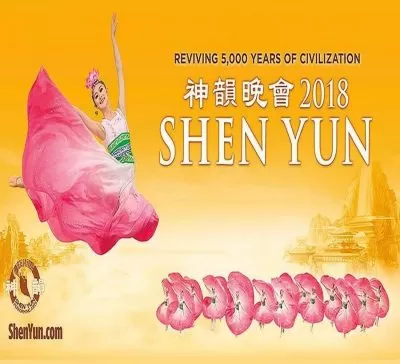 Yellow Shen Yun advertisement promoting the revival of 5,000 years of traditional Chinese culture and dance.
The performances weave together historical and mythological narratives with explicit contemporary messages. The dance “Goodness in the Face of Evil,” for example, portrays the resilience of Falun Dafa practitioners in the face of persecution. Other dances might draw on classical literature but infuse it with spiritual allegories that align with Falun Dafa’s cosmology. Unlike other forms of artistic expression focused on personal themes, such as [love poems about] individual relationships or abstract emotional landscapes, Shen Yun’s narrative threads are tightly linked to a specific spiritual and political agenda.
The visual spectacle is undeniable – the skill of the dancers trained at the Fei Tian Academy (associated with Falun Dafa), the vibrant costumes, the dynamic backdrops. However, this artistic presentation serves a deeper purpose. The meaning of Shen Yun, in essence, is found in its role as a cultural and artistic vehicle for the Falun Dafa movement – a public face designed to share its heritage, its plight, and its beliefs with a global audience, leveraging the universal appeal of dance and music to deliver a message that is both cultural revival and spiritual declaration.
In conclusion, while “Shen Yun” translates poetically as “the beauty of divine beings dancing,” its broader meaning encompasses a complex blend of classical Chinese art, spiritual teachings, political commentary, and a mission to preserve and promote Falun Dafa’s heritage and narrative in the face of persecution. It is a phenomenon where artistic performance serves a profound, multi-layered purpose, inviting audiences to witness not just a dance show, but a story of faith, resilience, and a vision of cultural and spiritual rebirth.