
For many in the English-speaking world, Shen Yun Performing Arts appears as a vibrant, enigmatic presence through ubiquitous advertising. Billboards, subway posters, and mailers feature vivid images of dancers in traditional Chinese attire, often accompanied by the tagline “5,000 Years of Civilization Reborn” or “Experience a Divine Culture.” This pervasive marketing campaign often leaves people wondering: what exactly is Shen Yun, and perhaps more fundamentally, where is Shen Yun from?
The question of origin is key to understanding Shen Yun. While its performances showcase classical Chinese dance and music, exploring themes from ancient myths to modern-day issues in China, the organization itself was not founded in mainland China. It was established in 2006 in New York’s Hudson Valley. This geographical origin is intrinsically linked to the spiritual movement that founded and sponsors Shen Yun: Falun Dafa (also known as Falun Gong).
Falun Dafa is a spiritual discipline introduced publicly in China by Li Hongzhi in 1992. It involves meditation exercises and moral teachings based on the principles of truthfulness, compassion, and forbearance. Initially popular in China, the movement faced severe persecution by the Chinese Communist Party (CCP) starting in 1999, leading many adherents to flee the country. Li Hongzhi himself immigrated to the United States. The founding of Shen Yun Performing Arts by Falun Dafa practitioners in New York provided a platform to revive and showcase traditional Chinese culture, which they believe has been suppressed or destroyed under Communist rule, and also to raise awareness about the persecution of Falun Dafa in China. Understanding this backdrop is crucial for grasping the deeper story of Shen Yun beyond its dazzling aesthetics.
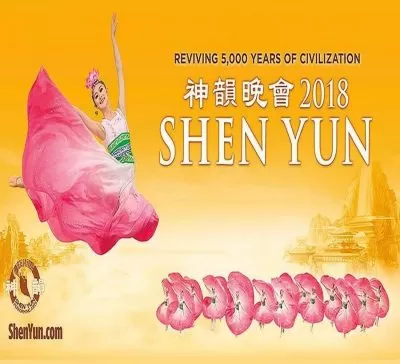 A Shen Yun billboard with a female dancer in traditional attire
The organizational structure of Shen Yun reflects its origins and mission. The performers are primarily trained at the Fei Tian Academy of the Arts, located on a large campus in upstate New York, which is also associated with Falun Dafa practitioners. The organization currently comprises six equally large touring companies, each with approximately forty dancers, a full orchestra incorporating Chinese instruments, and technical staff, totaling around eighty people per troupe. These companies simultaneously tour globally, visiting dozens of cities across North America, Europe, Asia, and Oceania each year.
The funding structure also links back to its roots. Shen Yun Performing Arts is a non-profit organization. Reporting significant assets and revenue, the scale of its operation, particularly the extensive advertising, raises questions about its financial backing. Investigations have reported that each city’s large-scale advertising campaign is often sponsored by the local Falun Dafa association. This decentralized funding model, combined with a centrally coordinated marketing strategy, contributes to Shen Yun’s widespread visibility. Examining the shen yun history further illuminates the organization’s rapid growth and touring capabilities since its inception in 2006.
The content of the Shen Yun performance itself further underscores its origins and mission. While showcasing impressive classical Chinese dance and music, the program includes narrative pieces depicting historical events, mythological tales, and contemporary stories, many of which portray the persecution of Falun Dafa practitioners in mainland China. Short skits illustrate themes of spiritual belief triumphing over adversity, often depicting negative forces associated with the Chinese Communist Party. Interspersed between dance pieces are solo vocalists and instrumentalists, whose songs often carry explicit messages about the importance of traditional values, spirituality, and warnings against modern ideologies like atheism and evolution, reflecting core tenets of Falun Dafa teachings. This thematic content leads some observers to question is shen yun chinese propaganda, though the organization frames it as artistic expression and a revival of suppressed culture.
Performances feature elaborate costumes and digital backdrops.
Beyond the political messaging, Falun Dafa and its associated organizations like Shen Yun have faced scrutiny regarding some of their beliefs. The founder, Li Hongzhi, has expressed views that have been labeled controversial, including statements on evolution, race, and homosexuality. The movement also holds beliefs regarding karma, sickness, and the limitations of modern medicine, which have led to criticism. The organization has also been noted for its strong reactions to critical media coverage or academic inquiry. However, Falun Dafa emphasizes its core values of truthfulness, compassion, and forbearance, and practitioners highlight the health and spiritual benefits they have gained. Despite controversies and varied shen yun show reviews, the performances continue to attract large audiences globally.
In conclusion, while Shen Yun Performing Arts presents a vision of 5,000 years of Chinese civilization, its institutional origin is firmly rooted in New York, United States. It was founded by practitioners of Falun Dafa as a means to preserve and promote traditional Chinese culture and raise global awareness about the persecution faced by the spiritual group in mainland China. Its widespread presence and distinctive messaging are a direct result of this connection, making the answer to “where is Shen Yun from?” a story of cultural revival, spiritual belief, and political activism based outside of China, primarily centered in the U.S.