
For many across North America and other parts of the world, the vibrant imagery and enigmatic phrase “5,000 Years of Civilization Reborn” associated with Shen Yun Performing Arts feel less like traditional advertising and more like an omnipresent cultural artifact. Like nursery rhymes or urban legends, Shen Yun ads saturate local media, appearing on billboards, in subway cars, and across digital platforms with a consistent, if content-light, visual identity featuring a leaping dancer in bright, flowing silks. This pervasive presence sparks curiosity and prompts questions, leading many to seek a deeper understanding – the kind of insight one might expect from a comprehensive Shen Yun documentary.
The advertising campaign is undeniably effective in creating awareness, if not clarity. For years, the colors and taglines shift – from lilac and “5,000 Years of Civilization Reborn” to goldenrod yellow and “Reviving 5,000 Years of Civilization,” or green with “Experience a Divine Culture.” The imagery remains consistent: idealized figures in historical Chinese dress, often set against fantastical digital backdrops. These posters, so ubiquitous yet vague, have even become a source of online memes, highlighting their uncanny ability to penetrate public consciousness without revealing much about the actual performance or the organization behind it. The sheer scale and consistency of this advertising blitz demand attention, prompting an investigation into what Shen Yun truly is.
 Lilac Shen Yun poster with leaping dancer
A personal encounter with Shen Yun moves beyond the advertisements into the live experience. Attending a performance reveals that it is far more than a standard cultural show. The production features classical Chinese dance and music, accompanied by an orchestra blending Eastern and Western instruments, and utilizes a large digital screen for animated backdrops that dancers interact with. The aesthetic is vibrant, sometimes jarringly so, with near-neon colors reminiscent of arcade games. However, the narrative content quickly steers towards explicit messaging.
The performance is structured as a series of vignettes, each introduced by bilingual hosts. While some pieces depict ancient legends or ethnic folk dances, many others serve as allegories for spiritual beliefs and contemporary political issues. Recurring themes include depictions of followers of Falun Dafa (also known as Falun Gong) being persecuted in modern China. These narratives are often graphic, such as a dance portraying the organ harvesting of a young Falun Dafa practitioner by Communist authorities. Other segments feature songs with lyrics translated on the backdrop, delivering clear, didactic messages. One memorable song critiqued atheism and evolution as “deadly ideas” and warned that “modern trends destroy what makes us human,” promoting a belief in a Creator and a “Great Way.”
The performance culminates in powerful, often unsettling, imagery contrasting traditional values and spiritual belief with modern decay and Communist oppression. One sequence depicted Falun Dafa followers confronting corrupt youth (identified by wearing black, using cell phones, and, in one instance, two men holding hands). This conflict escalated into apocalyptic visions: the sky turned black, a city was destroyed by an earthquake, followed by a “Communist tsunami” featuring a glowing hammer and sickle and, bizarrely, the face of Karl Marx disappearing in the wave. These explicit political and religious messages underscore that Shen Yun is not merely an artistic spectacle but a platform for advocating the beliefs of Falun Dafa and protesting its treatment by the Chinese Communist Party (CCP).
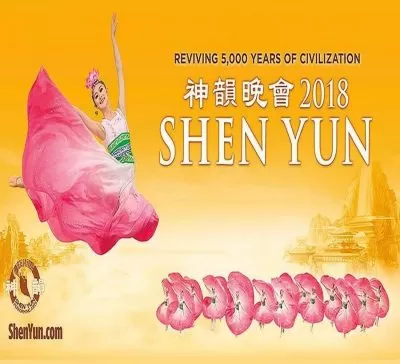 Goldenrod Shen Yun poster
Understanding Shen Yun requires understanding its parent organization, Falun Dafa. Founded in 1992 by Li Hongzhi in China, Falun Dafa is a spiritual discipline combining meditation, qigong exercises, and a moral philosophy centered on “truthfulness, compassion, and forbearance.” It gained rapid popularity in the 1990s, reportedly attracting tens of millions of adherents. This growth, however, raised concerns for the CCP, which viewed the independent organization as a potential threat to its authority. The government initially regulated qigong groups after the 1989 Tiananmen Square protests but intensified its crackdown on Falun Dafa starting in 1999 after more than ten thousand practitioners staged a silent protest outside the central government compound in Beijing. The CCP subsequently banned Falun Dafa and initiated a campaign of persecution that continues today, involving arrests, imprisonment, and reported torture.
Falun Dafa’s teachings, while emphasizing moral conduct and spiritual cultivation, also include controversial beliefs. Li Hongzhi has made statements criticizing evolution as fraudulent, suggesting racial separation in Heaven, and opposing homosexuality and promiscuity as unnatural. He has also spoken about aliens attempting to control humans through modern science, although he later clarified this was intended metaphorically. These specific teachings, coupled with the organization’s often defensive reaction to criticism or journalistic inquiry, have led some critics, including the Chinese Embassy, to label Falun Dafa a “cult.” While the organization’s practitioners are not known for violence and the group does not appear overtly coercive in its recruitment, the controversies surrounding its teachings and its response to external questioning are significant aspects for anyone seeking a full picture, akin to what a comprehensive Shen Yun documentary might explore.
Shen Yun Performing Arts was established in 2006 in New York’s Hudson Valley, home to a large compound for Falun Dafa practitioners, including the Fei Tian Academy where the dancers are trained. It began touring in 2007 and has rapidly expanded to multiple touring companies performing globally in dozens of countries and hundreds of cities annually. Despite being a non-profit, the scale of its operation and advertising suggests significant financial backing. Reports indicate that local Falun Dafa associations often sponsor the advertising campaigns in specific cities, funding the pervasive billboard and media presence.
The organization’s extensive reach and explicit messaging position Shen Yun as a powerful tool for raising awareness about Falun Dafa and its persecution in China. The performances aim to revive traditional Chinese culture, which the organization contends has been destroyed by Communist rule. However, this cultural presentation is inseparable from the group’s religious and political agenda. For audiences encountering Shen Yun for the first time, especially those drawn in by the enigmatic advertising, the performance can be surprising in its directness regarding Falun Dafa’s beliefs and its anti-CCP stance.
 Shen Yun poster with two dancers
The pervasive nature of Shen Yun’s advertising and the explicit messaging within the performance itself highlight the complex identity of the organization. It presents itself as a revival of traditional Chinese culture and art forms, yet it functions significantly as a vehicle for the spiritual and political views of Falun Dafa. For those seeking a factual account of Shen Yun beyond the glossy ads – the kind of objective detail and context a Shen Yun documentary would provide – it’s crucial to understand the organization’s deep roots in Falun Dafa and its mission to inform the world about the practice and the persecution faced by its adherents in mainland China.
The experience of watching Shen Yun underscores that its aesthetic appeal serves a larger purpose: to propagate Falun Dafa’s message and critique the Chinese Communist Party. The controversy surrounding Falun Dafa, including criticisms related to its teachings and practices, adds another layer of complexity to the perception of Shen Yun. Ultimately, Shen Yun is a unique global phenomenon, a blend of elaborate artistic production, spiritual advocacy, and political protest, whose widespread visibility through advertising prompts a deeper dive into its origins, message, and the controversies that define it.
[internal_links]
References:
- Jim Adler “Texas Hammer” Commercial (YouTube)
- Behind the Billboard: Joumana Kayrouz’s Against All Odds Story (Metro Times)
- A Beautiful Mind Trailer (YouTube)
- There’s a Name For That: The Baader-Meinhof Phenomenon (PS Mag)
- Photo Hunt Bar Game Example (YouTube)
- The Guardian: Shen Yun – the Chinese dance troupe China doesn’t want you to see
- Twitter: Jon Kauffman on Shen Yun Ads
- New York Times: Troupe’s Show, Protesting Beijing, Arrives With a Big Buzz
- Chinese Embassy Warning Against “Shenyun” (china-embassy.org)
- Falun Dafa Introduction (en.falundafa.org)
- JSTOR: Apocalyptic Sects in China (Excerpt)
- Amazon: Falun Gong: The End of Days by Maria Hsia Chang
- New York Times: China Moves on Sect After Protest (1999)
- New York Times: China Expels 53 Foreign Falun Gong Followers (2002)
- Falun Dafa: Lecture in Sydney (Evolution Criticism) (en.falundafa.org)
- Falun Dafa: Zhuan Falun Volume II (Racial Separation) (en.falundafa.org)
- Time: Li Hongzhi interview (Aliens) (content.time.com)
- Washington Post: Li Hongzhi interview (Aliens clarification) (washingtonpost.com)
- SFGate: CULTURE AND RELIGION: Critics and followers of Falun Gong face off
- Daily Kos: Sample Luo’s claims
- Archive.org: The Untold Story of Falun Gong (Samuel Luo’s website)
- Whittier Daily News: Falun Gong activists make appeals
- Ludwig-Van: How Shen Yun is becoming a tour de force
- Twitter thread on Shen Yun ad saturation
- LA Mag: Shen Yun Marketing
- Twitter thread on Shen Yun ads as meme
- Twitter: Shen Yun ad in Ebbing, Missouri meme
- [Reddit: Shen Yun ad in Blade Runner 2049 meme](https://www.reddit.com/r/LosAngeles/comments/al2vdk/los_angel es_2049/)
- Twitter: Shen Yun ad on Mars meme