
Often seen flanking the entrances of temples, palaces, and wealthy homes, Foo Dogs are iconic symbols deeply embedded in Chinese culture and Feng Shui. Despite their popular English name, these imposing figures are not canines but stylized depictions of lions, revered for their protective qualities. Understanding what Foo Dogs represent unlocks a deeper appreciation for their significance beyond mere decoration.
Contents
- More Than Just Statues: The Essence of Foo Dogs
- Unpacking the Symbols: Appearance and Meaning
- Foo Dogs as Celestial Guardians
- Placement and Color Symbolism in Feng Shui
- Etymology Quick Reference
- Enduring Significance
- Frequently Asked Questions – Foo Dogs
- Where do you place foo dogs?
- Why do fu dogs come in pairs?
More Than Just Statues: The Essence of Foo Dogs
At their core, what is a foo dog and what do they represent? They primarily symbolize protection, prosperity, and status. Traditionally carved from stone or cast in metal, their presence signified not only a safeguard against negative energy and malevolent spirits but also the wealth and prestige of the owners who could afford such craftsmanship. They act as vigilant guardians, creating a sacred barrier between the external world and the space they protect.
 Pair of Foo Dogs representing protection at an entrance.
The mythology surrounding these guardian lions traces back to the introduction of Buddhism to China during the Han Dynasty. Buddhist teachings often likened the Buddha’s pronouncements to the roar of a lion, powerful enough to silence opposition. Asiatic lions, arriving via the Silk Road, became associated with imperial power and Buddhist protection. The Chinese name for them, “shi,” literally means “lion.” Over centuries, their popularity spread across Asia, evolving into the forms we recognize today.
Unpacking the Symbols: Appearance and Meaning
The representation of Foo Dogs is intricately tied to their appearance, always presented as a pair, embodying the complementary forces of yin and yang.
- The Pair: Foo Dogs are always displayed as a male and a female. The male represents yang and is typically depicted with his paw resting on an embroidered ball, symbolizing the world, cosmic energy, or sometimes dominion and power over the empire.
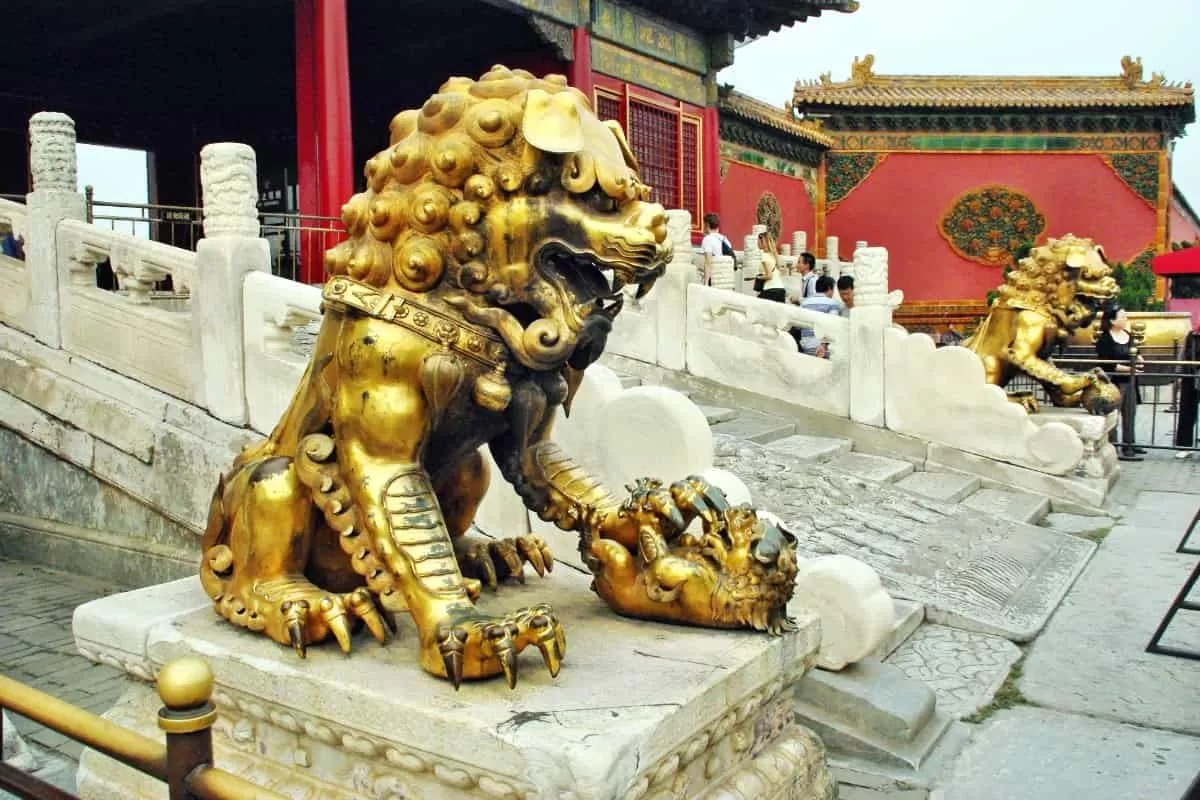
- Yin and Yang: The female represents yin and is usually shown with a small cub beneath her paw. This symbolizes nurturing, the cycle of life, and protection of those dwelling within the protected space. Together, the pair signifies balance and complete protection – the male guarding the external structure, the female safeguarding the occupants.
- Fierce Visage: Their stylized, often fierce, expressions are meant to deter evil spirits and unwelcome visitors. The exaggerated eyes, teeth, and claws are not just artistic choices but symbolic representations of their power to ward off negative influences.
- Mouth Position: Sometimes, one Foo Dog has an open mouth while the other has a closed mouth. This is said to symbolize the sacred sound “om” (AUM), prevalent in Buddhism, representing universal energy and connection.
 Close-up of a female Chinese guardian lion statue with a cub, symbolizing the cycle of life and yin.
The evolution of their artistic depiction, from the slender forms of the Han dynasty to the rounder, more stylized lions of the Qi dynasty with intricate manes, reflects changing aesthetic sensibilities while maintaining their core protective symbolism.
Foo Dogs as Celestial Guardians
In Chinese cosmology and Feng Shui, Foo Dogs hold a significant place as one of the Three Celestial Guardians. These divine creatures are believed to be sent to Earth to protect against negative energies and uphold the cosmic luck trinity of Tien Di Ren (Heaven, Earth, and Man luck).
The three guardians are:
- Foo Dog (Shi): Symbolizing protection against evil spirits and negative energy for both physical structures and their inhabitants.
- Chi Lin (Qi Lin or Gi Lin): A mythical creature symbolizing prosperity, success, longevity, and protection.
- Pi Xiu (Pi Yao or Pi Xie): A powerful hybrid creature symbolizing wealth accumulation, loyalty, and protection against harm.
Together, these guardians suppress the negative influences known as Sarm Saat (Three Killings), contributing to overall harmony and good fortune. Foo Dogs specifically represent the protective element that influences “Di” (Earth) luck – the luck derived from one’s environment and surroundings, which can be manipulated through Feng Shui principles.
 Chart showing the Three Celestial Guardians: Foo Dog, Chi Lin, and Pi Xiu, symbolizing protection against negativity.
Placement and Color Symbolism in Feng Shui
The meaning and effectiveness of Foo Dogs are also tied to their correct placement according to Feng Shui principles. Proper arrangement ensures they can fulfill their symbolic role of guarding and promoting positive energy.
- Placement: They are traditionally placed on either side of an entrance, looking outward. When facing the entrance from the outside, the male (with the ball) should be on the right (the male/Dragon side), and the female (with the cub) should be on the left (the female/Tiger side). This specific positioning maintains the yin/yang balance and ensures complete protective coverage. Even smaller versions like bookends should be kept as a pair in the same room, maintaining this relative positioning.
- Color: In Feng Shui’s Wu Xing (Five Elements) cosmology, colors are associated with directions and elements, influencing different aspects of life (career, wealth, relationships, etc.). While traditional Foo Dogs are stone or metal colored, their color can enhance their symbolic effect based on the direction they face or their placement within a room relative to the Bagua map. For instance, placing white, gold, or silver Foo Dogs in the West or Northwest areas can enhance creativity, children’s luck (West), or mentor/travel luck (Northwest). This adds another layer to what do foo dogs represent – their color can fine-tune the type of beneficial energy they attract or protect.
 Diagram illustrating correct Feng Shui placement of male and female Foo Dogs for protection.
Placement extends beyond main entrances. Large statues can guard property entrances, pathways, or structures like moon bridges in gardens, reinforcing the symbolism of transition and protection within a designed landscape.
 Black metal Foo Dog statues guarding a red moon bridge outdoors, symbolizing transition and protection.
Etymology Quick Reference
Understanding the different names for these guardian figures across cultures further illuminates their symbolic reach.
| ORIGIN | NAME | MEANING | APPEARANCE |
|---|---|---|---|
| China | Shi, Shishi, Tongshi, Ruishi | Lion, Stone Lion, Bronze Lion, Auspicious Lion | Paw on ball or cub, Made of stone/bronze, White with turquoise mane |
| India | Sher/Singha | Lion | 4 facing cardinal directions |
| Japan | Shishi, Komain | Lion, Korean Dog | Open mouth, Closed mouth |
| Korea | Haetae/Sanye | Lion | Scaly with horn & bell on neck |
| Thailand | Singha/Singh | Lion | May have wings & stand |
| Tibet | Gangs-Seng-Ge | Snow Lion | White with turquoise mane |
This table shows that while names and specific features might vary, the core representation of a powerful, protective lion figure is consistent across these Asian cultures.
 Collection of various colored Foo Dog statues, illustrating the significance of color in Feng Shui symbolism.
Enduring Significance
In conclusion, what do foo dogs represent? They are powerful, multi-layered symbols embodying protection against negativity, the balance of yin and yang, prosperity, and status. From their origins in Buddhist mythology and imperial courts to their role in modern Feng Shui practice, these guardian lions serve as enduring emblems of security and good fortune. Whether gracing a temple entrance or a bookshelf as decorative bookends, the symbolic weight of the Foo Dog pair continues to resonate, safeguarding spaces and invoking positive energy for those within.
Frequently Asked Questions – Foo Dogs
Where do you place foo dogs?
The male Fu Dog (the one holding the globe) is always placed on the male, or Dragon side of the house (to the right of the main door when facing inward). The female Fu Dog (with the cub) is placed on the female, or Tiger side of the house (to the left of the main door when facing inward). They should always face outwards from the entrance.
Why do fu dogs come in pairs?
Foo dogs are designed in pairs – one male and one female – to represent the essential balance of yin and yang. The female symbolizes yin and protects the inhabitants, while the male symbolizes yang and protects the physical structure, offering comprehensive protection.
References