
Often seen guarding entrances to temples, palaces, and homes across Asia, the imposing figures commonly known as Foo Dogs capture attention with their fierce visages and stoic presence. Despite their popular Western name, these aren’t canines but rather powerful, stylized representations of lions, deeply rooted in Chinese culture and symbolism. Far more than mere decorative elements, they serve as potent protective totems, embodying layers of meaning accumulated over centuries. Understanding what the Foo Dog represents requires delving into their historical origins, symbolic attributes, and their significant role in practices like Feng Shui.
Contents
These majestic figures, typically crafted from stone, bronze, or ceramic, are invariably displayed in pairs. This pairing is fundamental to their symbolism, representing the harmonious balance of yin and yang energies. Traditionally, their presence was a mark of status and wealth, reserved for the imperial court and elite families, underscoring their significance as guardians of important spaces and symbols of aristocratic power.
 Pair of stone Foo Dogs guarding an entrance, classic Chinese guardian lions
Origins and Evolution of the Chinese Guardian Lion
The mythology of these guardian lions, known as “shi” (lion) in Chinese, traces back to the introduction of Buddhism to China during the Han Dynasty (206 BC – 220 AD). In Buddhist tradition, the lion is a symbol of power and protection, often associated with the Buddha himself. The “roar of the lion” is a metaphor for the Buddha’s teachings, which are said to silence all other voices. While lions are not native to China, they were introduced through trade routes like the Silk Road and kept as exotic animals by emperors. These real-life lions likely served as inspiration for the earliest artistic depictions.
Over centuries, the depiction of the “shi” evolved from somewhat realistic forms to highly stylized and symbolic representations. Their popularity spread from China to neighboring countries like Japan, Korea, Thailand, and Tibet, each developing their own variations and names. The Western name “Foo Dog” or “Fu Dog” is believed to have originated from the Japanese “shishi” (lion) and potentially a misunderstanding or mispronunciation, eventually being associated with “Buddha” or “prosperity,” although these prefixes are not traditionally used by the Chinese. The visual resemblance to certain Chinese dog breeds like the Chow Chow and Shih Tzu, perhaps contributing to the “dog” moniker in the West, is more a result of artistic stylization over time rather than an intentional depiction of canines. Diverse forms of cultural expression, from protective sculptures to forms like [poetry by homer], offer insights into human endeavors across different civilizations.
 Entrance to a traditional Chinese Buddhist temple, showing architectural setting for Foo Dogs
Appearance and Deep Symbolism
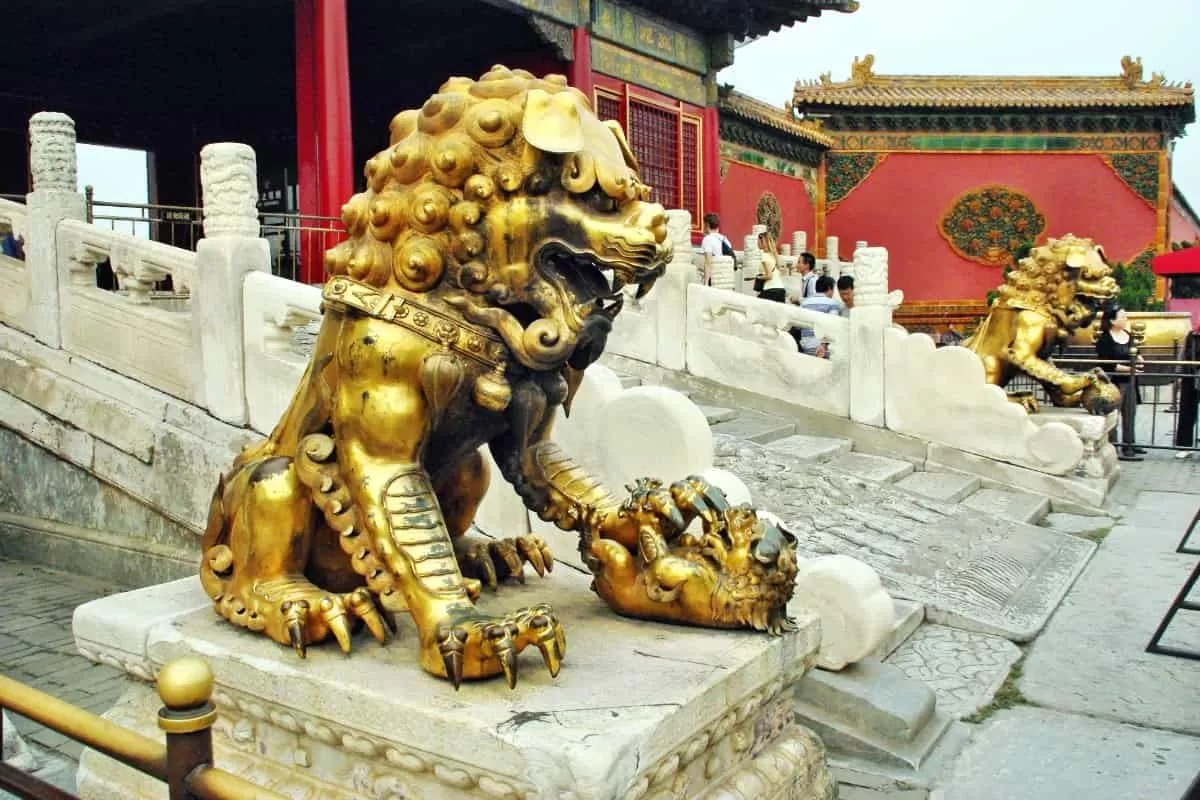
Chinese guardian lions are typically depicted in a powerful, crouching stance, radiating a fierce energy. Their stylized features – prominent eyes, sharp teeth, and powerful claws – are designed to intimidate and ward off negative influences and malicious spirits. Unlike the anatomically accurate lion sculptures found in European art, the Chinese guardian lions prioritize capturing the inherent power and spiritual energy of the animal over strict realism.
The symbolic core lies in their mandatory pairing: always a male and a female, representing the duality of yin and yang.
- The Male Lion: Is typically positioned on the right side (facing outward) and has a paw resting on an embroidered ball. This ball is rich in symbolism, representing the world, the globe, cosmic energy, and the unity of the empire. The male, representing yang, is seen as guarding the external structure and the physical realm.
- The Female Lion: Is positioned on the left side (facing outward) and has a paw playfully restraining a small cub. The cub symbolizes nurturing, the cycle of life, and future generations. The female, representing yin, is seen as protecting the interior of the dwelling and the well-being of those within.
The positions of their mouths also hold symbolic meaning. Often, one has its mouth open, while the other has it closed. This can symbolize the sacred sound “om” (Aum), where the open mouth represents the “A” sound (birth, action) and the closed mouth represents the “Um” sound (death, conclusion), together encompassing the totality of existence. Historically, the number of curls on a lion’s head could also indicate the rank of the official whose residence they guarded, adding another layer of social symbolism. Over the centuries, artistic styles evolved, as seen in the more rounded, stylized forms from the Qi dynasty compared to earlier periods. Exploring how form and content combine in various artistic mediums, including the intricate details of these statues and the structure found in [architecture and poetry], reveals fascinating cultural insights.
 Detail of a female Chinese guardian lion statue from the Qi dynasty period, showing stylized mane
Placement and Feng Shui Principles
The power and effectiveness of Foo Dogs as protectors are intrinsically linked to their correct placement, especially within the principles of Feng Shui. To maximize their protective energy and ensure the balance of qi (life force energy), they must be placed on either side of an entrance, whether it’s a main door, gate, or even a significant pathway.
- Primary Rule: When facing the entrance from the outside, the male lion (with the ball) should be on the right side, and the female lion (with the cub) should be on the left side. They should always face outwards, vigilant against negative energy attempting to enter.
- Smaller Statues: For smaller versions like bookends or table lamps placed inside a room, the principle remains the same relative to the entrance of that room. They should be kept together as a pair on the same surface, with the male on the right and female on the left when looking from within the room towards the entry point. If distinguishing male/female is difficult (e.g., identical statues), placement can sometimes be determined by which paw is raised (inside paws raised when facing each other).
This specific positioning reinforces their symbolic roles: the male guarding the external space, the female protecting the inner dwelling and its inhabitants.
 Diagram showing correct feng shui placement of male and female Foo Dogs at a doorway
Placement Beyond the Main Door
While guarding the main entrance is their most traditional role, Foo Dogs can also be placed elsewhere outdoors to extend their protective influence.
Large statues are effective at the entrance to a property, flanking a driveway or sidewalk. They can also be placed at the base of stairs leading to a porch or deck. In traditional or Zen gardens, smaller versions can mark significant points or guide visitors along pathways. Positioning them at the beginning of a trail or near secluded areas like gazebos can enhance the sense of transition and protection. For properties with water features or bridges, particularly the arched “moon bridges” (soribashi in Japanese) which symbolize a journey from the mundane world to nature, placing guardian lions at the approach reinforces this magical transition. Like the varied imagery found when exploring [the sea in poetry], these placements connect symbolic protectors with natural or constructed landscapes.
 Black metal Foo Dog statues placed on pedestals near a red moon bridge outdoors
The Significance of Color
In the intricate system of Feng Shui, the color of objects, including Foo Dogs, matters. Color is associated with specific elements and directions according to principles like the Wu Xing (Five Phases/Elements) cosmology.
The ideal color for a Foo Dog statue can depend on the direction the entrance they are guarding faces. For example, if an entrance faces North, associated with the Water element and career luck, black or blue Foo Dogs might be considered auspicious. An entrance facing South, linked to the Fire element and fame, might be enhanced by red statues. Understanding these directional associations based on Wu Xing can add another layer of intention when selecting and placing guardians:
- Center: Health & Well-Being (Earth: Brown, Yellow, Pink)
- North: Black (Water) – Career
- Northeast: Blue (Earth) – Education & Knowledge
- East: Green (Wood) – Family & New Beginnings
- Southeast: Purple (Wood) – Wealth & Prosperity
- South: Red (Fire) – Fame & Recognition
- Southwest: Brown, Yellow & Pink (Earth) – Love & Relationships
- West: White, Gold & Silver (Metal) – Creativity & Children
- Northwest: White, Gold & Silver (Metal) – Mentors & Travel
For smaller statues placed within rooms, their ideal color and placement might be determined using a Bagua map, which divides a space into nine areas corresponding to different life aspects.
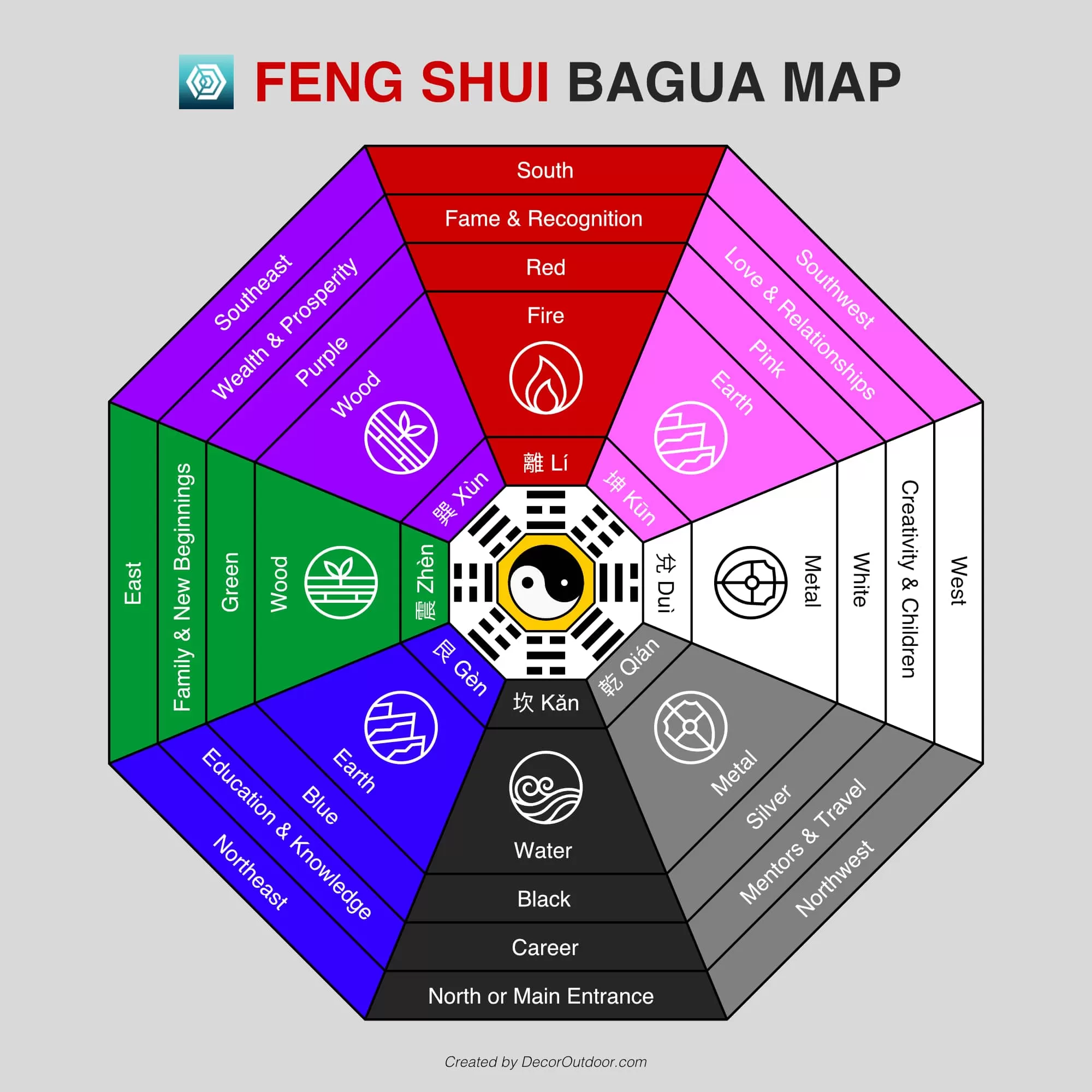 Illustration of a traditional Feng Shui Bagua map showing life areas and directions
 Pair of small Foo Dog statues used as bookends on a shelf indoors
Part of the Celestial Guardians
The Foo Dog is recognized as one of the Three Celestial Guardians in Chinese cosmology and Feng Shui, revered entities sent to protect against malevolent forces known as Sarm Saat (Three Killings). These guardians work together to suppress negative energy and safeguard against misfortune.
- Foo Dog: As detailed, they protect dwellings and inhabitants, embodying the yin/yang balance.
- Chi Lin (Qi Lin / Gi Lin): Often called a Chinese Unicorn, this mythical creature combines features of a horse, fish scales, and a dragon head. It symbolizes prosperity, success, longevity, and protection.
- Pi Xiu (Pi Yao / Pi Xie): A powerful hybrid typically depicted with a lion/dog body and a dragon head, sometimes winged. It is known for attracting wealth and guarding against harm, fiercely loyal to its owner.
 Illustration showing the Three Celestial Guardians: Foo Dog, Chi Lin, and Pi Xiu
These guardians are considered vital protectors within the framework of Tien Di Ren, the cosmic luck trinity that influences an individual’s fortune:
- Tien (Heaven): Destiny determined by birth circumstances (uncontrollable).
- Di (Earth): Luck influenced by environment and location (can be influenced by Feng Shui).
- Ren (Man): Luck influenced by personal actions, relationships, and choices (controllable).
The Celestial Guardians, including Foo Dogs, are primarily seen as influencing Di luck by harmonizing the surrounding environment. Their widespread presence in significant locations underscores their cultural importance in seeking protection and promoting good fortune. Just as different cultural expressions like [byron poetry love] delve into human relationships and choices, these guardians symbolize attempts to influence environmental harmony for human well-being.
 Diagram illustrating the concept of Tien Di Ren luck (Heaven, Earth, Man) in Feng Shui
 Various colored Foo Dog statues displayed together
Conclusion
So, what does the Foo Dog represent? Primarily, they are powerful symbols of protection, standing guard against negative energy and evil spirits. Beyond this fundamental role, they embody status and wealth, historically marking important and prosperous households. Their pairing symbolizes balance and harmony, representing the complementary forces of yin and yang, male and female. The male’s ball signifies the world or empire, while the female’s cub represents the cycle of life and continuity. Within Feng Shui, they represent the potential to influence environmental harmony and contribute to Di (Earth) luck. Their connection to Buddhism links them to concepts of power and truth, and their place among the Three Celestial Guardians solidifies their role in combating negative forces at a cosmic level. While the Western name might be a misnomer, the core meaning of vigilant protection and symbolic significance remains central to their enduring presence in Asian culture and their increasing appreciation worldwide, reflecting a broader interest in incorporating elements that promote positive energy and well-being, similar to how diverse cultural narratives are expressed in forms like a [poem about mexico]. Whether approached with strict adherence to Feng Shui principles or simply as striking cultural artifacts, Foo Dogs stand as timeless guardians, rich with layers of history and meaning.
References
Ogilvie, D., Ng, T., Xiang, D., Ryan, J., & Yong, Y. (2018). The Business of Hospitality: Asian Perspectives.