
Good Friday marks a day of profound solemnity and reflection for Christians worldwide. It commemorates the crucifixion of Jesus Christ, an event central to Christian theology, representing ultimate sacrifice and suffering. As a day steeped in deep emotion and theological significance, Good Friday has long been a powerful subject for poets. Poetry offers a unique language to grapple with the paradoxes of the cross: suffering and salvation, despair and hope, death and the promise of life. Exploring good friday poems allows us to delve into the historical narrative, the human emotions surrounding the event, and its enduring spiritual meaning.
The tradition of reflecting on Jesus’ final words from the cross, often referred to as the “Seven Sentences” or “Seven Sayings,” provides a powerful framework for meditation and poetic response. Each sentence offers a distinct glimpse into Christ’s state of mind, his connection to humanity, and his relationship with the divine during his final hours. These poignant phrases have inspired countless reflections in scripture, liturgy, and, notably, poetry.
This article explores a series of poems that engage with these pivotal moments on the cross. By examining these poetic responses alongside the scriptural accounts and traditional reflections, we can gain a deeper appreciation for the layers of meaning contained within the Good Friday narrative and understand how poetry helps to unlock the emotional and spiritual weight of this significant day. Let us turn our focus to these good friday poems that bloom from the hard ground of Golgotha.
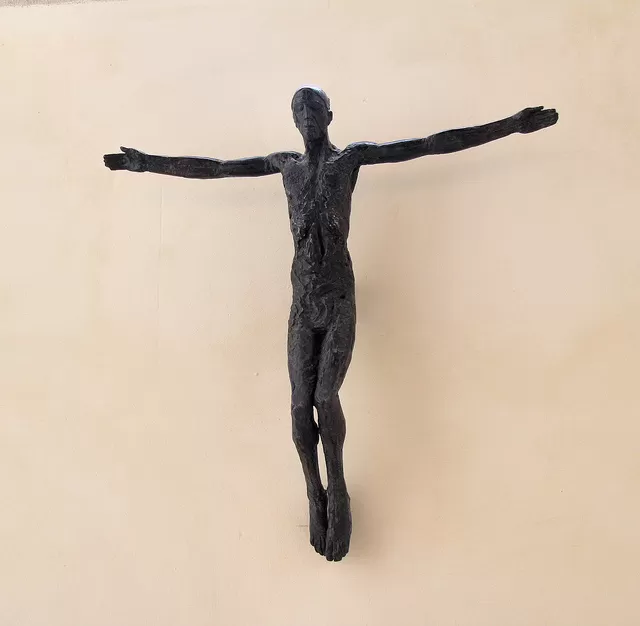 Sculpture of the crucifixion by Elizabeth Frink, evoking the physical suffering.
The First Sentence: “Father, forgive them, for they do not know what they are doing.”
Scripture Reading (from Matthew 27:27-37 and Luke 23:33-34):
Then the governor’s soldiers took Jesus into the Praetorium and gathered the whole company of soldiers around him. They stripped him and put a scarlet robe on him, and then twisted together a crown of thorns and set it on his head. They put a staff in his right hand and knelt in front of him and mocked him. “Hail, king of the Jews!” they said. They spat on him, and took the staff and struck him on the head again and again. After they had mocked him, they took off the robe and put his own clothes on him. Then they led him away to crucify him. As they were going out, they met a man from Cyrene, named Simon, and they forced him to carry the cross. They came to a place called Golgotha (which means The Place of the Skull). There they offered Jesus wine to drink, mixed with gall; but after tasting it, he refused to drink it. When they had crucified him, they divided up his clothes by casting lots. Above his head they placed the written charge against him: THIS IS JESUS, THE KING OF THE JEWS. Two criminals were crucified with him, one on his right and one on his left. Jesus said, “Father, forgive them, for they do not know what they are doing.”
Poem:
We don’t know what we do, from the careless word that starts a fire of anger, to the careless killing of a butterfly – who knows what wide effects, what winds and rains, begin and end with just one death?
We walk in darkness, so often, and so often, we close our eyes, we do not wish to know. And Jesus, seeing this, that his life would end with angry shouts, with fearful washing of hands, with indifferent playing of dice, Knowing all this, even so, he bore our lawful unthinking violence, our blundering disregard for consequences. Another would pay for our actions.
Yet as the ripple of our acts flows out, through the world, who knows where, so too, now, flows forgiveness, following on, spreading and transforming, watering dry ground, lifting burdens and carrying them away.
Reflection: This poem unpacks the radical nature of the first sentence. It extends the concept of “not knowing what we do” from the soldiers and crowds at the cross to the everyday human condition, linking grand violence to small, careless acts like “the killing of a butterfly.” The imagery of a ripple effect highlights the far-reaching consequences of our actions, intended or not. The phrase “lawful unthinking violence” is particularly striking, suggesting that much harm is done under the guise of legitimacy or simple indifference. The poem contrasts this with the counter-flow of forgiveness, which “spreads and transforms,” offering healing and renewal. It emphasizes that forgiveness, like violence, has wide-reaching effects, providing a powerful theme found in many poem of good friday.
Response from Psalm 22: v3-5
Yet you are holy, dwelling in the praises of Israel. In you our fathers trusted; they trusted, and you delivered them. To you they cried, and were rescued; in you they trusted and were not put to shame.
 Painting 'Angus Dei' by Francisco de Zurbarán, a symbolic depiction of Christ as the sacrificial lamb.
The Second Sentence: “Truly I say to you, today you will be with me in paradise.”
Scripture Reading (from Luke 23:39-43):
One of the criminals who hung there hurled insults at him: “Aren’t you the Christ? Save yourself and us!” But the other criminal rebuked him. “Don’t you fear God,” he said, “since you are under the same sentence? We are punished justly, for we are getting what our deeds deserve. But this man has done nothing wrong.” Then he said, “Jesus, remember me when you come into your kingdom”. Jesus answered him, “I tell you the truth, today you will be with me in paradise.”
Poem:
Even as he hung upon the cross, even with blood from that false crown running down, not wiped away, he saw the two men at his side,
One joined in mocking with the priests and soldiers, speaking from his pain, and one did not, this second kept his eyes on something else – a hope.
A hope the one he looked on was a king, and of a kingdom where such things as crosses are not lifted up, a hope, even, of an end to death and pain – this pain, this death.
And, ah, his king begins to speak, of paradise. What a world to gift him dying there. A word of such sweetness, freedom, peace. See – clear water flowing, and flowers, hear the sound of birds, the lazy buzz of insects, the flutter of their wings.
What a word, at your end, to hold to, to capture our beginning, once again. But even more than this, to be with him, beside the king, seen and known, held in the loving gaze of one who hung up on the cross. Might this, even this, be paradise?
Reflection: This poem focuses on the dialogue between Jesus and the repentant criminal, highlighting the contrast between the two men crucified alongside him. It emphasizes the “hope” held by the second criminal, who saw beyond the immediate suffering to recognize Jesus as a king and glimpse the possibility of a different kingdom. The poem vividly imagines the conventional imagery of paradise (“clear water flowing, and flowers”) but then shifts to suggest a deeper, perhaps more profound, definition: being “with him, beside the king, seen and known, held in the loving gaze.” This offers a moving interpretation of paradise as not just a place, but a state of being in the presence of divine love. This hopeful message is a crucial counterpoint within poems about good friday, which often focus predominantly on suffering.
Response from Psalm 22:v 27-28
All the ends of the earth shall remember and turn to the Lord, and all the families of the nations shall worship before you. For kingship belongs to the Lord.
 Abstract image prompting reflection on the concept of paradise, linked to Jesus' words on the cross.
The Third Sentence: “Dear woman, here is your son,” and to the disciple, “Son, here is your mother.”
Scripture Reading (from John 19:25-27):
Near the cross of Jesus stood his mother, his mother’s sister, Mary the wife of Clopas, and Mary Magdalene. When Jesus saw his mother there, and the disciple whom he loved standing nearby, he said to his mother, “Dear woman, here is your son,” and to the disciple, “Son, here is your mother.” From that time on, this disciple took her into his home.
Poem:
And still he sees, looks down towards the one who bore him, bearing this, the pain – not her own pain – worse, the pain of watching one you love twisting on those wooden beams, the nails piercing her own flesh too.
The time has come when all the treasure of her heart is broken open, scattered, lying in the dirt. What use to hold in mind the words of angels, the wealthy gifts brought by the wise, what preparation Simeon’s warning, when now she sees his agony with her eyes. But she is not alone, his friend sees too. John, who writes it down, bears witness, even here, even so. They turn their gaze upon each other and see each other with new eyes – a mother, and a son. Gifting them each other – his one last act of love, this giving, from an empty cup. This task of care can be ours too, to behold each other in our pain, and in our sorrow, walk each other home.
Reflection: This poem highlights the deeply human element of the crucifixion narrative – Jesus’ concern for his mother. It emphasizes Mary’s unique suffering, portraying it as worse than physical pain because it is the agony of witnessing the suffering of her child. The poem contrasts past moments of joy and prophecy (“words of angels,” “gifts brought by the wise”) with the stark reality of the present agony. Jesus’ act of entrusting Mary to the disciple is presented as a final act of love, a “giving, from an empty cup,” emphasizing the immense cost to him. The poem expands this command outwards, suggesting that the task of “behold[ing] each other in our pain, and in our sorrow, walk[ing] each other home” is a call to the reader as well, connecting the specific scene at the cross to a universal call for compassionate care. This theme resonates with the supportive nature found in some quilting poems, though the context is vastly different.
Response from Psalm 22: v 9-11
Yet you are he who took me from the womb; you made me trust you at my mother’s breasts. On you was I cast from my birth, and from my mother’s womb you have been my God. Be not far from me, for trouble is near, and there is none to help.
 Michelangelo's Pieta sculpture, depicting Mary holding the body of Jesus after the crucifixion, reflecting on maternal sorrow.
The Fourth Sentence: “My God, my God, why have you forsaken me?”
Scripture Reading (from Matthew 27:45-46):
From the sixth hour until the ninth hour darkness came over all the land. About the ninth hour Jesus cried out in a loud voice, “Eloi, Eloi, lama sabachthani?”–which means, “My God, my God, why have you forsaken me?”
Poem:
You felt your generous heart forsaken, you felt the absence of the one who helps, who was beside you, in the beginning, who knew you from before first light.
We know too well the sparseness of your isolation, without light, and companionless, in the darkness of our own long night. And yet, within our dark, we find you there, Find you have waited for us long days, and years, while our poor eyes have grown accustomed to the dark, have learned at last to see you through our tears. So as you know our pain and feel it, you break our separation with your own. Help us see the forsaken all around us, invisible and in darkness, but seen by you. May we seek each other in the dark, May we have courage to cry out, like you, and so be found.
Reflection: This sentence introduces a moment of profound desolation, and the poem explores the feeling of being “forsaken.” It connects Jesus’ experience of feeling abandoned by God to the human experience of isolation and “darkness.” However, the poem introduces a turn: it is within this shared darkness that a connection is forged. Jesus’ experience of abandonment is portrayed as breaking our separation, allowing us to find him in our own dark nights. The poem moves from contemplating Jesus’ isolation to a call to recognize and seek out the “forsaken all around us,” drawing a parallel between divine and human experiences of loneliness and the need for connection. This raw expression of spiritual pain is a key aspect of many [good friday poems].
Response from Psalm 22: v11, 14
Be not far from me, for trouble is near, and there is none to help.
I am poured out like water, and all my bones are out of joint, my heart is like wax it is melted within my breast.
 Image representing darkness or despair, potentially symbolizing the feeling of being forsaken expressed in the fourth saying.
The Fifth Sentence: “I thirst.”
Scripture Reading (from John 19:28):
Knowing that all was now completed, and so that the Scripture would be fulfilled, Jesus said, “I thirst.”
Poem:
The well is deep, and you have nothing to draw with. Where now that living water? Where is that spring within you, gushing up to fullness of life? Do you remember, now, the woman by the well? Your deepening talk of thirst and water, as now, again, you humbly ask another for a drink – this time, a sponge of sour wine?
Do you remember too, as the taste dries on your lips, that wedding feast, where water changed to finest wine? The richness and fullness of that beginning soured to this cold bitterness.
You are our source, the spring of all our rivers and still you thirst like us, need help to drink. And so give us this grace, that as we do for the least of these, we may know we do for you.
May we see you in each thirsty face.
Reflection: The simple declaration “I thirst” speaks to the physical reality of crucifixion but also carries symbolic weight. The poem connects this physical thirst to Jesus’ earlier teachings about “living water” and the imagery of wells and springs, particularly referencing his encounter with the Samaritan woman. It contrasts the “fullness” of life and abundance symbolized by the water-into-wine miracle with the “cold bitterness” of the sour wine offered on the cross. By stating, “You are our source… and still you thirst like us,” the poem highlights Christ’s identification with human need and suffering. The poem concludes with a call to action, linking ministering to the thirsty and needy (“the least of these”) with ministering to Christ himself, a theme that finds echoes in devotional texts and some forms of spiritual verse like short easter poem for church.
Response from Psalm 22: v 15
My strength is dried up like a potsherd and my tongue sticks to my jaws you lay me in the dust of death.
The Sixth Sentence: “It is finished.”
Scripture Reading (John 19:29-30):
A jar of wine vinegar was there, so they soaked a sponge in it, put the sponge on a stalk of the hyssop plant, and lifted it to Jesus’ lips. When he had received the drink, Jesus said, “It is finished.”
Poem:
All things come to an end. Even pain like this, Even the anger and the cruelty of a crowd, of us all, even the certainty of those so certain of God they hang a man upon a tree. Even the punishment and scapegoating even violence, even death.
The work is done. It has all been borne. You have poured out your love, your life. You have carried our sorrows, suffered under our iniquities.
Your head bowed now, you sink into the final pain of nails, your body bears no more, having borne all. The work is done.
Reflection: “It is finished” can be interpreted as a cry of completion – the task assigned has been accomplished. The poem expands on this, listing the difficult things that come to an end with Christ’s finished work: physical pain, human cruelty, religious certainty turned to violence, punishment, and even death itself. It emphasizes the totality of what was borne: “our sorrows,” “our iniquities.” The final lines reinforce the physical reality of the death while affirming that the spiritual “work” is concluded, a pivotal turning point in the narrative often explored in deeper [good friday poems].
Response from Psalm 22: v 24
For he has not despised or abhorred the affliction of the afflicted. and he has not hidden his face from him but has heard, when he cried to him.
 Stars visible through trees, symbolizing hope or the spirit's ascent after the cry 'It is finished'.
The Seventh Sentence: “Father, into your hands I commit my spirit.”
Scripture Reading (from Luke 23:44-49):
It was now about noon, and darkness came over the whole land until three in the afternoon, while the sun’s light failed; and the curtain of the temple was torn in two. Jesus called out with a loud voice, “Father, into your hands I commit my spirit.”
Poem:
There is darkness now, deep darkness, over the face of the deep, and no hovering like a brooding bird, instead, the temple curtain torn in two, from top to bottom, and the Holy of Holies empty.
God is not found there, but here, with this dying man on a tree, He calls out father, and talks of hands, and we remember what his own hands have done, how many were healed by their touch, raised up and restored from cruelty and death, and now, he too will be held in loving hands, a reconciliation beyond our grasp, a trust even at this moment of last breath.
Dying, he taught us to die, dying he brought us life. May we be reconciled, may we know at our end, the comfort of those hands.
Reflection: This final saying expresses trust and surrender. The poem uses powerful imagery: the primordial “darkness over the face of the deep” from creation, contrasting it with the tearing of the temple curtain, symbolizing direct access to God no longer confined to a physical space. The poem posits that God’s presence is now fundamentally linked to the suffering Christ (“God is not found there, but here, with this dying man on a tree”). It emphasizes Jesus’ own healing hands and contrasts them with his own surrender into God’s hands. The act of dying is reframed not just as an end, but as a final lesson and the source of life for others, moving towards a message of reconciliation and comfort. This concluding reflection brings together the themes of suffering, divine presence, and the promise of transformation inherent in the Good Friday story, making it a poignant piece among english language haiku and longer forms alike that grapple with ultimate realities.
Response from Psalm 22: v 26
The afflicted shall eat and be satisfied those who seek him shall praise the Lord May your hearts live for ever.
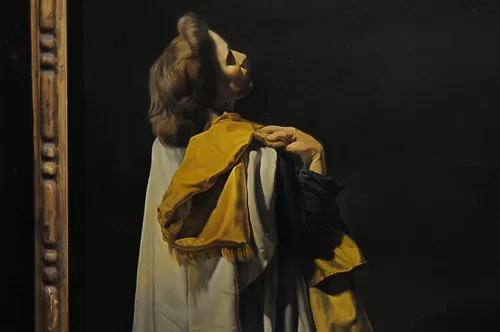 Detail from Salvador Dalí's 'Corpus Hypercubus', depicting the crucifixion with mathematical structure, reflecting on the spiritual dimension.
Conclusion
Exploring these good friday poems offers a deeply moving way to connect with the events of the crucifixion. By meditating on each of Jesus’ final sentences through the lens of poetry, we are invited to move beyond historical narrative into emotional and spiritual engagement. The poems provide rich imagery, theological insight, and a bridge between the events of 2000 years ago and our own lives, prompting reflection on themes of forgiveness, hope, human connection, divine abandonment, suffering, completion, and surrender. Poetry, in its condensed and evocative form, allows us to sit with the discomfort and sorrow of the day while also glimpses of the profound love and ultimate purpose central to the Good Friday story.
These poetic responses, paired with scripture and psalm verses, create a layered experience that acknowledges the complexity of the cross. They remind us that Good Friday, while somber, is a necessary prelude to the hope of Easter, a day where death is faced head-on before life can fully bloom. Engaging with such good friday poems enriches our understanding and deepens our personal connection to this pivotal moment in history and faith.