
Good Friday stands as a pivotal moment in the Christian calendar, a day of profound reflection on the sacrifice of Jesus Christ on the cross. It is a day marked by sorrow, solemnity, and deep contemplation of suffering, love, and redemption. For centuries, artists, theologians, and writers have sought to capture the immense weight and significance of this day. Poetry, with its unique ability to condense complex emotions and narratives into potent imagery and rhythm, offers a powerful lens through which to engage with the events of the crucifixion. Engaging with a poem of good friday allows us to connect on an emotional and spiritual level, moving beyond mere historical recounting to a deeper understanding of the human and divine drama unfolding on Golgotha. This article explores a sequence of poems inspired by the “Seven Last Words from the Cross,” offering a meditation on each poignant utterance and delving into the poetic nuances that illuminate their enduring meaning.
Contents
- The First Word: “Father, forgive them, for they do not know what they are doing”
- The Second Word: “Truly I say to you, today you will be with me in paradise.”
- The Third Word: “Dear woman, here is your son,” and “Son, here is your mother.”
- The Fourth Word: “My God, my God, why have you forsaken me?”
- The Fifth Word: “I thirst.”
- The Sixth Word: “It is finished.”
- The Seventh Word: “Father, into your hands I commit my spirit.”
- Conclusion
The “Seven Last Words” are traditionally drawn from the Gospel accounts, moments where Jesus speaks from the cross, revealing his character, purpose, and the depth of his suffering and faith. Each word, brief yet resonant, provides a window into the heart of the Passion. By approaching these words through the medium of poetry, we can unlock layers of meaning and emotional resonance that prose might struggle to convey. This exploration aims to provide insightful analysis and commentary on how poetic form and language enhance our contemplation of these sacred words, serving as a guide through a meditative journey on this solemn day.
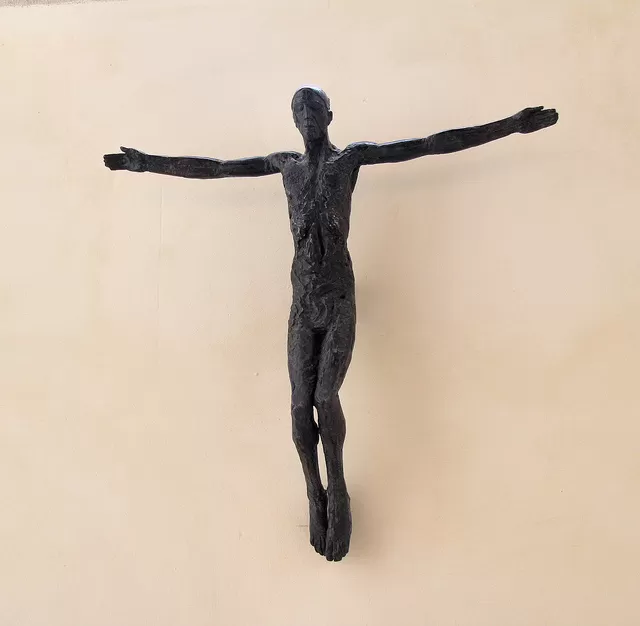 Elizabeth Frink sculpture reflecting Good Friday themes
The First Word: “Father, forgive them, for they do not know what they are doing”
Spoken amidst the brutal act of crucifixion, this first word, recorded in Luke 23:34, is an astonishing expression of forgiveness. It is directed not just at the Roman soldiers carrying out the execution, but implicitly at all who contributed to his suffering and indeed, humanity’s capacity for misunderstanding and sin.
The poem reflecting on this word delves into the nature of human actions and ignorance:
We don’t know what we do, from the careless word that starts a fire of anger, to the careless killing of a butterfly – who knows what wide effects, what winds and rains, begin and end with just one death?
We walk in darkness, so often, and so often, we close our eyes, we do not wish to know. And Jesus, seeing this, that his life would end with angry shouts, with fearful washing of hands, with indifferent playing of dice, Knowing all this, even so, he bore our lawful unthinking violence, our blundering disregard for consequences. Another would pay for our actions.
Yet as the ripple of our acts flows out, through the world, who knows where, so too, now, flows forgiveness, following on, spreading and transforming, watering dry ground, lifting burdens and carrying them away.
This poem of good friday immediately broadens the scope of “them” to encompass a universal human condition: “We don’t know what we do.” The examples move from the seemingly small (“careless word,” “killing of a butterfly”) to the profound violence of the crucifixion, highlighting how thoughtlessness and ignorance can have far-reaching, devastating consequences. The imagery of a “fire of anger” and the butterfly effect underscores the uncontrolled spread of harm initiated by simple, often unintentional, acts.
The poem identifies a deliberate component to this ignorance: “we close our eyes, we do not wish to know.” This suggests a wilful blindness, a refusal to acknowledge the impact of our deeds. Yet, set against this human failing, the poem emphasizes Jesus’ full awareness (“Knowing all this”) and his conscious choice to “bore our lawful unthinking violence.” The phrase “lawful unthinking violence” is particularly powerful, suggesting that even within systems or actions deemed legitimate, a fundamental lack of awareness or empathy can render them violent and unjust.
The final stanza shifts from the problem to the solution: forgiveness. The poem uses the same metaphor of outward flow (“ripple of our acts”) but applies it to forgiveness, which “flows on, spreading and transforming.” This counter-movement of grace actively works against the destructive ripple of ignorance and violence. Forgiveness is depicted as an active, life-giving force, “watering dry ground,” and relieving burdens. This poetic treatment transforms a moment of suffering into a powerful statement about the redemptive counter-force available to humanity, originating from the cross. It powerfully articulates the core message of this first, remarkable poems about good friday reflection.
Response from Psalm 22: v3-5:
Yet you are holy, dwelling in the praises of Israel. In you our fathers trusted; they trusted, and you delivered them. To you they cried, and were rescued; in you they trusted and were not put to shame.
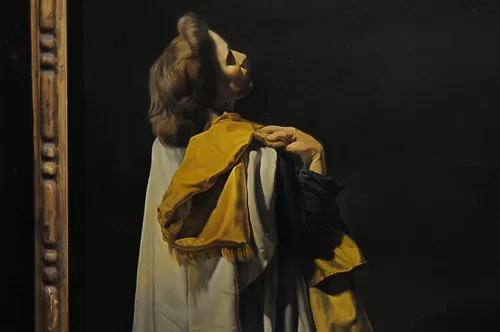
 Francisco de Zurbarán's painting of the Lamb of God (Angus Dei)
The Second Word: “Truly I say to you, today you will be with me in paradise.”
This word, found in Luke 23:43, is spoken to one of the criminals crucified alongside Jesus. It is a word of immediate grace and hope, promising salvation to a penitent heart in the face of imminent death.
The poem captures the profound contrast between the physical reality of the cross and the spiritual promise:
Even as he hung upon the cross, even with blood from that false crown running down, not wiped away, he saw the two men at his side,
One joined in mocking with the priests and soldiers, speaking from his pain, and one did not, this second kept his eyes on something else – a hope.
A hope the one he looked on was a king, and of a kingdom where such things as crosses are not lifted up, a hope, even, of an end to death and pain – this pain, this death.
And, ah, his king begins to speak, of paradise. What a world to gift him dying there. A word of such sweetness, freedom, peace. See – clear water flowing, and flowers, hear the sound of birds, the lazy buzz of insects, the flutter of their wings.
What a word, at your end, to hold to, to capture our beginning, once again. But even more than this, to be with him, beside the king, seen and known, held in the loving gaze of one who hung up on the cross. Might this, even this, be paradise?
The poem opens with stark physical details – the cross, the flowing blood – grounding the moment in harsh reality. It then focuses on the interaction between the three figures, highlighting the different responses to suffering: mocking versus hope. The penitent criminal’s hope is defined by a vision of Jesus as a king and a kingdom free from suffering and death. This hope provides a counterpoint to the surrounding pain.
The arrival of the word “paradise” is depicted almost breathlessly (“And, ah”). The poem uses sensory language to paint a picture of this promised state: “sweetness, freedom, peace,” “clear water flowing, and flowers,” “sound of birds,” “lazy buzz of insects.” This vivid imagery makes the abstract concept of paradise tangible and deeply desirable, especially in contrast to the agony being endured. It emphasizes the incredible generosity of this gift given at the point of death.
The final stanza elevates the promise beyond just a place; it is about presence: “to be with him, beside the king, seen and known, held in the loving gaze.” This suggests that the true essence of paradise, in this context, is not merely an idyllic setting but the experience of being in the presence of divine love and recognition, even from one who is suffering alongside you. This redefinition of paradise provides a powerful meditation on the nature of salvation offered through Christ on this poem of good friday.
Response from Psalm 22:v 27-28:
All the ends of the earth shall remember and turn to the Lord, and all the families of the nations shall worship before you. For kingship belongs to the Lord.
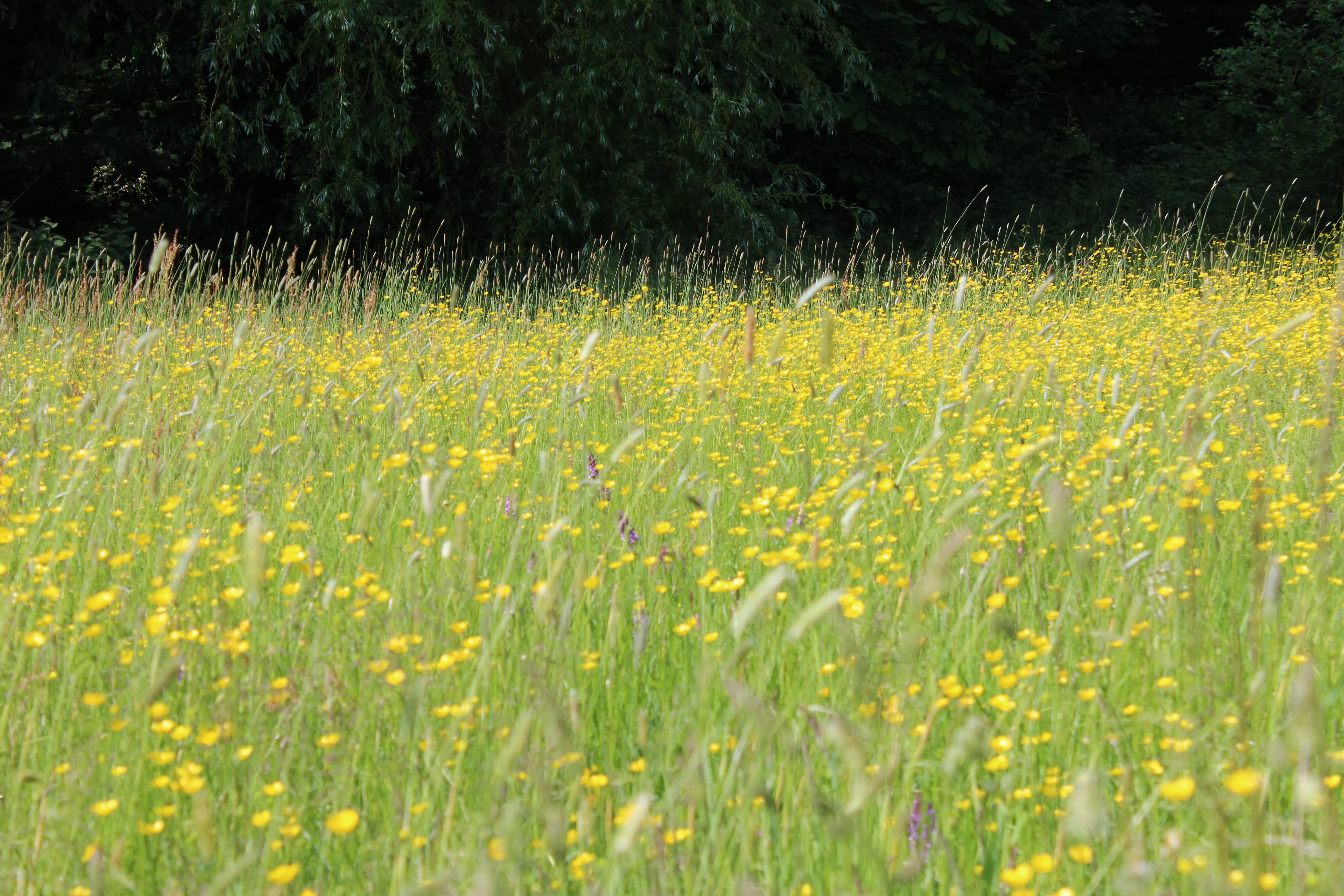 Pastoral field scene evoking the imagery of paradise
The Third Word: “Dear woman, here is your son,” and “Son, here is your mother.”
From John 19:25-27, these words are addressed to Mary, Jesus’ mother, and the “disciple whom he loved,” traditionally identified as John. This moment emphasizes Jesus’ human relationships and his concern for his family even in his final moments, entrusting his mother’s care to his beloved disciple.
The poem reflects on the shared pain and the new bond forged at the foot of the cross:
And still he sees, looks down towards the one who bore him, bearing this, the pain – not her own pain – worse, the pain of watching one you love twisting on those wooden beams, the nails piercing her own flesh too.
The time has come when all the treasure of her heart is broken open, scattered, lying in the dirt. What use to hold in mind the words of angels, the wealthy gifts brought by the wise, what preparation Simeon’s warning, when now she sees his agony with her eyes. But she is not alone, his friend sees too. John, who writes it down, bears witness, even here, even so. They turn their gaze upon each other and see each other with new eyes – a mother, and a son. Gifting them each other – his one last act of love, this giving, from an empty cup. This task of care can be ours too, to behold each other in our pain, and in our sorrow, walk each other home
This poems about good friday delves deeply into the emotional anguish of witness, particularly Mary’s. The poem emphasizes that her pain is not primarily her own physical suffering but the far more intense pain of watching her son’s agony. The visceral image of “the nails piercing her own flesh too” conveys the depth of empathetic suffering.
The poem contrasts Mary’s past joys and prophecies (angels, wise men, Simeon’s warning) with the stark reality before her, suggesting that no past preparation could truly brace her for this moment. Her heart’s “treasure” is “broken open, scattered, lying in the dirt,” a powerful metaphor for the shattering of hopes and dreams.
The presence of John is crucial; he “sees too” and “bears witness,” validating the reality of the suffering. The core of the poem lies in the moment Mary and John look at each other and see “with new eyes,” recognizing a new relationship being formed by Jesus’ words. The act of “Gifting them each other” is described as “his one last act of love, this giving, from an empty cup.” This phrase beautifully captures the selfless nature of Jesus’ act – even when physically and emotionally drained (“empty cup”), he continues to give love and care. The final lines extend this act of care to the reader, suggesting that “to behold each other in our pain, and in our sorrow, walk each other home” is a contemporary manifestation of this Good Friday command.
Response from Psalm 22: v 9-11:
Yet you are he who took me from the womb; you made me trust you at my mother’s breasts. On you was I cast from my birth, and from my mother’s womb you have been my God. Be not far from me, for trouble is near, and there is none to help.
 Detail of Michelangelo's Pieta sculpture depicting sorrow on Good Friday
The Fourth Word: “My God, my God, why have you forsaken me?”
This agonizing cry, recorded in Matthew 27:46 and Mark 15:34, is perhaps the most human and mysterious of the seven words. It echoes Psalm 22, expressing a profound sense of abandonment and separation from God.
The poem grapples with this expression of divine suffering and its resonance in human experience:
You felt your generous heart forsaken, you felt the absence of the one who helps, who was beside you, in the beginning, who knew you from before first light.
We know too well the sparseness of your isolation, without light, and companionless, in the darkness of our own long night. And yet, within our dark, we find you there, Find you have waited for us long days, and years, while our poor eyes have grown accustomed to the dark, have learned at last to see you through our tears. So as you know our pain and feel it, you break our separation with your own. Help us see the forsaken all around us, invisible and in darkness, but seen by you. May we seek each other in the dark, May we have courage to cry out, like you, and so be found.
This poem of good friday immediately humanizes Jesus’ cry, describing his “generous heart forsaken” and the felt “absence.” It contrasts this moment with his eternal relationship with God (“beside you, in the beginning, who knew you from before first light”), emphasizing the depth of the separation he experienced on the cross.
The poem then draws a direct parallel to human experience: “We know too well the sparseness of your isolation… in the darkness of our own long night.” This universality of feeling forsaken connects Christ’s suffering to the reader’s own moments of despair and isolation. However, the poem pivots from shared pain to shared presence: “within our dark, we find you there.” This suggests that Christ’s experience of abandonment allows him to be uniquely present with us in our own darkness.
The imagery of eyes growing “accustomed to the dark” and learning “to see you through our tears” beautifully portrays the process of finding faith and connection amidst suffering. The poem asserts that Jesus’ act of being forsaken “break[s] our separation with your own,” implying that his descent into the depths of human despair bridges the gap for us. The final lines serve as a call to action and empathy, urging us to see the “forsaken all around us” and to have the courage to cry out our own pain, knowing that this shared vulnerability connects us to both Christ and each other, ensuring we “so be found.”
Response from Psalm 22: v11, 14:
Be not far from me, for trouble is near, and there is none to help.
I am poured out like water, and all my bones are out of joint, my heart is like wax it is melted within my breast
 Image depicting a dark well, symbolizing isolation and crying out from the depths
The Fifth Word: “I thirst.”
A simple, raw statement of physical suffering, recorded in John 19:28. This word underscores the very real human agony Jesus endured.
The poem reflects on this basic human need in a theological context:
The well is deep, and you have nothing to draw with. Where now that living water? Where is that spring within you, gushing up to fullness of life? Do you remember, now, the woman by the well? Your deepening talk of thirst and water, as now, again, you humbly ask another for a drink – this time, a sponge of sour wine?
Do you remember too, as the taste dries on your lips, that wedding feast, where water changed to finest wine? The richness and fullness of that beginning soured to this cold bitterness.
You are our source, the spring of all our rivers and still you thirst like us, need help to drink. And so give us this grace, that as we do for the least of these, we may know we do for you.
May we see you in each thirsty face.
This poems about good friday begins with the powerful imagery of a deep well and no means to draw water, a metaphor for profound need and helplessness. It immediately contrasts this physical thirst with Jesus’ previous teachings about “living water” and the “spring within you, gushing up,” referencing his encounter with the Samaritan woman (John 4). This contrast highlights the extent to which Jesus emptied himself, experiencing human need to its fullest.
The poem draws another contrast, recalling the wedding at Cana (John 2), where water was transformed into the “finest wine,” symbolizing abundance and joy. This is juxtaposed with the “sour wine” offered on the cross, illustrating the bitter culmination of his earthly journey. The shift from richness and fullness to “cold bitterness” emphasizes the sacrifice involved.
The central paradox is captured in the line, “You are our source, the spring of all our rivers and still you thirst like us, need help to drink.” The one who provides ultimate spiritual sustenance experiences the most basic physical lack. This vulnerability creates a point of identification between the divine and the human. The poem concludes by connecting this physical thirst to the needs of others, echoing Jesus’ teaching in Matthew 25:40 (“as you did it to one of the least of these… you did it to me”). The final line is a prayer for empathy, asking to recognize Christ in the suffering of others, particularly those who thirst in any sense.
Response from Psalm 22: v 15:
My strength is dried up like a potsherd and my tongue sticks to my jaws you lay me in the dust of death
 Rough stone texture possibly symbolizing dryness or thirst
The Sixth Word: “It is finished.”
Pronounced in John 19:30 just before death, this word can be understood as the completion of Jesus’ mission, the fulfilment of prophecy, and the ultimate sacrifice offered for humanity’s redemption. It is a statement of accomplishment, even in the face of death.
The poem explores the profound finality and meaning of this declaration:
All things come to an end. Even pain like this, Even the anger and the cruelty of a crowd, of us all, even the certainty of those so certain of God they hang a man upon a tree. Even the punishment and scapegoating even violence, even death.
The work is done. It has all been borne. You have poured out your love, your life. You have carried our sorrows, suffered under our iniquities.
Your head bowed now, you sink into the final pain of nails, your body bears no more, having borne all. The work is done.
This poem of good friday begins by affirming the universal truth that “All things come to an end,” but immediately applies it to negative forces and experiences: pain, anger, cruelty, misplaced certainty, punishment, scapegoating, violence, and death itself. By stating that even these come to an end here, through Christ’s finished work, the poem suggests that his death signifies the beginning of the end for these destructive forces.
The core of the poem focuses on the completeness of Jesus’ work: “The work is done. It has all been borne.” The poem enumerates aspects of this work: pouring out love and life, carrying sorrows, suffering under iniquities. This language directly references Old Testament prophecies (like Isaiah 53) and theological concepts of atonement, where Christ takes upon himself the burdens and sins of humanity.
The poem returns to the physical reality of the body (“Your head bowed now,” “body bears no more”), but frames it not as defeat but as the final sign of a task completed. The physical exhaustion and surrender are the result of having “borne all.” The repetition of “The work is done” reinforces the sense of completion and profound accomplishment inherent in this sixth word. It signifies the culmination of the journey begun on this poem of good friday and points towards the hope of what comes next.
Response from Psalm 22: v 24:
For he has not despised or abhorred the affliction of the afflicted. and he has not hidden his face from him but has heard, when he cried to him.
 Stars visible through trees at night, suggesting cosmic darkness and significance
The Seventh Word: “Father, into your hands I commit my spirit.”
The final word, recorded in Luke 23:46, is a declaration of trust and surrender. Despite the feeling of being forsaken (the fourth word), Jesus ultimately commits his spirit to God, demonstrating profound faith even in death.
The poem meditates on this ultimate act of surrender and trust:
There is darkness now, deep darkness, over the face of the deep, and no hovering like a brooding bird, instead, the temple curtain torn in two, from top to bottom, and the Holy of Holies empty.
God is not found there, but here, with this dying man on a tree, He calls out father, and talks of hands, and we remember what his own hands have done, how many were healed by their touch, raised up and restored from cruelty and death, and now, he too will be held in loving hands, a reconciliation beyond our grasp, a trust even at this moment of last breath.
Dying, he taught us to die, dying he brought us life. May we be reconciled, may we know at our end, the comfort of those hands.
This final poem of good friday opens by setting the scene with cosmic and religious symbolism: the “deep darkness” echoing creation narratives and the torn “temple curtain” signifying a radical shift in access to the divine. The “Holy of Holies empty” underscores this shift – God’s presence is no longer confined to a sacred space.
The poem then states where God is found: “here, with this dying man on a tree.” This emphasizes the Incarnation to the very end – God is found in the midst of suffering and death. The focus on “hands” in Jesus’ last word prompts a reflection on Jesus’ own hands and their work of healing and restoration. This contrast between his active, life-giving hands and his passive surrender into God’s hands is powerful.
The concept of “loving hands” receiving him signifies not just a return but a “reconciliation beyond our grasp,” a mystical reunion. The poem highlights the extraordinary “trust” required for this final act. The final lines summarize the profound paradox of Christ’s death: “Dying, he taught us to die, dying he brought us life.” His death is both an example of how to surrender and the source of new life for others. The concluding prayer asks for this same comfort and reconciliation in our own deaths. This contemplation of the final word brings the Good Friday journey to its conclusion, while implicitly pointing towards the themes explored in easter day poems and easter poem church, which celebrate the life that emerges from this death, often reflected in church easter poems services.
 Detail from Salvador Dalí's unique Crucifixion painting (Corpus Hypercubus)
Conclusion
Exploring the Seven Last Words through the lens of poetry offers a deeply moving and insightful experience. Each poems about good friday in this collection serves as a meditative guide, drawing out the emotional, theological, and human dimensions of Christ’s final utterances. From the stunning grace of forgiveness and the promise of paradise to the raw cry of abandonment, the profound care for relationships, the simple human need of thirst, the declaration of finished work, and the ultimate act of surrender, these poems illuminate the multi-faceted nature of the crucifixion.
Poetry provides a unique space for contemplation, allowing readers to linger on specific images, phrases, and feelings evoked by the language. It encourages a personal engagement with the narrative, transforming it from a distant historical event into a present reality that speaks to human suffering, hope, and faith. Engaging with a poem of good friday such as this sequence enriches our understanding and appreciation of the profound sacrifice commemorated on this solemn day. It reminds us that even in the darkest moments, there is grace, connection, completion, and ultimate trust.