
William Shakespeare, the towering figure of English literature, left behind a legacy not only in his unparalleled plays and sonnets but also in the enduring mystery surrounding his death and burial. Laid to rest in the chancel of Holy Trinity Church in Stratford-Upon-Avon, his tomb is marked not by his name, but by a stern inscription – a curse intended to safeguard his remains for eternity. This peculiar epitaph is one of the most discussed features of his final resting place, prompting countless inquiries into what is written on Shakespeare’s grave.
The inscription etched onto the ledger stone covering Shakespeare’s grave is a quatrain believed to have been penned by the Bard himself. It reads:
Good friend for Jesus sake forbeare,
To dig the dust enclosed here.
Blessed be the man that spares these stones,
And cursed be he that moves my bones.
This chilling verse serves as a powerful warning to anyone contemplating disturbing the ground beneath. In an era when churchyards were often reused and bodies exhumed to make space or for anatomical study, Shakespeare’s concern about the sanctity of his burial site was far from unfounded. The curse reflects a deep-seated desire for perpetual peace in his final resting place, a stark contrast to the dynamic, often turbulent worlds depicted in his plays and, perhaps, mirroring themes found in shakespeare death poems.
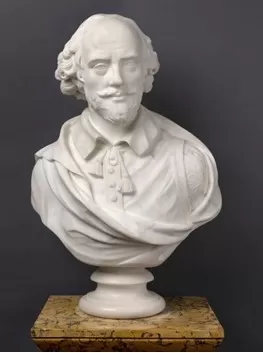 One of only two known portraits of William Shakespeare, believed to be by John Taylor, illustrating the iconic face behind the tomb’s mystery.
For centuries, it seemed the curse held sway. Despite appeals from researchers and a natural historical curiosity, the Church of the Holy Trinity consistently refused permission for any physical excavation of the grave, citing a desire to honor Shakespeare’s explicit wishes. Builders performing repairs in 2008 notably avoided disturbing the stones, a testament to the inscription’s enduring power. This respect for the Bard’s final words highlights the cultural significance attributed to what is written on Shakespeare’s grave. Many visitors to Stratford-Upon-Avon make a pilgrimage specifically to see this unique and foreboding epitaph. Exploring shakespeare poetry offers further insight into the mind that crafted such a definitive final statement.
Beyond the famous curse, Shakespeare’s grave presents other intriguing anomalies. Unlike the ledger stones of his wife, Anne Hathaway, and other family members buried nearby, his stone bears no name. His identity is commemorated by a funerary monument erected on the adjacent wall, featuring a half-effigy of Shakespeare in the act of writing, installed sometime before 1623. Furthermore, the grave itself is unusually short, measuring less than a meter, and evidence suggests he was not buried in a traditional coffin but likely wrapped in a winding sheet, a practice common at the time but adding another layer to the distinctiveness of his burial site.
 Shakespeare’s funerary monument sits above his grave, featuring a carving of the playwright, a key visual element near what is written on Shakespeare’s grave.
The mystery deepened significantly in 2016, the 400th anniversary of his death. While physical excavation was still off-limits, a non-invasive ground-penetrating radar scan was permitted. The results were startling: the scan indicated disturbances at the head end of the grave and suggested Shakespeare’s skull might be missing. This finding gave new credence to a long-dismissed story published in 1879 in Argosy Magazine, which recounted a tale of grave robbers stealing Shakespeare’s skull in 1794 for a hefty sum. While a subsequent search for the skull in a nearby church yielded only the remains of an elderly woman, the scan provides compelling modern evidence that the grave was indeed tampered with at some point after burial.
 A view of Shakespeare’s grave within Holy Trinity Church, showing the ledger stone inscribed with the famous curse that defines what is written on Shakespeare’s grave.
The enduring question of the missing skull adds a layer of macabre intrigue to the site, making the curse inscribed on the stone all the more poignant. Whether the supposed grave robbers suffered any ill fate as a result of their actions remains unknown. However, the tale underscores the power of the warning carved into the stone and the public’s fascination with the possibility that the Bard’s final words might carry a potent, if perhaps symbolic, retribution. The mystery of Shakespeare’s grave, from its unusual features to the potential violation suggested by the scan, ensures that what is written on Shakespeare’s grave continues to captivate and intrigue visitors centuries after his passing, a final, dramatic act from the master storyteller. You can delve deeper into his vast literary output by exploring works from shakespeare poetry.