
William Shakespeare (1564-1616) is undoubtedly one of history’s most celebrated literary figures. While his fame often rests on his monumental plays, earning him the moniker “The Bard,” his prolific output also includes a significant body of poetry. Over 150 sonnets and two major narrative poems form a crucial part of the poem Shakespeare legacy, offering deep insights into his artistry beyond the theatrical world. To fully appreciate Shakespeare’s genius, one must delve into these often-overlooked poetic works, exploring their structure, themes, and enduring impact.
Contents
 Portrait of William Shakespeare, the famous English poet and playwright
While his 37 plays captivated audiences, Shakespeare’s poems reveal a different facet of his mastery of language and form. They showcase his ability to craft intricate verses that explore the human condition with unparalleled depth and beauty. For those seeking to understand the full scope of Shakespeare’s literary contributions, exploring his poetic works is essential. Many poems from William Shakespeare continue to resonate with readers today, proving their timeless appeal.
The Craft of Shakespearean Sonnets
Shakespeare is most widely recognized poetically for his sequence of 154 sonnets. Composed in a form that would eventually bear his name – the Shakespearean or English sonnet – these fourteen-line poems follow a specific structure and rhyme scheme. The form consists of three quatrains (four-line stanzas) and a concluding couplet (two-line stanza), typically following an ABAB CDCD EFEF GG rhyme scheme.
This structure allowed Shakespeare to develop an argument or theme across the quatrains, often presenting variations or shifts in perspective, before delivering a concluding thought or resolution in the final couplet. Far from being mere rhyming exercises, Shakespeare’s sonnets demonstrate a profound ability to weave complex ideas, vivid imagery, and powerful emotions within the constraints of the form. His careful attention to meter (often iambic pentameter) and the natural flow of language created a distinct rhythm that enhances the reading, or even the oration, experience.
Consider the opening lines of Sonnet 1, often seen as an introduction to the sequence’s themes concerning procreation, beauty, and time:
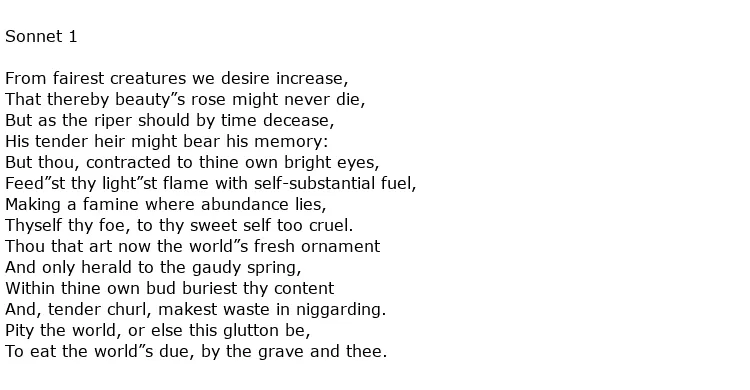 Extract from a poem by Shakespeare showing early lines of a sonnet
Here, the ABAB rhyme scheme (A: desire/fire, B: increase/decrease) is immediately evident. More subtly, the inherent rhythm of the iambic pentameter creates a musicality distinct from the end rhymes. These technical elements are masterfully employed not for their own sake, but to serve the poem’s core message about preserving beauty against the ravages of time. Many shakespeares poems utilize this delicate balance of structure and meaning.
The sonnets delve into diverse themes, including love (both idealized and complex), the passage of time, beauty’s fragility, jealousy, infidelity, and the power of poetry itself to immortalize its subject. Exploring the extensive collection of love poems written by William Shakespeare offers a journey through the multifaceted nature of affection and desire as perceived in the Elizabethan era.
Narrative Poems: Telling Tales in Verse
Lesser known but equally significant are Shakespeare’s two major narrative poems: Venus and Adonis and The Rape of Lucrece. Published early in his career (1593 and 1594 respectively), these longer poems demonstrate Shakespeare’s skill in epic storytelling through verse. They are believed to have been composed during periods when London theatres were closed due to plague, offering Shakespeare alternative avenues for his writing talents and perhaps, more reliably, income from noble patrons.
Venus and Adonis, dedicated to the Earl of Southampton, is an Ovidian-inspired mythological tale recounting the passionate but unrequited love of the goddess Venus for the beautiful youth Adonis. The poem, written in six-line stanzas (sestets) with an ABABCC rhyme scheme, is rich in vivid descriptions, sensual imagery, and dramatic dialogue. It explores themes of love, lust, beauty, death, and the conflict between passion and youthful resistance. This work solidified Shakespeare’s reputation as a gifted poet in his time and remains a powerful example of early modern narrative verse. Within this poem, as in many love william shakespeare poems, the complexities of desire and relationships are laid bare.
The Rape of Lucrece, also dedicated to Southampton, is a darker, more psychologically intense poem written in rhyme royal stanzas (seven-line stanzas with an ABABBC rhyme scheme). It tells the tragic story of the Roman noblewoman Lucretia, who is raped by Tarquin and subsequently takes her own life. The poem delves into themes of honor, shame, tyranny, injustice, and the devastating consequences of violence. Its exploration of moral conflict and psychological turmoil resonates with the depth found in Shakespeare’s later tragedies like Hamlet and Macbeth, suggesting a thematic link between his poetic and dramatic works written around similar periods.
Both narrative poems showcase Shakespeare’s burgeoning ability to craft complex characters, build dramatic tension, and explore weighty philosophical and moral issues through compelling verse. They represent an important phase in his development as a writer and are essential reading for a complete understanding of his oeuvre. Finding poems about love William Shakespeare wrote requires looking at the breadth of his work, from the intense passion in Venus and Adonis to the complex emotions in the sonnets.
The Enduring Legacy of Poem Shakespeare
For aspiring poets and literary enthusiasts alike, studying the poem Shakespeare offers invaluable lessons in craft, language, and thematic depth. The sonnets provide a masterclass in concise expression and the power of form, while the narrative poems offer insight into sustained poetic storytelling and character development.
The influence of Shakespeare’s poetry, particularly his sonnets, on subsequent generations of poets is immeasurable. His innovations in form and his profound exploration of universal themes set a high standard for poetic achievement. To truly appreciate the trajectory of English poetry, one must engage with the foundational works of The Bard. His verses remain a vital source of inspiration and study, reminding us of the enduring power of words to capture the essence of the human experience. Engaging with these works deepens our appreciation for his genius beyond the stage.