
William Shakespeare (1564-1616) stands as an unparalleled figure in the literary canon, often hailed as “The Bard.” While primarily celebrated for his revolutionary plays, his profound contribution to poetry is equally significant, offering deep insights into his understanding and mastery of the art form. Exploring shakespeare on poetry means delving into his extensive body of verse, including 154 sonnets and two major narrative poems, which reveal not only his technical brilliance but also his perspective on themes ranging from love and beauty to time and mortality.
Contents
The Art of the Shakespearean Sonnet
Shakespeare’s sonnets are arguably his most famous poetic achievement. Composed predominantly in the popular form of the time, which would eventually bear his name – the Shakespearean or English sonnet – these fourteen-line poems adhere to a strict structure. This form typically consists of three quatrains (four-line stanzas) followed by a concluding couplet (two lines), with a characteristic rhyme scheme of ABAB CDCD EFEF GG. This structure allows for the development of an argument or theme across the quatrains, leading to a final, often surprising or conclusive, turn (volta) in the couplet.
Beyond the technical framework, Shakespeare infused the sonnet with unparalleled emotional depth and intellectual complexity. Consider his very first sonnet:
From fairest creatures we desire increase,
That thereby beauty’s rose might never die,
But as the riper should by time decrease,
His tender heir might bear his memory:
But thou contracted to thine own bright eyes,
Feed’st thy light’s flame with self-substantial fuel,
Making a famine where abundance lies,
Thy self thy foe, to thy sweet self too cruel:
Thou that art now the world’s fresh ornament,
And only herald to the gaudy spring,
Within thine own bud buryest thy content,
And tender churl mak’st waste in niggarding.
Pity the world, or else this glutton be,
To eat the world’s due, by the grave and thee.
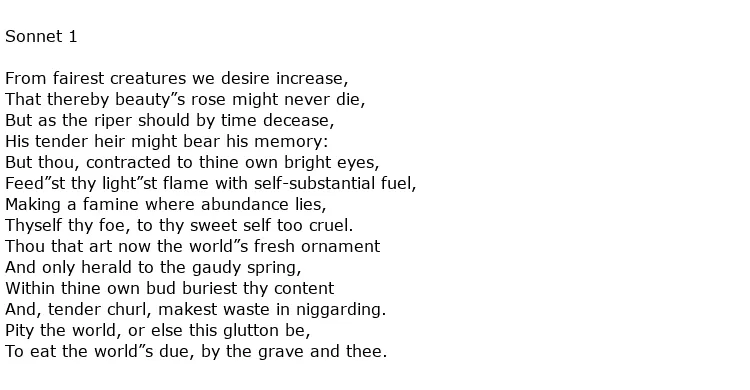 The text of Shakespeare's Sonnet 1, beginning 'From fairest creatures we desire increase'.
This sonnet, part of the collection urging a young man to procreate, showcases Shakespeare’s command of language, rhythm, and argument within the sonnet’s confines. The iambic pentameter provides a natural, flowing rhythm, while the carefully chosen rhymes reinforce the poem’s structure and themes. Through vivid imagery – the “rose,” the “famine,” the “bud” – Shakespeare explores complex ideas about beauty, legacy, and self-interest. His ability to weave philosophical inquiry with personal address demonstrates a key aspect of shakespeare on poetry: his belief in its capacity to explore the most intricate facets of the human condition.
Thematic Explorations in Shakespeare’s Verse
While many associate Shakespeare’s sonnets primarily with themes of love, his poetic scope is much broader. The sonnets delve into the destructive power of time, the fleeting nature of beauty, jealousy, infidelity, and the transcendent power of art and verse to immortalize their subjects.
The prevalence of love as a theme, particularly in the sonnets addressed to the “Fair Youth” and the “Dark Lady,” can also be understood within the historical context of the Elizabethan era. Poetry, especially when dedicated or commissioned, was a means of patronage. Writing poems, particularly sonnets, was often more financially viable than writing plays in certain periods of his career. This practical consideration influenced the output, but Shakespeare’s genius elevated these works far beyond mere commissioned pieces, transforming conventional themes into timeless explorations of human emotion.
Narrative Poems: Epic Scope in Verse
Beyond the sonnets, Shakespeare penned two significant narrative poems: Venus and Adonis (1593) and The Rape of Lucrece (1594). These longer works demonstrate a different facet of shakespeare on poetry – his ability to tell complex stories using poetic form and language.
Venus and Adonis, dedicated to the Earl of Southampton, retells the mythological tale of the goddess Venus’s unrequited love for the beautiful youth Adonis. Written in six-line stanzas (sestets) with an ABABCC rhyme scheme, the poem is rich in sensual description, vivid imagery, and dramatic dialogue. It explores themes of love, lust, beauty, and death through the lens of classical mythology, a frequent source of inspiration that ties his work to ancient traditions and the Renaissance revival of classical learning. This epic-scale poetic exploration was a popular genre at the time, and Shakespeare proved his mastery of sustained narrative in verse. Readers embarking on a poetic exploration of his work should certainly include these lesser-known but vital pieces.
 William Shakespeare portrait, the author of numerous poems and plays.
The Rape of Lucrece, also dedicated to Southampton, is a darker, more psychologically intense work written in rhyme royal (seven-line stanzas with an ABABBCC rhyme scheme). Based on the Roman legend of Lucretia, the poem recounts the virtuous Lucrece’s rape by Tarquin and her subsequent suicide, exploring themes of virtue, violation, honor, and political tyranny. This poem showcases Shakespeare’s burgeoning ability to delve into character psychology and dramatic tension through soliloquy and internal monologue, foreshadowing the profound character studies seen in his later tragedies like Hamlet or Macbeth.
Shakespeare’s Enduring Poetic Legacy
Understanding shakespeare on poetry requires appreciating his multifaceted approach: his rigorous command of form, his boundless thematic range, and his ability to use verse for both concise emotional expression and expansive narrative. He didn’t just write poems; he pushed the boundaries of what poetry could do, influencing generations of poets who followed.
Aspiring poets can learn invaluable lessons from studying his sonnets, mastering the balance of structure and spontaneity, word choice, and rhythmic flow. The narrative poems offer lessons in storytelling, character development, and sustained poetic voice. For any serious reader or writer of poetry, engaging with Shakespeare’s verse is not merely an academic exercise but a vital encounter with the foundations of English poetic tradition. His work continues to resonate, proving that the Bard’s voice speaks as powerfully through his poems as it does through his plays.