
William Shakespeare (1564–1616), widely celebrated as the world’s greatest dramatist, was also a poet of profound depth and influence. While his 37 plays dominate literary discussion, his significant body of poetic work, comprising over 150 poems including the famous sonnets and two major narrative poems, solidifies his position as arguably the most recognized poet of all time. His ability to delve into the complexities of human nature and elevate thought through verse has rightfully earned him the title of “The Bard” in the realm of [shakespear poetry](https://latrespace.com/shakespear-poetry/). It would be a significant oversight for any student or enthusiast of literature, particularly poetry, to overlook these masterful creations, which stand independently as pinnacles of English verse. Understanding [shakespeare and poetry](https://latrespace.com/shakespeare-and-poetry/) provides crucial insight into the complete range of his genius.
Contents
The Mastery of the Sonnet Form
Shakespeare’s most famous contributions to shakespeare poetry are his 154 sonnets, published in a collection in 1609. He did not invent the sonnet form, which originated in Italy, but he perfected what is now known as the English or Shakespearean sonnet. This form is distinct, consisting of fourteen lines written in iambic pentameter, a meter featuring ten syllables per line alternating unstressed and stressed beats.
The structure of a Shakespearean sonnet is typically divided into three quatrains (four-line stanzas) and a final rhyming couplet (two lines). The standard rhyme scheme is ABAB CDCD EFEF GG. This structure often allows the poet to explore a theme or argument in the quatrains, with the couplet providing a conclusion, twist, or resolution, known as the volta or “turn.” This sophisticated architecture allows for a complex development of ideas within a relatively brief space.
Sonnet 1: A Poetic Foundation
Shakespeare’s Sonnet 1 serves as a prime example of his sonnet craft and sets a foundational theme for many of the poems that follow, particularly those addressed to the “Fair Youth.”
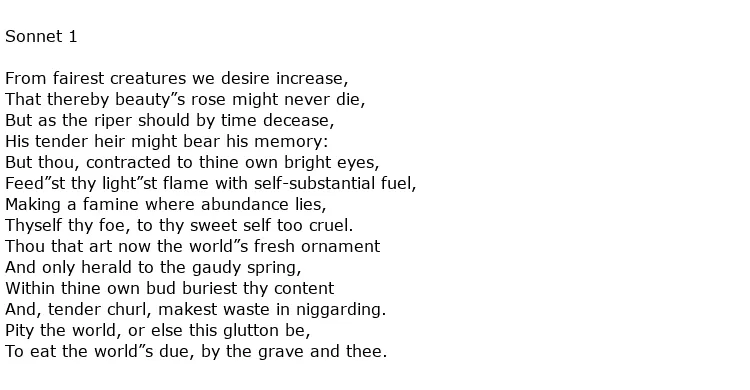 Text of Shakespeare's Sonnet 1
From fairest creatures we desire increase,
That thereby beauty’s rose might never die,
But as the riper should by time decease,
His tender heir might bear his memory:
But thou, contracted to thine own bright eyes,
Feed’st thy light’s flame with self-substantial fuel,
Making a famine where abundance lies,
Thy self thy foe, to thy sweet self too cruel.
Thou that art now the world’s fresh ornament,
And only herald to the gaudy spring,
Within thine own bud buriest thy content,
And tender churl makes waste in niggarding.
Pity the world, or else this glutton be,
To eat the world’s due, by the grave and thee.
This sonnet follows the classic ABAB CDCD EFEF GG rhyme scheme. Its theme is the speaker’s plea to a beautiful young man to marry and have children, thus preserving his beauty against the ravages of time. The analysis of [example of sonnet shakespearean](https://latrespace.com/example-of-sonnet-shakespearean/) like this reveals Shakespeare’s intricate wordplay, vivid imagery (beauty’s rose, light’s flame, fresh ornament, gaudy spring, tender churl), and persuasive rhetorical structure, leading to a powerful concluding couplet.
Beyond Sonnets: Shakespeare’s Narrative Poems
Less known than his sonnets but equally significant within shakespeare poetry are his two long narrative poems: Venus and Adonis (1593) and The Rape of Lucrece (1594). These were published relatively early in his career and were dedicated to his patron, Henry Wriothesley, the Earl of Southampton. Composing narrative poems was a common literary pursuit during this period, and their dedication to a nobleman suggests they were intended, at least in part, to gain patronage and financial support—a more reliable income source than writing plays at the time.
Venus and Adonis: A Tale of Unrequited Desire
Venus and Adonis, Shakespeare’s first published work, is an Ovidian-inspired epyllion, a short epic poem. Written in six-line stanzas (sestets) with an ABABCC rhyme scheme, it tells the story of the goddess Venus’s unrequited passion for the beautiful youth Adonis, who prefers hunting to love. The poem is rich in sensuous description and mythological detail, exploring themes of desire, rejection, mortality, and the conflict between love and lust. This work showcases Shakespeare’s early skill in sustained poetic narrative and his engagement with classical sources, a characteristic that appears throughout shakespeare romantic poetry.
The Rape of Lucrece: Tragedy and Virtue
The Rape of Lucrece is a more somber and psychologically intense narrative poem, written in rhyme-royal stanzas (seven-line stanzas in iambic pentameter with an ABABBCC rhyme scheme). It recounts the legendary story of the virtuous Roman noblewoman Lucretia, her rape by Tarquin, and her subsequent suicide, which ignited the rebellion leading to the overthrow of the Roman monarchy. This poem delves into themes of honor, shame, violation, tyranny, and political upheaval. Its focus on internal psychological torment and moral conflict connects it directly to the thematic depth found in his later tragedies like Hamlet or Macbeth, suggesting how his poetic explorations informed his dramatic work.
Recurring Themes in Shakespeare’s Poetry
Across his diverse poetic output, several themes consistently emerge, reflecting both the conventions of Elizabethan poetry and Shakespeare’s unique perspective. Love, in its many forms—idealized, passionate, unrequited, destructive—is perhaps the most prominent, especially in the sonnets and Venus and Adonis. [shakespeare love poetry](https://latrespace.com/shakespeare-love-poetry/) explores beauty, desire, and the passage of time. The inevitability of decay and mortality, and the power of verse or procreation to grant immortality, is a central concern in the Sonnets. Other themes include friendship, betrayal, social status, virtue, vice, and the complex interplay between appearance and reality. The commercial realities of the era, as the original article notes, likely influenced the popularity of certain themes, like love, which resonated with the aristocratic patrons.
Shakespeare’s Influence on Poets and Readers
William Shakespeare’s contribution to poetry is immeasurable. His sonnets not only standardized a form that remains vibrant today but also set a benchmark for thematic depth, linguistic innovation, and emotional intensity. For aspiring poets, his works offer invaluable lessons in form, meter, rhyme, imagery, and the nuanced expression of complex feelings. The intricate storytelling within his narrative poems provides a masterclass in sustained poetic voice and character portrayal.
For readers, delving into Shakespeare’s poems offers a different, often more intimate, connection with The Bard than his plays. They provide profound insights into the human condition, presented with unparalleled linguistic beauty and technical skill. Many later poets, both modern and contemporary, have studied, emulated, and responded to Shakespeare’s poetry, recognizing it as a fundamental building block of English verse. To truly appreciate the rich tapestry of poetry, one must engage with the foundational works of William Shakespeare.