
William Shakespeare (1564-1616) stands as arguably the most renowned figure in literary history, celebrated primarily for his groundbreaking plays. Yet, to truly appreciate the depth and breadth of his genius, one must delve into the equally significant body of poems from William Shakespeare. While his 37 plays command the stage and academic study, his collection of over 150 poems offers a distinct window into his poetic craft, thematic concerns, and the literary landscape of the Elizabethan and Jacobean eras. These works, though often overshadowed by his dramatic output, are crucial for understanding the full scope of “The Bard’s” artistry and his profound influence on the English language and poetic tradition.
Contents
 Portrait of William Shakespeare
The Mastery of the Sonnet
Among the most celebrated poems from William Shakespeare are his 154 sonnets, published in 1609. Shakespeare did not invent the sonnet form, but he perfected and adapted it, giving rise to what is now known as the Shakespearean or English sonnet. This structure consists of fourteen lines, typically in iambic pentameter, divided into three quatrains and a final rhyming couplet. The standard rhyme scheme is ABAB CDCD EFEF GG. This form allowed Shakespeare to explore complex ideas and emotions, building arguments or narratives across the quatrains before offering a concluding thought, twist, or resolution in the couplet.
Unlike many of his contemporaries who used sonnet sequences to chronicle idealized courtly love, Shakespeare’s sonnets delve into a wider range of human experience. They address themes of love, beauty, time, mortality, jealousy, desire, and the power of poetry itself. The sequence is traditionally divided into two main sections: the first 126 sonnets addressed to a young man (often debated as a patron or friend) and sonnets 127-154 addressed to a “Dark Lady,” a mysterious and complex figure.
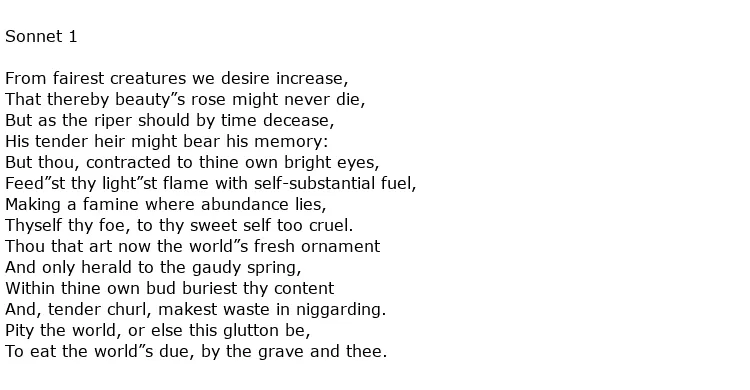
Consider the opening lines of Sonnet 1, which introduces a central theme of the first part of the sequence – the need for the young man to procreate and preserve his beauty through offspring:
{width=750 height=390}
*The opening lines of Shakespeare's Sonnet 1, demonstrating the quatrain structure.*From fairest creatures we desire increase,
That thereby beauty’s rose might never die,
But as the riper should by time decrease,
His tender heir might bear his memory:
But thou contracted to thine own bright eyes,
Feed’st thy light’s flame with self-substantial fuel,
Making a famine where abundance lies,
Thyself thy foe, to thy sweet self too cruel.
Thou that art now the world’s fresh ornament,
And only herald to the gaudy spring,
Within thine own bud buriest thy content,
And, tender churl, mak’st waste in niggarding.
Pity the world, or else this glutton be,
To eat the world’s due, by the grave and thee.
This sonnet exemplifies the form’s structure and Shakespeare’s linguistic skill. The ABAB CDCD EFEF GG rhyme scheme is evident. Beyond the rhyme, the iambic pentameter lends a natural yet elevated rhythm to the lines. The argument progresses from a general desire for beauty’s preservation (Quatrain 1) to a specific address to the young man and his self-absorption (Quatrains 2 & 3), culminating in a forceful plea in the final couplet. This ability to weave complex thought into a strict metrical and rhyming pattern is a hallmark of Shakespeare’s sonnets and a key reason they remain so compelling. Exploring various poetic themes, including contemplations on loss or the passage of time, can be found in collections like dying poems inspirational.
Historical Context and Thematic Focus
Understanding the context in which poems from William Shakespeare were written is crucial. During the late 16th and early 17th centuries, poetry, particularly sonnets, was a popular and fashionable genre among the aristocracy and educated elite. While plays were performed for a broader audience, published poetry often catered to patrons and those with leisure time and literacy. Poets frequently sought patronage to support their work, and the dedication of Venus and Adonis to Henry Wriothesley, 3rd Earl of Southampton, highlights this practice.
Love is a pervasive theme throughout Shakespeare’s sonnets, but it is far from simplistic. He explores passionate love, unrequited love, treacherous love, and love in the face of time’s destructive power. However, his sonnets also engage with themes of beauty’s fragility, the ravages of time, mortality, friendship, betrayal, and the enduring power of poetry itself to immortalize its subjects. While some collections focus exclusively on themes like sorrow and endings, such as poems about dying young, Shakespeare interweaves these elements with celebration, wit, and profound psychological insight.
The financial realities of being a writer also influenced his output. Plays were the primary source of income, explaining their greater number. Poems, especially narrative poems, might have been seen as opportunities for significant patronage or publishing revenue, though perhaps less reliably than the theatre.
The Narrative Poems: Venus and Adonis and The Rape of Lucrece
Beyond the sonnets, two significant narrative poems from William Shakespeare stand out: Venus and Adonis (published 1593) and The Rape of Lucrece (published 1594). These longer, more ambitious works showcase Shakespeare’s ability to tell a story through elevated, descriptive verse, drawing heavily on classical mythology and history.
-
Venus and Adonis: This poem, Shakespeare’s first published work, is based on Ovid’s Metamorphoses. It tells the story of the goddess Venus’s unrequited passion for the beautiful youth Adonis and her tragic grief after he is killed by a boar. Written in six-line stanzas (sestets) with an ABABCC rhyme scheme, the poem is rich in sensory detail, vivid imagery, and rhetorical flourishes. While a tale of mythological love, it also explores themes of desire, beauty, mortality, and the relationship between humans and nature. It’s a powerful early example of Shakespeare’s dramatic use of language and his interest in classical sources, linking him to the broader Renaissance tradition. The contemplation of loss and sorrow found here resonates with themes explored in poems about dying or grief.
-
The Rape of Lucrece: Also written in rhyme, this poem uses seven-line stanzas (rhyme royal) with an ABABBCC scheme. Based on the legend from Roman history, it recounts the virtuous Lucrece’s rape by Tarquin, her subsequent revelation, and her suicide, which precipitates the overthrow of the Roman monarchy. This poem is a darker, more psychological work than Venus and Adonis. It delves into the minds of the characters, exploring themes of honor, shame, tyranny, and injustice. The intense focus on psychological torment and the consequences of violation foreshadows the deep character studies found in his later tragedies. This tragic narrative, dealing with themes of violation and ultimate loss, could be seen in conversation with themes explored in poems about dying love or innocence lost.
These narrative poems demonstrate Shakespeare’s versatility beyond the sonnet form and his engagement with classical themes and structures popular at the time. They represent significant early achievements that likely helped establish his reputation as a poet before his dramatic fame fully solidified. Discussions about the profound emotional impact of such narratives connect with the broader human experiences captured in dying poems that confront mortality and suffering.
Legacy and Influence
The poems from William Shakespeare, particularly the sonnets, have exerted an immeasurable influence on subsequent generations of poets and readers. Their formal innovation, linguistic richness, and profound exploration of universal human themes set a benchmark for English poetry. Poets like John Milton, John Keats, and Wordsworth were deeply influenced by his sonnets, adapting the form and engaging with his thematic concerns.
For anyone seeking to understand the foundations of English poetry or to develop their own poetic voice, engaging with Shakespeare’s poems is essential. The sonnets offer lessons in compression, structure, and the interplay of sound and meaning, while the narrative poems provide models for sustained poetic storytelling and character portrayal. They offer not just technical instruction but also a deep well of emotional and philosophical insight into the human condition, proving why Shakespeare remains “The Bard” of poetry as well as drama.
In conclusion, exploring the poems from William Shakespeare is not merely an academic exercise but a vital journey for any lover of literature. From the intricate beauty of the sonnets to the compelling drama of the narrative poems, these works reveal the multifaceted genius of a writer whose words continue to resonate across centuries, enriching our understanding of ourselves and the world around us.