
While seeking to understand the diverse forms of literature associated with the historical figure of Julius Caesar, one might explore historical accounts, biographies, or dramatic interpretations. Beyond factual narratives, the exploration of poems by Julius Caesar himself is limited, as his fame rests primarily on his military and political achievements rather than prolific verse. However, within dramatic works about him, such as Shakespeare’s renowned play Julius Caesar, we encounter significant poetic language and, surprisingly, a character explicitly identified as “a Poet.” Delving into this specific character’s abrupt appearance offers a unique lens through which to view not only Shakespeare’s dramatic technique but also the vibrant, often contentious, literary world of Elizabethan England.
Shakespeare’s Julius Caesar, particularly Act 4, Scene 2, presents a powerful and intense argument between the key figures Brutus and Cassius. This dramatic confrontation, masterfully rendered through heightened language and rapid exchange, is a core moment in the play, showcasing the strain on their relationship. As their heated debate begins to subside, moving towards reconciliation, the stage direction introduces an unexpected figure: “Enter Lucillius and a POET.”
The sudden arrival of this character feels jarring and, initially, superfluous to the dramatic flow. The Poet’s interjection occurs just as Brutus and Cassius are embracing, seemingly having resolved their differences:
Cassius: Hath Cassius lived To be but mirth and laughter to his Brutus When grief and blood ill-tempered vexeth him?
Brutus: When you spoke that, I was ill-tempered too.
Cassius: Do you confess so much? Give me your hand.
Brutus: And my heart too. [They embrace]
Cassius: O Brutus!
Brutus: What’s the matter?
Cassius: Have you not love enough to bear with me When that rash humour which my mother gave me Makes me forgetful?
Brutus: Yes, Cassius, and from henceforth, When you are over earnest with your Brutus, He’ll think your mother chides, and leave you so.
At this precise moment of burgeoning peace, the Poet enters and attempts to insert himself into the private affairs of the generals, offering unsolicited advice in verse:
POET: Let me go in to see the generals. There is some grudge between ’em; ’tis not meet They be alone.
Lucillius: You shall not come to them.
POET: Nothing but death shall stay me.
Cassius, startled, asks “How now! What’s the matter?” The Poet then delivers his rhyming counsel:
POET: For shame, you generals, what do you mean? Love and be friends, as two such men should be. For I have seen more years, I’m sure, than ye.
This intervention is swiftly dismissed by the generals, particularly Brutus, who finds the intrusion and the rhyming format offensive in the context of their serious affairs:
Cassius: Ha, ha! How vilely doth this cynic rhyme!
Brutus [to the Poet] Get you hence, sirrah, saucy fellow, hence!
Cassius: Bear with him, Brutus, ’tis his fashion.
Brutus: I’ll know his humour when he knows his time. What should the wars do with these jigging fools? [To the Poet] Companion, hence!
Cassius: Away, away, be gone!
Exit POET
The Poet’s brief appearance concludes as abruptly as it began, leaving many readers and viewers questioning his purpose. He doesn’t further the main plot, and the reconciliation between Brutus and Cassius is already underway before his arrival. This structural oddity has led to speculation about this character’s role and origin within the play often studied for its dramatic portrayal of Roman history, a different kind of exploration than seeking historical poems by Julius Caesar.
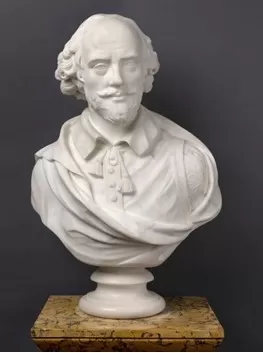 Portrait of William Shakespeare, playwright of Julius Caesar
To understand the potential significance of this character, it’s helpful to examine Shakespeare’s primary source for Julius Caesar: Plutarch’s Parallel Lives. In Plutarch’s account of Brutus, there is indeed an interruption during the argument between Brutus and Cassius, but the interrupter is identified as Marcus Favonius, a devotee of Cato. Plutarch describes Favonius as an impetuous Roman senator who forced his way into the room “reciting in an affected voice the verses wherein Homer represents Nestor as saying:—’But do ye harken to me, for ye both are younger than I am,’ and so forth.” Plutarch notes that Cassius laughed, but Brutus drove Favonius out, calling him names. However, Plutarch explicitly states that “at the time, this incident put an end to their quarrel, and they separated at once.”
Comparing Plutarch’s account to Shakespeare’s reveals key differences. Shakespeare transforms Favonius from a senator quoting Homer into an unnamed “Poet” who offers original, albeit “vile,” rhymes. More importantly, in Shakespeare’s version, Brutus and Cassius reconcile before the Poet enters, removing the character’s function as a peacemaker present in the historical source. If Shakespeare aimed solely for historical accuracy based on Plutarch, the Poet character, as depicted, seems redundant.
This suggests the Poet’s inclusion serves a purpose beyond simply dramatizing Plutarch’s narrative. A compelling theory posits that the Poet is an interpolation added by Shakespeare, likely as a satirical commentary on a contemporary literary figure during a period known as the “Poet’s War.”
The Poet’s War (or Poetomachia) was a literary feud primarily involving Ben Jonson, John Marston, and Thomas Dekker, which played out on the London stages around 1599-1602. Playwrights lampooned each other through characters and dialogue in their plays, and the Elizabethan audience would have been keenly aware of these veiled attacks. Ben Jonson was a central figure, known for his classical learning, adherence to dramatic rules (like the classical unities of time, place, and action), and often critical stance towards his contemporaries.
Evidence suggests Shakespeare was drawn into this conflict. A Return from Parnassus (1601-1602), an anonymous play from St. John’s College, Cambridge, explicitly mentions Shakespeare’s involvement and suggests he “purged” Ben Jonson, implying a successful satirical counter-attack. While Jonson’s “pill” is generally understood to be his lampooning of Marston and Dekker in his play Poetaster, Shakespeare’s “purge” has been debated by scholars.
Jonson himself was not shy about criticizing Shakespeare. He famously commented on a line from Shakespeare’s Julius Caesar, stating that Shakespeare “fell into those things could not escape laughter: as when he said in the person of Caesar, one speaking to him, ‘Caesar, thou dost me wrong,’ he replied ‘Caesar did never wrong, but with just cause,’ and such like, which were ridiculous.” Curiously, this line does not appear in the version of Julius Caesar that has come down to us. Instead, we find “Know Caesar doth no wrong, nor without cause / Will he be satisfied.” This discrepancy suggests the line was altered, adding a layer of plausibility to the idea that Julius Caesar was revised after its initial composition. Perhaps Shakespeare, in revising the play (potentially correcting the line Jonson mocked), also inserted his own jab at Jonson.
Another point of contention between the two playwrights related to dramatic form. Jonson, an advocate for classical dramatic principles, criticized Shakespeare’s disregard for the unities, particularly in plays like Henry V. Jonson’s prologue to his play Every Man In His Humour (published in the 1616 Folio, but potentially written earlier) is a pointed critique of popular stage practices, including the disregard for realistic time progression (“To make a child now swaddled, to proceed / Man, and then shoot up, in one beard and weed, / Past threescore years”) and unrealistic staging (“Nor creaking throne comes down the boys to please; / Nor nimble squib is seen to make afeard / The gentlewomen”). Jonson champions plays that depict “deeds, and language, such as men do use, / And persons, such as comedy would choose,” implicitly contrasting his style with Shakespeare’s more expansive and less strictly classical approach. This highlights a key difference in their artistic philosophies – a difference that could fuel satirical attacks.
Considering this context, let’s re-examine the Poet character in Julius Caesar with the theory that he is a satirical portrayal of Ben Jonson.
When the Poet forces his way in, his opening line, “Let me go in to see the generals,” and his boastful claim, “Nothing but death shall stay me,” could be seen as caricaturing Jonson’s assertive personality and willingness to barge into literary disputes (perhaps even referencing Jonson’s reported physical confrontation with Marston). His advice, “Love and be friends, as two such men should be,” offered in “vile rhyme,” aligns with Jonson’s critical view of simplistic or poorly constructed verse. Cassius’s reaction, “Ha, ha! How vilely doth this cynic rhyme!”, is key. The term “cynic” links the Poet to the historical Favonius (who was associated with Cynicism, a philosophy that rejected social conventions and hierarchy). However, it could also double as a jab at Jonson, who, despite his classical learning, was known for his cynical wit and disdain for others’ perceived social climbing. Jonson famously mocked Shakespeare’s family’s pursuit of a coat of arms.
Brutus’s harsh dismissal, “Get you hence, sirrah, saucy fellow, hence!”, followed by Cassius’s interjection, “Bear with him, Brutus, ’tis his fashion,” further develop the satire. Cassius’s line suggests the Poet’s disruptive behavior is not principled conviction but merely his characteristic fashion or mannerism – perhaps a slight against Jonson’s perceived posturing or his use of specific dramatic “humours” (ruling traits) as a structural principle in his own plays, a stark contrast to the exploration of deep character often found in works related to poems by Julius Caesar or other significant historical figures.
Brutus’s final lines deliver what could be seen as the core of Shakespeare’s satirical response: “I’ll know his humour when he knows his time. What should the wars do with these jigging fools?” “I’ll know his humour” seems a direct reference to Jonson’s signature comedic style, focusing on characters dominated by a single “humour.” “When he knows his time” could be a pointed remark on Jonson’s rigid adherence to the classical unity of time, suggesting Jonson is out of step with the demands and possibilities of contemporary Elizabethan theatre. Finally, the dismissive question, “What should the wars do with these jigging fools?”, contrasts the serious, elevated subject matter of a history play like Julius Caesar (or Henry V, another play criticized by Jonson) with the triviality of “jigging” (rhyming) fools – a clear jab at Jonson and his rhyming prologue or his emphasis on comedic, perhaps less profound, subjects compared to the grand historical narratives Shakespeare often tackled, a theme far removed from historical poems by Julius Caesar himself.
 Ancient Roman bust potentially depicting Lucius Junius Brutus
The combined effect of the Poet’s ill-timed, unsolicited, rhyming intervention and the generals’ contemptuous reaction creates a moment of comic relief that also serves a critical function. Just as Plutarch’s Favonius eased the tension between Brutus and Cassius through their shared annoyance, Shakespeare’s Poet achieves a similar result, but the shared annoyance is directed at the figure implicitly representing their contemporary rival, Ben Jonson. This layered interpretation adds depth to an otherwise puzzling dramatic choice, suggesting that even in a play about Roman history, dedicated to the complex figure often studied for his military prose rather than poems by Julius Caesar, Shakespeare woven in commentary on the literary landscape of his own time. Exploring such nuances enriches our understanding of Shakespeare’s work and the dynamic literary environment in which it was created.
In conclusion, the abrupt and seemingly unnecessary appearance of the Poet in Shakespeare’s Julius Caesar, Act 4, Scene 2, is plausibly interpreted as a clever interpolation intended as a satirical jab at Ben Jonson during the Poet’s War. By transforming Plutarch’s Favonius into a rhyming “Poet” and removing his original function, Shakespeare created a character whose brief, disruptive presence and contemptible verse mirrored characteristics and criticisms associated with Jonson. The reactions of Brutus and Cassius, filled with mockery and dismissal of the Poet’s “humour” and “time,” function as Shakespeare’s witty counter-attack. This hidden layer of meaning transforms a seemingly awkward scene into a fascinating example of how personal and professional rivalries played out on the Elizabethan stage, offering insights far removed from the pursuit of actual poems by Julius Caesar, yet deeply embedded in the poetic and dramatic currents of Shakespeare’s era.
References:
- Shakespeare, William. The Norton Shakespeare. Edited by Stephen Greenblatt et al., W. W. Norton & Company, 1997.
- Plutarch. Plutarch’s Lives. Translated by Bernadotte Perrin, vol. 6, Harvard University Press, 1918.
- Bednarz, James P. Shakespeare & The Poet’s War. Columbia University Press, 2001.
- Jonson, Ben. Poetaster. (Cited via external sources in original).
- Jonson, Ben. Every Man In His Humour. (Cited via external sources in original).
- The Return from Parnassus. (Cited via external sources in original).