
 Engraving of William Shakespeare, widely considered the greatest English poet and playwright.
Contents
While the name William Shakespeare is most often synonymous with iconic plays like Hamlet, Romeo and Juliet, and Macbeth, his prolific output extended far beyond the stage. Shakespeare was also a poet of immense skill and influence, composing over 150 sonnets and several significant narrative poems. Understanding William Shakespeare’s poetry is crucial not only for appreciating the full scope of his genius but also for grasping the evolution of English verse itself. His poetic works solidified forms, explored enduring themes with unparalleled depth, and continue to inspire readers and writers centuries later, cementing his title as “The Bard.” Exploring his non-dramatic verse reveals a different facet of his artistry, one that offers profound insights into the human condition and the craft of poetry. As one of the foremost shakespeare poets, his contribution is foundational.
The Enduring Power of Shakespeare’s Sonnets
Among Shakespeare’s most celebrated poetic achievements are his 154 sonnets, first published together in 1609. These poems, primarily addressed to a young man (the “Fair Youth”) and a mysterious “Dark Lady,” delve into a complex web of relationships, emotions, and philosophical inquiries. They are renowned for their intricate structure and their exploration of timeless themes. For a deeper dive into their significance, you might explore shakespeare sonnets and meanings.
The Shakespearean Sonnet Form
Shakespeare didn’t invent the sonnet, but he perfected and popularized a specific structure that now bears his name: the English or Shakespearean sonnet. This form consists of 14 lines, typically written in iambic pentameter (a rhythm of ten syllables per line, alternating unstressed and stressed). The structure is divided into three quatrains (four-line stanzas) and a final couplet (two-line stanza). The characteristic rhyme scheme is ABAB CDCD EFEF GG.
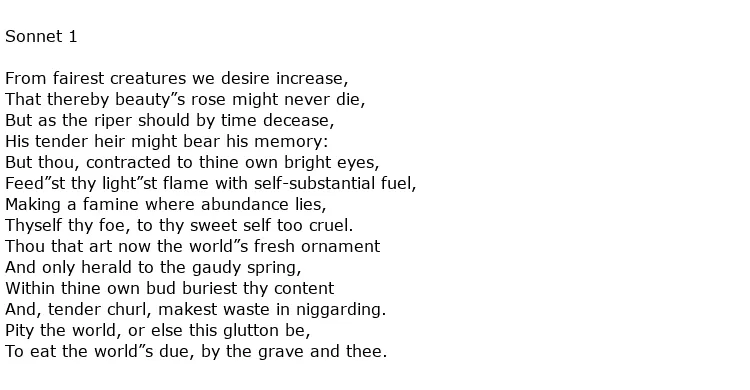 Image of Sonnet 1 by William Shakespeare illustrating the sonnet form and rhyme scheme.
This structure allows Shakespeare to develop an argument, explore different facets of a theme across the quatrains, and then provide a concluding thought, resolution, or twist in the final couplet, often referred to as the “volta” or “turn.” This flexible yet disciplined form enabled Shakespeare to explore a vast emotional and intellectual landscape within a compact space.
Themes and Emotions in the Sonnets
While often categorized as poem william shakespeare love, the sonnets engage with a broader spectrum of human experience than just romantic affection. They grapple with:
- Love: From idealized devotion to tormented obsession.
- Time: The destructive power of time and the desire to immortalize beauty and love through verse.
- Beauty: The ephemeral nature of physical beauty and its significance.
- Mortality: The awareness of death and decay.
- Friendship: Deep bonds between individuals.
- Jealousy, Infidelity, and Betrayal: The darker sides of relationships.
Sonnets like Sonnet 18 (“Shall I compare thee to a summer’s day?”) offer immortal praise, while Sonnet 130 (“My mistress’ eyes are nothing like the sun”) playfully subverts conventional love poetry. Sonnet 116, which famously begins “Let me not to the marriage of true minds,” provides a timeless definition of steadfast love. You can find a specific analysis at poem sonnet 116.
Beyond the Sonnets: Shakespeare’s Narrative Poems
Less widely read than the sonnets, Shakespeare’s two major narrative poems, Venus and Adonis (1593) and The Rape of Lucrece (1594), were actually his first published works and proved quite popular in his time. These longer poems showcase his ability to tell complex stories in verse, drawing on classical sources and exploring intense psychological drama.
Context and Early Success
Published during a period when London theatres were closed due to plague, these poems likely served both as a creative outlet and a means to establish himself as a writer in print, potentially securing noble patronage. Venus and Adonis, dedicated to the young Earl of Southampton, was particularly successful, going through multiple editions during Shakespeare’s lifetime.
Venus and Adonis
Based on a story from Ovid’s Metamorphoses, this poem recounts the tale of the goddess Venus’s unrequited passion for the handsome youth Adonis, who is more interested in hunting than love. The poem is rich in vivid imagery and descriptive language, exploring themes of lust versus chaste love, mortality, and the unpredictable nature of desire. It demonstrates Shakespeare’s early mastery of elaborate verse and his engagement with classical mythology.
The Rape of Lucrece
This darker, more somber poem, also based on a classical source (Livy), tells the tragic story of the virtuous Roman noblewoman Lucrece, her rape by Tarquin, and the subsequent political upheaval that led to the founding of the Roman Republic. The poem is a profound psychological study of shame, violation, tyranny, and honor. It shows Shakespeare’s early interest in themes of moral corruption and political violence, which he would later explore more fully in his tragedies like Hamlet and Macbeth.
The Bard as Poet: A Lasting Legacy
William Shakespeare’s poetry stands as a monumental achievement in English literature. His sonnets alone revolutionized the form, offering unparalleled insights into the human heart and mind. His narrative poems, while different in scope, showcase his versatility and early thematic concerns.
For aspiring poets, studying Shakespeare’s verse offers invaluable lessons in craft – from the musicality of iambic pentameter to the power of well-placed imagery and the art of developing complex ideas within form. For all readers, engaging with his poetry provides access to some of the most beautiful, insightful, and emotionally resonant verse ever written. They remain among the best loved poems in the English language. To truly understand “The Bard,” one must delve into his poems as well as his plays, for they reveal the depth and breadth of his unique poetic voice.